Results by title
100 books match the query 'Microeconomics' and 4 start with c
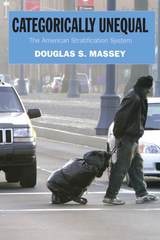
Categorically Unequal
The American Stratification SystemDouglas S. Massey
Russell Sage Foundation, 2007
The United States holds the dubious distinction of having the most unequal income distribution of any advanced industrialized nation. While other developed countries face similar challenges from globalization and technological change, none rivals America's singularly poor record for equitably distributing the benefits and burdens of recent economic shifts. In Categorically Unequal, Douglas Massey weaves together history, political economy, and even neuropsychology to provide a comprehensive explanation of how America's culture and political system perpetuates inequalities between different segments of the population. Categorically Unequal is striking both for its theoretical originality and for the breadth of topics it covers. Massey argues that social inequalities arise from the universal human tendency to place others into social categories. In America, ethnic minorities, women, and the poor have consistently been the targets of stereotyping, and as a result, they have been exploited and discriminated against throughout the nation's history. African-Americans continue to face discrimination in markets for jobs, housing, and credit. Meanwhile, the militarization of the U.S.-Mexican border has discouraged Mexican migrants from leaving the United States, creating a pool of exploitable workers who lack the legal rights of citizens. Massey also shows that women's advances in the labor market have been concentrated among the affluent and well-educated, while low-skilled female workers have been relegated to occupations that offer few chances for earnings mobility. At the same time, as the wages of low-income men have fallen, more working-class women are remaining unmarried and raising children on their own. Even as minorities and women continue to face these obstacles, the progressive legacy of the New Deal has come under frontal assault. The government has passed anti-union legislation, made taxes more regressive, allowed the real value of the federal minimum wage to decline, and drastically cut social welfare spending. As a result, the income gap between the richest and poorest has dramatically widened since 1980. Massey attributes these anti-poor policies in part to the increasing segregation of neighborhoods by income, which has insulated the affluent from the social consequences of poverty, and to the disenfranchisement of the poor, as the population of immigrants, prisoners, and ex-felons swells. America's unrivaled disparities are not simply the inevitable result of globalization and technological change. As Massey shows, privileged groups have systematically exploited and excluded many of their fellow Americans. By delving into the root causes of inequality in America, Categorically Unequal provides a compelling argument for the creation of a more equitable society. A Volume in the Russell Sage Foundation's Centennial Series
[more]
Changing Poverty, Changing Policies
Maria Cancian
Russell Sage Foundation, 2009
Poverty declined significantly in the decade after Lyndon Johnson's 1964 declaration of "War on Poverty." Dramatically increased federal funding for education and training programs, social security benefits, other income support programs, and a growing economy reduced poverty and raised expectations that income poverty could be eliminated within a generation. Yet the official poverty rate has never fallen below its 1973 level and remains higher than the rates in many other advanced economies. In this book, editors Maria Cancian and Sheldon Danziger and leading poverty researchers assess why the War on Poverty was not won and analyze the most promising strategies to reduce poverty in the twenty-first century economy. Changing Poverty, Changing Policies documents how economic, social, demographic, and public policy changes since the early 1970s have altered who is poor and where antipoverty initiatives have kept pace or fallen behind. Part I shows that little progress has been made in reducing poverty, except among the elderly, in the last three decades. The chapters examine how changing labor market opportunities for less-educated workers have increased their risk of poverty (Rebecca Blank), and how family structure changes (Maria Cancian and Deborah Reed) and immigration have affected poverty (Steven Raphael and Eugene Smolensky). Part II assesses the ways childhood poverty influences adult outcomes. Markus Jäntti finds that poor American children are more likely to be poor adults than are children in many other industrialized countries. Part III focuses on current antipoverty policies and possible alternatives. Jane Waldfogel demonstrates that policies in other countries—such as sick leave, subsidized child care, and schedule flexibility—help low-wage parents better balance work and family responsibilities. Part IV considers how rethinking and redefining poverty might take antipoverty policies in new directions. Mary Jo Bane assesses the politics of poverty since the 1996 welfare reform act. Robert Haveman argues that income-based poverty measures should be expanded, as they have been in Europe, to include social exclusion and multiple dimensions of material hardships. Changing Poverty, Changing Policies shows that thoughtful policy reforms can reduce poverty and promote opportunities for poor workers and their families. The authors' focus on pragmatic measures that have real possibilities of being implemented in the United States not only provides vital knowledge about what works but real hope for change.
[more]
Choice Over Time
George Loewenstein
Russell Sage Foundation, 1992
Many of our most urgent national problems suggest a widespread lack of concern for the future. Alarming economic conditions, such as low national savings rates, declining corporate investment in long-term capital projects, and ballooning private and public debt are matched by such social ills as diminished educational achievement, environmental degradation, and high rates of infant mortality, crime, and teenage pregnancy. At the heart of all these troubles lies an important behavioral phenomenon: in the role of consumer, manager, voter, student, or parent, many Americans choose inferior but immediate rewards over greater long-term benefits. Choice Over Time offers a rich sampling of original research on intertemporal choice—how and why people decide between immediate and delayed consequences—from a broad range of theoretical and methodological perspectives in philosophy, political science, psychology, and economics. George Loewenstein, Jon Elster, and their distinguished colleagues review existing theories and forge new approaches to understanding significant questions: Why do people seem to "discount" future benefits? Do individuals use the same decision-making strategy in all aspects of their lives? What part is played by situational factors such as the certainty of delayed consequences? How are decisions affected by personal factors such as willpower and taste? In addressing these issues, the contributors to Choice Over Time address many social, economic, psychological, and personal time problems. Their work demonstrates the predictive power of short-term preferences in behavior as varied as addiction and phobia, the effect of prices on consumption, and the dramatic rise in debt and decline in savings. Choice Over Time provides an essential source for the most recent research and theory on intertemporal choice, offering new models for time preference patterns—and their aberrations—and presenting a diversity of potential solutions to the problem of "temporal myopia."
[more]
Constructing Cooperation
The Evolution of Institutions of ComanagementSara Singleton
University of Michigan Press, 1999
In a pathbreaking analysis, Sara Singleton explores the development of schemes for the management of fisheries in the northwestern United States in which native American tribes, and state, federal, and local governments cooperate to manage limited fishing resources. In the policy dispute over the apportionment of scarce resources, some argue that only government control or private ownership will prevent the destruction of limited common resources. The author shows how cooperation among interested parties can produce a workable system for self-management of common resources. Through the detailed study of the management of fisheries in the Northwest the author tests theories explaining the basis of collective action and social cooperation, an area of rich theoretical speculation in political science, law, economics and sociology. At the same time, her findings have important implications for policy makers who are interested in efficient and effective schemes of resource control that avoid the problems caused by regulation by remote government officials or private control.
This book will appeal to policy makers concerned with the management of natural resources as well as to economists, political scientists, and sociologists concerned with collective action problems.
Sara Singleton is Assistant Professor of Political Science, Tulane University.
This book will appeal to policy makers concerned with the management of natural resources as well as to economists, political scientists, and sociologists concerned with collective action problems.
Sara Singleton is Assistant Professor of Political Science, Tulane University.
[more]