Results by title
188 books match the query 'Middle Eastern' and 10 start with c

Camera Orientalis
Reflections on Photography of the Middle EastAli Behdad
University of Chicago Press, 2016
Considering a range of Western and Middle Eastern archival material from the late nineteenth and early twentieth centuries, Ali Behdad offers a rich account of how photography transformed Europe’s distinctly Orientalist vision into what seemed objective fact, a transformation that proved central to the project of European colonialism. At the same time, Orientalism was useful for photographers from both regions, as it gave them a set of conventions by which to frame exotic Middle Eastern cultures for Western audiences. Behdad also shows how Middle Eastern audiences embraced photography as a way to foreground status and patriarchal values while also exoticizing other social classes.
An important examination of previously overlooked European and Middle Eastern photographers and studios, Camera Orientalis demonstrates that, far from being a one-sided European development, Orientalist photography was the product of rich cultural contact between the East and the West.
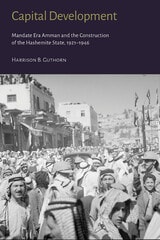
Capital Development
Mandate Era Amman and the Construction of the Hashemite State (1921–1946)Harrison B. Guthorn
Gingko, 2021
Amman, the capital of Jordan, contends with a crisis of identity rooted in how it grew to become a symbol for the Anglo-Hashemite government first, and a city second. As a representation of the new centralized authority, Amman became the seat of the Mandatory government that orchestrated the development of Transjordan, the British mandate established in 1921.
Despite its diminutive size, the city grew to house all the components necessary for a thriving and cohesive state by the end of the British mandate in 1946. However, in spite of its modernizing and regulatory ambitions, the Transjordan government did not control all facets of life in the region. Instead, the story of Transjordan is one of tensions between the state and the realities of the region, and these limitations forced the government to scale down its aspirations. This book presents the history of Amman’s development under the rule of the British mandate from 1921–46 and illustrates how the growth of the Anglo-Hashemite state imbued the city with physical, political, and symbolic significance.
Checkbook Zionism
Philanthropy and Power in the Israel-Diaspora RelationshipEric Fleisch
Rutgers University Press, 2024
By delving into the history of American Jews’ philanthropic giving to Israelis, Fleisch assesses the core nature of power sharing between both sides of the Jewish diaspora to the United States through in-depth contemporary case studies of the relationship between sixteen non-governmental organizations and their American Jewish donors. Field observation, document analysis, and interviews with leaders, activists, and select donors alike serve a critical role here, as Fleisch assesses whether these contemporary philanthropic associations repeat classic dynamics of power-sharing or whether they represent a marked departure from the Checkbook Zionism of old. The result is a new paradigm for evaluating power sharing that can be applied to future considerations of development in the Israel-Diaspora relationship.

Checkpoint 300
Colonial Space in PalestineMark Griffiths
University of Minnesota Press, 2025
Tracing how a notorious checkpoint shapes power, resistance, and lives in Palestine
Checkpoint 300, the highly securitized border facility between occupied Bethlehem and Jerusalem, is a central feature of Israeli control of Palestinian land and life. An apparatus of turnstiles, overcrowded corridors, and invasive inspections, the checkpoint regulates the movement of hundreds of thousands of Palestinians, granting access to some while excluding most. Offering a nuanced exploration of space, Mark Griffiths reveals Checkpoint 300 as a stark symbol of Israeli colonialism that embodies larger systems of control and violence.
Griffiths’s sensitive and timely work highlights the myriad ways Palestinians are affected by Israel’s spatial control—whether they travel through the checkpoint or not—demonstrating how colonial infrastructures of inequity extend far beyond their physical boundaries to shape daily life. Drawing on nearly a decade of fieldwork, Griffiths examines how colonial power infiltrates family dynamics, enforces gendered mobility restrictions, shapes local economies, and extends into the global exchange of capital and security technologies. He also underscores how Palestinians endure and resist under oppressive conditions and how indigenous forms of life and living are sustained, illuminating how colonial space is contested and countered, unmade and remade.
Blending meticulous research with vivid human stories to show the lived realities of borders, power, and resistance in the West Bank, Checkpoint 300 portrays the checkpoint as an entry into the ways that colonial space is formed through security infrastructure that is both the product and producer of wider geographies of oppression, complicity, and control.
Retail e-book files for this title are screen-reader friendly with images accompanied by short alt text and/or extended descriptions.

Class Forces
Youth and Labor in the Making of the Egyptian Uprising of 2011Nada Matta
University of Michigan Press, 2027
Class Forces offers a new political economy explanation of the forces behind Egypt’s 2011 uprising. How did movements that had long struggled to challenge an authoritarian regime suddenly help generate a mass uprising capable of bringing down President Hosni Mubarak—and why did that uprising ultimately fail? Moving beyond explanations centered on economic grievances and political repression, the book shows how transformations in capitalism and changing class relations created new opportunities for labor, democratic, and youth movements to mobilize. It traces how the evolving relationship between business and the regime indirectly helped open political space and strengthen movements whose organizational capacities had remained limited.
Nada Matta argues that class dynamics were central to the extraordinary mass mobilization that filled Tahrir Square during the uprising. By focusing on class linkages rather than the more static concept of cross-class coalitions, Matta offers a dynamic account of class relations that also identifies the limits of associational capacities and durable cross-class alliances and helps explain why democratic forces failed to consolidate political gains after President Hosni Mubarak’s ouster. Class Forces illuminates the sources of movement power and vulnerability under contemporary capitalism for social movement practitioners.
Coalition Politics and Cabinet Decision Making
A Comparative Analysis of Foreign Policy ChoicesJuliet Kaarbo
University of Michigan Press, 2013
Every day, coalition cabinets make policy decisions critical to international politics. Juliet Kaarbo examines the dynamics of these multiparty cabinets in parliamentary democracies in order to assess both the quality of coalition decision making and the degree to which coalitions tend to favor peaceful or military solutions. Are coalition cabinets so riddled by conflict that they cannot make foreign policy effectively, or do the multiple voices represented in the cabinet create more legitimate and imaginative responses to the international system? Do political and institutional constraints inherent to coalition cabinets lead to nonaggressive policies? Or do institutional and political forces precipitate more belligerent behavior?
Employing theory from security studies and political psychology as well as a combination of quantitative cross-national analyses and twelve qualitative comparative case studies of foreign policy made by coalition cabinets in Japan, the Netherlands, and Turkey, Kaarbo identifies the factors that generate highly aggressive policies, inconsistency, and other policy outcomes. Her findings have implications not merely for foreign policy but for all types of decision making and policy-making by coalition governments.
Contours of Israeli Politics
Jewish Ethnicity, Religious Nationalism, and DemocracyHannah M. Ridge
Temple University Press, 2025
The timely Contours of Israeli Politics focuses on the socio-political ramifications of this hierarchy within the upper stratum of Israeli society. Using public opinion studies and qualitative data, Hannah Ridge examines the effects of this social hierarchy to address attitudes on Israeli ethnicity and religious majoritarianism, support for Israeli democracy, and preference for an expanded territorial state and peace with its neighbors.
As various Jewish ethnic groups face greater pressure to assert their in-group membership (their Jewishness), they are more likely to protect the status privileges of that group. This can strengthen their ideas about identity, nationalism, democratic values, and conflict attitudes. Ridge’s findings reveal the ways in which Jewish ethnicity continues to influence the politics of Israel, a Jewish ethno-religious state.

Cosmopolitical Claims
Turkish-German Literatures from Nadolny to PamukB. Venkat Mani
University of Iowa Press, 2007
Moving deftly from the theoretical literature to the texts themselves, Mani’s groundbreaking study explores these conflicts and dialogues and the resulting cultural hybridization as they are expressed in four novels that document the complexity of Turkish-German cultural interactions in the late twentieth and early twenty-first centuries. His innovative readings will engage students of contemporary German literature as well as illuminate the discussion of minority literature in a multicultural setting.
As Salman Rushdie said in the 2002 Tanner Lecture at Yale, “The frontier is an elusive line, visible and invisible, physical and metaphorical, amoral and moral. . . . To cross a frontier is to be transformed.” It is in this vein that Mani’s dynamic and subtle work posits a still evolving discourse between Turkish and German writers.
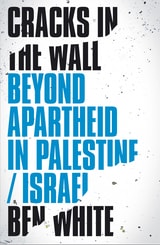
Cracks in the Wall
Beyond Apartheid in Palestine/IsraelBen White
Pluto Press, 2018
But while the situation on the ground is bleak, Ben White argues that there are widening cracks in Israel's traditional pillars of support. Opposition to Israeli policies and even critiques of Zionism are growing in Jewish communities, as well as amongst Western progressives. The election of Donald Trump has served as a catalyst for these processes, including the transformation of Israel from a partisan issue into one that divides the US establishment. Meanwhile, the Palestinian-led boycott campaign is gathering momentum, prompting a desperate backlash by Israel and its allies.
With sharp analysis, Ben White says now is the time to plot a course that avoids the mistakes of the past - a way forward beyond apartheid in Palestine. The solution is not partition and ethnic separation, but equality and self-determination - for all.
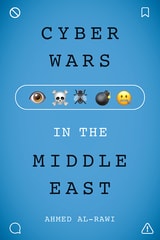
Cyberwars in the Middle East
Ahmed Al-Rawi
Rutgers University Press, 2021
On the one hand, nation-states as well as their affiliated hacking groups like cyber warriors employ hacking as offensive and defensive tools in connection to the cyber activity or inactivity of other nation-states, such as the role of Russian Trolls disseminating disinformation on social media during the US 2016 presidential election. This is regarded as a horizontal flow of political disruption. Sometimes, nation-states, like the UAE, Saudi Arabia, and Bahrain, use hacking and surveillance tactics as a vertical flow (top-bottom) form of online political disruption by targeting their own citizens due to their oppositional or activists’ political views. On the other hand, regular hackers who are often politically independent practice a form of bottom-top political disruption to address issues related to the internal politics of their respective nation-states such as the case of a number of Iraqi, Saudi, and Algerian hackers. In some cases, other hackers target ordinary citizens to express opposition to their political or ideological views which is regarded as a horizontal form of online political disruption. This book is the first of its kind to shine a light on many ways that governments and hackers are perpetrating cyber attacks in the Middle East and beyond, and to show the ripple effect of these attacks.