Results by title
105 books match the query 'Mind' and 4 start with c
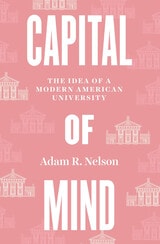
Capital of Mind
The Idea of a Modern American UniversityAdam R. Nelson
University of Chicago Press, 2024
Capital of Mind is the second volume in a breathtakingly ambitious new economic history of American higher education. Picking up from the first volume, Exchange of Ideas, Adam R. Nelson looks at the early decades of the nineteenth century, explaining how the idea of the modern university arose from a set of institutional and ideological reforms designed to foster the mass production and mass consumption of knowledge. This “industrialization of ideas” mirrored the industrialization of the American economy and catered to the demands of a new industrial middle class for practical and professional education. From Harvard in the north to the University of Virginia in the south, new experiments with the idea of a university elicited intense debate about the role of scholarship in national development and international competition, and whether higher education should be supported by public funds, especially in periods of fiscal austerity. The history of capitalism and the history of the university, Nelson reveals, are intimately intertwined—which raises a host of important questions that remain salient today. How do we understand knowledge and education as commercial goods? Should they be public or private? Who should pay for them? And, fundamentally, what is the optimal system of higher education for a capitalist democracy?

Coming to Mind
The Soul and Its BodyLenn E. Goodman and D. Gregory Caramenico
University of Chicago Press, 2013
Rooted in some of the richest philosophical and intellectual traditions of Western and Eastern philosophy, psychology, literature, and the arts and the latest findings of cognitive psychology and brain science—Coming to Mind is a subtle manifesto of a new humanism and an outstanding contribution to our understanding of the human person. Drawing on new and classical understandings of perception, consciousness, memory, agency, and creativity, Goodman and Caramenico frame a convincing argument for a dynamic and integrated self capable of language, thought, discovery, caring, and love.

Conrad’s Models of Mind
Bruce Johnson
University of Minnesota Press, 1971
Conrad's Models of Mind was first published in 1971. Minnesota Archive Editions uses digital technology to make long-unavailable books once again accessible, and are published unaltered from the original University of Minnesota Press editions.
In a new approach to understanding the psychological assumptions that lie behind the creation of a work of fiction, Professor Johnson analyzes a number of Joseph Conrad's novels and short stories, identifying and explaining Conrad's changing conceptions or models of mind. As he points out in his introduction: "Every writer makes assumptions about the nature of the mind, whether they may be elaborate theories, metaphors that seem simple but imply a great deal, downright beliefs, or vague gestalten. And such assumptions color his whole creation, the way his characters think and feel and react, possibly even his choice of subject matter."
The author traces Conrad's steady progression away from deductive psychology, involving such entities as will, passion, ego, or sympathy, toward a flexible, and, for the period, new psychology that had implications for his entire development as a writer.
Professor Johnson finds certain affinities between Conrad's models of mind and those of a number of other writers, among them, Schopenhauer, Sartre, and Pascal. He shows that one aspect of Conrad's psychology was closely allied to the Schopenhauerian concept of will but that when he wrote Lord Jim, Heart of Darkness, and Nostromo Conrad moved toward an existential concept of self-image and self-creation similar to Sartre's psychology in Being and Nothingness. Finally, Professor Johnson examines Conrad's novel The Rescue and shows how hopeless it was for Conrad to return to earlier conceptions of mind after he had explored the new existential models.
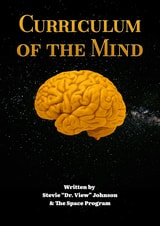
Curriculum of the Mind
Stevie “Dr. View” Johnson and The Space Program
University of Michigan Press, 2026
Curriculum of the Mind is a groundbreaking hip-hop album that transforms the boundaries of scholarship, sound, and storytelling. A deeply personal and political intervention into the structures of higher education, the project speaks directly to the soul of education, identity, and cultural resilience. Part collective memoir, part mixtape, and part political manifesto, Curriculum of the Mind invites readers and listeners alike into a world where turntables become textbooks, beats carry the weight of history, and samples act as archives of Black life.
Produced by Stevie “Dr. View” Johnson, this album features the work of Black students, parents, creatives, and prospective college-goers who rarely see themselves reflected in academia. At the same time, it challenges educators, librarians, and institutions to rethink what learning looks and sounds like in the 21st century. The album draws from and contributes to interdisciplinary fields including Black studies, critical race theory, performance studies, and hip-hop pedagogy. Through powerful mashups and lyrical reflections, Dr. View and The Space Program explore themes of educational trauma, invisibility, intergenerational resilience, and the radical potential of sound as a vehicle for theorizing lived experience. Paired with a written preface, the project challenges the primacy of text-based knowledge, asserting that sound, emotion, and memory are equally valid forms of intellectual inquiry—and that scholarship can, and should, be a collective effort. As a model for the future of performance-based scholarship, Curriculum of the Mind proves that hip-hop is not only music—it’s a method, a memory, and a movement.