Results by title
89 books match the query 'Mind & Body' and 4 start with c
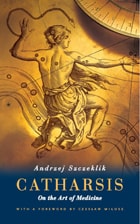
Catharsis
On the Art of MedicineAndrzej Szczeklik
University of Chicago Press, 2005
The ancient Greeks used the term catharsis for the cleansing of both the body by medicine and the soul by art. In this inspiring book, internationally renowned cardiologist Andrzej Szczeklik draws deeply on our humanistic heritage to describe the artistry and the mystery of being a doctor. Moving between examples ancient and contemporary, mythological and scientific, Catharsis explores how medicine and art share common roots and pose common challenges.
The process of diagnosis, for instance, belongs to a world of magic and metaphor; the physician must embrace it like a poem or painting, with particular alertness and keen receptivity. Speculation on ways to slow aging through genetics, meanwhile, draws directly on the dream of immortality that artists and poets have nourished through the ages. And the concept of catharsis itself has made its way from the writings of Aristotle to today's growing interest in the benefits of music to health, especially in newborns. As Szczeklik explores such subjects as the mysteries of the heart rhythm, the secret history of pain relief, the enigmatic logic of epidemics, near-death or out-of-body experiences, and many more, he skillfully weaves together classical literature, the history of medicine, and moving anecdotes from his own clinical experiences. The result is a life-affirming book that will enrich the healing work of patients and doctors alike and make an invaluable contribution to our still-expanding vision of the art of medicine.
The process of diagnosis, for instance, belongs to a world of magic and metaphor; the physician must embrace it like a poem or painting, with particular alertness and keen receptivity. Speculation on ways to slow aging through genetics, meanwhile, draws directly on the dream of immortality that artists and poets have nourished through the ages. And the concept of catharsis itself has made its way from the writings of Aristotle to today's growing interest in the benefits of music to health, especially in newborns. As Szczeklik explores such subjects as the mysteries of the heart rhythm, the secret history of pain relief, the enigmatic logic of epidemics, near-death or out-of-body experiences, and many more, he skillfully weaves together classical literature, the history of medicine, and moving anecdotes from his own clinical experiences. The result is a life-affirming book that will enrich the healing work of patients and doctors alike and make an invaluable contribution to our still-expanding vision of the art of medicine.
[more]
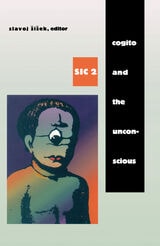
Cogito and the Unconscious
sic 2Slavoj Žižek, ed.
Duke University Press, 1998
The Cartesian cogito—the principle articulated by Descartes that "I think, therefore I am"—is often hailed as the precursor of modern science. At the same time, the cogito's agent, the ego, is sometimes feared as the agency of manipulative domination responsible for all present woes, from patriarchal oppression to ecological catastrophes. Without psychoanalyzing philosophy, Cogito and the Unconscious explores the vicissitudes of the cogito and shows that psychoanalyses can render visible a constitutive madness within modern philosophy, the point at which "I think, therefore I am" becomes obsessional neurosis characterized by "If I stop thinking, I will cease to exist."
Noting that for Lacan the Cartesian construct is the same as the Freudian "subject of the unconscious," the contributors follow Lacan's plea for a psychoanalytic return to the cogito. Along the path of this return, they examine the ethical attitude that befits modern subjectivity, the inherent sexualization of modern subjectivity, the impasse in which the Cartesian project becomes involved given the enigmatic status of the human body, and the Cartesian subject's confrontation with its modern critics, including Althusser, Bataille, and Dennett. In a style that has become familiar to Žižek's readers, these essays bring together a strict conceptual analysis and an approach to a wide range of cultural and ideological phenomena—from the sadist paradoxes of Kant's moral philosophy to the universe of Ayn Rand's novels, from the question "Which, if any, is the sex of the cogito?" to the defense of the cogito against the onslaught of cognitive sciences.
Challenging us to reconsider fundamental notions of human consciousness and modern subjectivity, this is a book whose very Lacanian orthodoxy makes it irreverently transgressive of predominant theoretical paradigms. Cogito and the Unconscious will appeal to readers interested in philosophy, psychoanalysis, cultural studies, and theories of ideology.
Contributors. Miran Bozovic, Mladen Dolar, Alain Grosrichard, Marc de Kessel, Robert Pfaller, Renata Salecl, Slavoj Žižek, Alenka Zupancic
[more]
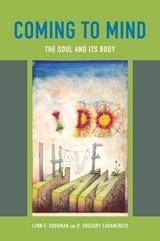
Coming to Mind
The Soul and Its BodyLenn E. Goodman and D. Gregory Caramenico
University of Chicago Press, 2013
How should we speak of bodies and souls? In Coming to Mind, Lenn E. Goodman and D. Gregory Caramenico pick their way through the minefields of materialist reductionism to present the soul not as the brain’s rival but as its partner. What acts, they argue, is what is real. The soul is not an ethereal wisp but a lively subject, emergent from the body but inadequately described in its terms.
Rooted in some of the richest philosophical and intellectual traditions of Western and Eastern philosophy, psychology, literature, and the arts and the latest findings of cognitive psychology and brain science—Coming to Mind is a subtle manifesto of a new humanism and an outstanding contribution to our understanding of the human person. Drawing on new and classical understandings of perception, consciousness, memory, agency, and creativity, Goodman and Caramenico frame a convincing argument for a dynamic and integrated self capable of language, thought, discovery, caring, and love.
Rooted in some of the richest philosophical and intellectual traditions of Western and Eastern philosophy, psychology, literature, and the arts and the latest findings of cognitive psychology and brain science—Coming to Mind is a subtle manifesto of a new humanism and an outstanding contribution to our understanding of the human person. Drawing on new and classical understandings of perception, consciousness, memory, agency, and creativity, Goodman and Caramenico frame a convincing argument for a dynamic and integrated self capable of language, thought, discovery, caring, and love.
[more]
Commentaries on Aristotle's "On Sense and What Is Sensed" and "On Memory and Recollection" (Thomas Aquinas in Translation)
Saint Thomas Aquinas
Catholic University of America Press, 2005
The translations presented in this volume are based on the critical Leonine edition of the commentaries, which includes the Latin translations of the Aristotelian texts on which Aquinas commented.
[more]