Results by title
149 books match the query 'Modernity' and 11 start with c
C. P. Snow and the Struggle of Modernity
By John de la Mothe
University of Texas Press, 1992
The condition of modernity springs from that tension between science and the humanities that had its roots in the Enlightenment but reached its full flowering with the rise of twentieth-century technology. It manifests itself most notably in the crisis of individuality that is generated by the nexus of science, literature, and politics, one that challenges each of us to find a way of balancing our personal identities between our public and private selves in an otherwise estranging world. This challenge, which can only be expressed as "the struggle of modernity," perhaps finds no better expression than in C. P. Snow. In his career as novelist, scientist, and civil servant, C. P. Snow (1905-1980) attempted to bridge the disparate worlds of modern science and the humanities.
While Snow is often regarded as a late-Victorian liberal who has little to say about the modernist period in which he lived and wrote, de la Mothe challenges this judgment, reassessing Snow's place in twentieth-century thought. He argues that Snow's life and writings—most notably his Strangers and Brothers sequence of novels and his provocative thesis in The Two Cultures and the Scientific Revolution—reflect a persistent struggle with the nature of modernity. They manifest Snow's belief that science and technology were at the center of modern life.

Carlos Fuentes, Mexico, and Modernity
Maarten van Delden
Vanderbilt University Press, 1998
Van Delden's thorough command of the subject matter, his innovative and sometimes iconoclastic conclusions, and his clear and engaging writing style make this study more than just an interpretation of Fuentes's work. Carlos Fuentes, Mexico, and Modernity offers nothing less than a comprehensive analysis of Fuentes's intellectual development in the context of modern Mexican political and cultural life.
Christianity and Modernity in Eastern Europe
Bruce R. Berglund
Central European University Press, 2010
Cinema and Modernity
Pomerance, Murray
Rutgers University Press, 2006
The modern impulse gave us captivating technology and dark anxiety, rampant mobility and a world filled with strangers, the futuristic city and a fragmentation of experience. Motion pictures––the quintessence of modernism––entered into this cultural, technical, and philosophical richness with a vast public appeal and a jarring new vision of what life could be.
In Cinema and Modernity, Murray Pomerance brings together new essays by seventeen leading scholars to explore the complexity of the essential connection between film and modernity. Among the many films considered are Detour, Shock Corridor, The Last Laugh, Experiment in Terror, The Great Dictator, Leave Her to Heaven, The Talented Mr. Ripley, Eyes Wide Shut, Sunrise, The Crowd, The Shape of Things to Come, The War of the Worlds, The Day the Earth Stood Still, Scarlet Street, Shadow of a Doubt, Stella Dallas, The Blue Angel, Sullivan’s Travels, and Catch Me If You Can.
Civilization and Monsters
Spirits of Modernity in Meiji JapanGerald Figal
Duke University Press, 2000
After discussing the role of the fantastic in everyday Japan at the eve of the Meiji period, Figal draws new connections between folklorists, writers, educators, state ideologues, and policymakers, all of whom crossed paths in a contest over supernatural terrain. He shows the ways in which a determined Meiji state was engaged in a battle to suppress, denigrate, manipulate, or reincorporate folk belief as part of an effort toward the consolidation of a modern national culture. Modern medicine and education, functioning as a means for the state to exercise its power, redefined folk practices as a source of evil. Diverse local spirits were supplanted by a new Japanese Spirit, embodied by the newly constituted emperor, the supernatural source of the nation’s strength. The monsters of folklore were identified, catalogued, and characterized according to a new regime of modern reason. But whether engaged to support state power and forge a national citizenry or to critique the arbitrary nature of that power, the fantastic, as Figal maintains, is the constant condition of Japanese modernity in all its contradictions. Furthermore, he argues, modernity in general is born of fantasy in ways that have scarcely been recognized.
Bringing unexplored and provocative new ideas to the Japan specialist, Civilization and Monsters will also appeal to readers concerned with issues of modernity in general.
Civilizing Natures
Race, Resources, and Modernity in Colonial South IndiaPhilip, Kavita
Rutgers University Press, 2003
Science was a central pillar of colonialism, but the converse holds true as well: colonialism profoundly shaped the character of nineteenth-century science. Civilizing Natures unravels unexpected relationships between science, technology, and administrative systems in colonial India from the 1850s to the 1930s, deepening our perspective on continuing conflicts over race, resources, and empire.
Botanists, anthropologists, and foresters had their most important sources of data—nature and natives—located at colonial sites. In the hilly, forested regions of Madras Presidency, tribal populations were studied by ethnographers, managed by revenue officials, recruited by plantation contractors, and modernized by missionaries. Racial constructions of nature and modernity helped criminalize and domesticate unruly natives. This is a story about the construction of nature in southern India that is deeply local and irreducibly global.
Through detailed case studies, Kavita Philip shows how race and nature are fundamental to understanding colonial modernities. Through its insightful combination of methodologies from both the humanities and the social sciences, Civilizing Natures complicates our understandings of the relationships between science and religion, pre-modern and civilized, environment and society.
Conjuring the Folk
Forms of Modernity in African AmericaDavid G. Nicholls
University of Michigan Press, 2000
In a series of revisionary readings, Nicholls studies how the "folk" is shaped by the ideology of form. He examines the presence of a spectral "folk" in Toomer's modernist pastiche, Cane. He explores how Hurston presents folklore as a contemporary language of resistance in her ethnography, Mules and Men. In Claude McKay's naturalistic romance, Banana Bottom, Nicholls discovers the figuration of an alternative modernity in the heroine's recovery of her lost "folk" identity. He unearths the individualist ethos of Booker T. Washington in two novels by George Wylie Henderson. And he reveals how Richard Wright's photo-documentary history, 12 Million BlackVoices, places the "folk" in a Marxian narrative of modernization toward class-consciousness.
A provocative rereading of the cultural politics of the Harlem Renaissance, Conjuring the Folk offers a new way of understanding literary responses to migration, modernization, and the concept of the "folk" itself.
David G. Nicholls is a post-doctoral fellow in the Center for the Study of Race, Politics, and Culture, University of Chicago.
Conscripts of Modernity
The Tragedy of Colonial EnlightenmentDavid Scott
Duke University Press, 2004
Scott explores the political and epistemological implications of how the past is conceived in relation to the present and future through a reconsideration of C. L. R. James’s masterpiece of anticolonial history, The Black Jacobins, first published in 1938. In that book, James told the story of Toussaint L’Ouverture and the making of the Haitian Revolution as one of romantic vindication. In the second edition, published in the United States in 1963, James inserted new material suggesting that that story might usefully be told as tragedy. Scott uses James’s recasting of The Black Jacobins to compare the relative yields of romance and tragedy. In an epilogue, he juxtaposes James’s thinking about tragedy, history, and revolution with Hannah Arendt’s in On Revolution. He contrasts their uses of tragedy as a means of situating the past in relation to the present in order to derive a politics for a possible future.
Cosmopolis
The Hidden Agenda of ModernityStephen Toulmin
University of Chicago Press, 1992
In the seventeenth century, a vision arose which was to captivate the Western imagination for the next three hundred years: the vision of Cosmopolis, a society as rationally ordered as the Newtonian view of nature. While fueling extraordinary advances in all fields of human endeavor, this vision perpetuated a hidden yet persistent agenda: the delusion that human nature and society could be fitted into precise and manageable rational categories. Stephen Toulmin confronts that agenda—its illusions and its consequences for our present and future world.

Crash Cultures
Modernity, Mediation and the MaterialEdited by Jane Arthurs and Iain Grant
Intellect Books, 1995
In trying to give meaning to one celebrity crash, the more general significance of the car crash, its challenge to rational control or explanation, its disregard for the subject and its will, became the focus for attention. Coincidentally, the two most newsworthy films of 1997 were David Cronenberg's Crash and James Cameron's Titanic, both of which generated intense popular interest.
The principal purpose of this collection of essays is to subject texts, within which crashes figure, to well-defined cultural study. The themes that emerge from this collection, which is truly experimental in attempting to draw together the resources for a cultural study of events, are many and varied. Moreover, they vary in format, in order to bring as many modes of address as possible to bear on the crashes that catastrophically and fantastically punctuate the fabric of everyday life.
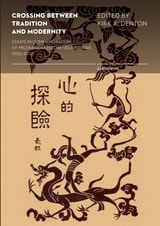
Crossing between Tradition and Modernity
Essays in Commemoriation of Milena Doležalová-Velingerová (1932–2012)Edited by Kirk A. Denton
Karolinum Press, 2017