Results by title
99 books match the query 'Motion picture producers and directors' and 7 start with c
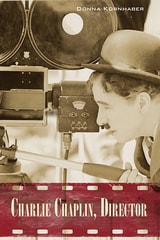
Charlie Chaplin, Director
Donna Kornhaber
Northwestern University Press, 2014
Charlie Chaplin was one of the cinema’s consummate comic performers, yet he has long been criticized as a lackluster film director. In this groundbreaking work—the first to analyze Chaplin’s directorial style—Donna Kornhaber radically recasts his status as a filmmaker. Spanning Chaplin’s career, Kornhaber discovers a sophisticated "Chaplinesque" visual style that draws from early cinema and slapstick and stands markedly apart from later, "classical" stylistic conventions. His is a manner of filmmaking that values space over time and simultaneity over sequence, crafting narrative and meaning through careful arrangement within the frame rather than cuts between frames. Opening up aesthetic possibilities beyond the typical boundaries of the classical Hollywood film, Chaplin’s filmmaking would profoundly influence directors from Fellini to Truffaut. To view Chaplin seriously as a director is to re-understand him as an artist and to reconsider the nature and breadth of his legacy.
Cinema Today
A Conversation with Thirty-nine Filmmakers from around the WorldOumano, Elena
Rutgers University Press, 2011
Can't spare the time from work or class? Travel expense too great? What? You can't even find such a collaborative event?
Then imagine curling up with a good book, maybe a shot of espresso in hand, and becoming engrossed in the exciting and informative conversation that Elena Oumano has ingeniously crafted from her personal and individual interviews with these artists. Straying far from the usual choppy question-and-answer format, Cinema Today saves you from plowing through another tedious read, in which the same topics and issues are directed to each subject, over and over-an experience that is like being trapped in a revolving door.
Oumano stops that revolving door by following a lively symposium-in-print format, with the filmmakers' words and thoughts grouped together under various key cinema topics. It is as though these experts are speaking to each other and you are their audience--collectively they reflect on and explore issues and concerns of modern filmmaking, from the practical to the aesthetic, including the process, cinematic rhythm and structure, and the many aspects of the media: business, the viewer, and cinema's place in society. Whether you are a movie lover, a serious student of cinema, or simply interested in how we communicate in today's global village through films that so profoundly affect the world, Cinema Today is for you.
Cinema and Social Change in Latin America
Conversations with FilmmakersEdited by Julianne Burton
University of Texas Press, 1986
Since the late 1960s, films from Latin America have won widening audiences in North America and Europe. Until now, no single book has offered an introduction to the diverse personalities and practices that make up this important regional film movement.
In Cinema and Social Change in Latin America, Julianne Burton presents twenty interviews with key figures of Latin American cinema, covering three decades and ranging from Argentina to Mexico. Interviews with pioneers Fernando Birri, Nelson Pereira dos Santos, and Glauber Rocha, renowned feature filmmakers Tomás Gutiérrez Alea and Carlos Diegues, prize-winning documentarists Patricio Guzmán and Helena Solberg-Ladd, among others, endeavor to balance personal achievement against the backdrop of historical, political, social, and economic circumstances that have influenced each director's career. Presented also are conversations that cast light on the related activities of acting, distribution, theory, criticism, and film-based community organizing.
More than their counterparts in other regions of the world, Latin American artists and intellectuals acknowledge the degree to which culture is shaped by history and politics. Since the mid-1950s, a period of rising nationalism and regional consciousness, talented young artists and activists have sought to redefine the uses of the film medium in the Latin American context. Questioning the studio and star systems of the Hollywood industrial model, these innovators have developed new forms, content, and processes of production, distribution, and reception.
The specific approaches and priorities of the New Latin American Cinema are far from monolithic. They vary from realism to expressionism, from observational documentary to elaborate fictional constructs, from "imperfect cinema" to a cinema that emulates the high production values of the developed sectors, from self-reflexive to "transparent" cinematic styles, from highly industrialized modes of production to purely artisanal ones. What does not vary is the commitment to film as a vehicle for social transformation and the expression of national and regional cultural autonomy.
From early alternative cinema efforts in Argentina, Brazil, and Cuba to a contemporary perspective from within the Mexican commercial industry to the emerging cinema and video production from Central America, Cinema and Social Change in Latin America offers the most comprehensive look at Latin American film available today.
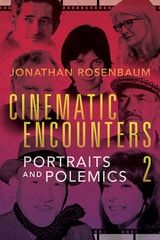
Cinematic Encounters 2
Portraits and PolemicsJonathan Rosenbaum
University of Illinois Press, 2019
Rosenbaum takes on filmmakers like Chantal Akerman, Richard Linklater, Manoel De Oliveira, Mark Rappaport, Elaine May, and Béla Tarr. He also engages, implicitly and explicitly, with other writers, arguing with Pauline Kael—and Wikipedia—over Jacques Demy, with the Hollywood Reporter and Variety reviewers of Jarmusch’s The Limits of Control, with David Thomson about James L. Brooks, and with many American and English film critics about misrepresented figures from Jerry Lewis to Yasujiro Ozu to Orson Welles. Throughout, Rosenbaum mines insights, pursues pet notions, and invites readers to join the fray.
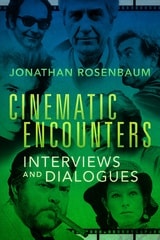
Cinematic Encounters
Interviews and DialoguesJonathan Rosenbaum
University of Illinois Press, 2018
Cinematic Encounters collects more than forty years of interviews that embrace Rosenbaum's vision of film criticism as a collaboration involving multiple voices. Rosenbaum accompanies Orson Welles on a journey back to Heart of Darkness, the unmade film meant to be Welles's Hollywood debut. Jacques Tati addresses the primacy of décor and soundtrack in his comedic masterpiece PlayTime, while Jim Jarmusch explains the influence of real and Hollywoodized Native Americans in Dead Man. By arranging the chapters chronologically, Rosenbaum invites readers to pursue thematic threads as if the discussions were dialogues between separate interviews. The result is a rare gathering of filmmakers trading thoughts on art and process, on great works and false starts, and on actors and intimate moments.
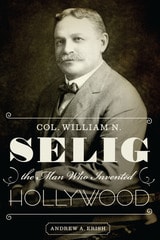
Col. William N. Selig, the Man Who Invented Hollywood
By Andrew A. Erish
University of Texas Press, 2012
All histories of Hollywood are wrong. Why? Two words: Colonel Selig. This early pioneer laid the foundation for the movie industry that we know today. Active from 1896 to 1938, William N. Selig was responsible for an amazing series of firsts, including the first two-reel narrative film and the first two-hour narrative feature made in America; the first American movie serial with cliffhanger endings; the first westerns filmed in the West with real cowboys and Indians; the creation of the jungle-adventure genre; the first horror film in America; the first successful American newsreel (made in partnership with William Randolph Hearst); and the first permanent film studio in Los Angeles. Selig was also among the first to cultivate extensive international exhibition of American films, which created a worldwide audience and contributed to American domination of the medium.
In this book, Andrew Erish delves into the virtually untouched Selig archive at the Academy of Motion Picture Arts and Sciences Library to tell the fascinating story of this unjustly forgotten film pioneer. He traces Selig’s career from his early work as a traveling magician in the Midwest, to his founding of the first movie studio in Los Angeles in 1909, to his landmark series of innovations that still influence the film industry. As Erish recounts the many accomplishments of the man who first recognized that Southern California is the perfect place for moviemaking, he convincingly demonstrates that while others have been credited with inventing Hollywood, Colonel Selig is actually the one who most deserves that honor.
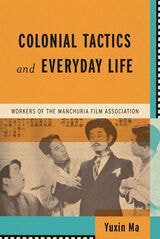
Colonial Tactics and Everyday Life
Workers of the Manchuria Film AssociationYuxin Ma
University of Wisconsin Press, 2023
By focusing on the daily challenges and experiences of the Chinese workers at the corporation, Ma examines how life was actually lived by people navigating between practical and ideological concerns. She illustrates how the inhabitants of Manchukuo navigated social opportunities, economic depression, educational reforms, fascist rule, commercial interests, practical daily needs, and more—and reveals ways in which these conflicting preoccupations sometimes manifested as tension and ambiguity on screen. In the battle between repression and expression, these Chinese actors, directors, writers, and technicians adopted defensive and opportunistic tactics. They did so in colonial spaces, often rejecting modernist representations of Manchukuo in favor of venerating traditional Chinese culture and values. The expertise, skills, and professional networks they developed extended well beyond the occupation into the postwar period, and may individuals reestablished themselves as cinema professionals in the socialist era.