Results by title
72 books match the query 'Nature conservation' and 5 start with c
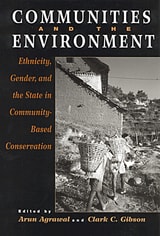
Communities and The Environment
Ethnicity, Gender, and the State in Community-Based ConservationAgrawal, Arun
Rutgers University Press, 2001
For years environmentalists thought natural resources could be best protected by national legislation. But the poor outcomes of this top-down policy have led conservation professionals today to regard local communities as the agents of conservation efforts. According to a recent survey, more than fifty countries report that they pursue partnerships with local communities in an effort to protect their forests. Despite the recent popularity of a community-based approach, the concept of community rarely receives the attention it should get from those concerned with resource management. This balanced volume redresses the situation, demonstrating both the promise and the potential dangers of community action.
Although the contributors advocate community-based conservation, they examine the record with a critical eye. They pay attention to the concrete political contexts in which communities emerge and operate. Understanding the nature of community requires understanding the internal politics of local regions and their relationship to external forces and actors. Especially critical are issues related to ethnicity, gender, and the state.
Conservancy
The Land Trust Movement in AmericaRichard Brewer
Dartmouth College Press, 2004
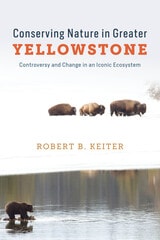
Conserving Nature in Greater Yellowstone
Controversy and Change in an Iconic EcosystemRobert B. Keiter
University of Chicago Press, 2025
For more than 150 years, the Yellowstone region—now widely known as the twenty-three million acre Greater Yellowstone Ecosystem—has played a prominent role in the United States’ nature conservation agenda. In this book, Robert B. Keiter, an award-winning public land law and policy expert, traces the evolution and application of fundamental ecological conservation concepts tied to Yellowstone.
Keiter’s book highlights both the conservation successes and controversies connected with this storied region, which has been enmeshed in change. During the 1980s, leaders in Yellowstone embraced ecosystem management concepts to recover a dwindling grizzly bear population and to support wolf reintroduction. Since then, management policies in the region’s two national parks and adjacent national forests have largely followed suit, prioritizing ecosystem-level conservation over industrial activity. Groundbreaking efforts are currently afoot to protect elk, deer, and pronghorn migration corridors and to maintain the park’s bison population, effectively expanding the scope of regional conservation initiatives. But in the face of explosive human population growth and related development pressures, new efforts must also account for the region’s privately owned lands along with accelerating recreational activities that present quite different problems.
Indeed, the Greater Yellowstone Ecosystem—extending across three states and twenty counties and embracing more than sixteen million acres of federal land as well as private and tribal lands —can only be characterized as a complex, jurisdictionally fragmented landscape. As Keiter makes clear, the quest for common ground among federal land managers, state officials, local communities, conservationists, ranchers, Indigenous tribes, and others is a vital, enduring task.
Exploring both notable conservation accomplishments and the ongoing challenges confronting this special place, Keiter’s book explains the many forces—scientific, political, economic, legal, cultural, climatic, and more—at work driving controversy and change across the region. But more than this, Conserving Nature in Greater Yellowstone shows us that the lessons gleaned from Yellowstone’s expansive nature conservation efforts are profoundly important for both the country and the world.
Corporate Nature
An Insider's Ethnography of Global ConservationSarah Milne
University of Arizona Press, 2022
Sarah Milne spent more than a decade working for and observing global conservation projects in Cambodia. During this time, she saw how big environmental NGOs can operate rather like corporations. Their core practice involves rolling out appealing and deceptively simple policy ideas, like Payments for Ecosystem Services (PES). Yet, as policy ideas prove hard to implement, NGOs must also carefully curate evidence from the field to give the impression of success and effectiveness.
In Corporate Nature, Milne delves inside the black box of mainstream global conservation. She reveals how big international NGOs struggle in the face of complexity—especially in settings where corruption and political violence prevail. She uses the case of Conservation International’s work in Cambodia to illustrate how apparently powerful NGOs can stumble in practice: policy ideas are transformed on the ground, while perverse side effects arise, like augmented authoritarian power, illegal logging, and Indigenous dispossession.
The real power of global conservation NGOs is therefore not in their capacity to control what happens in the field but in their capacity to ignore or conceal failings. Milne argues that this produces an undesirable form of socionature, called corporate nature, that values organizational success over diverse knowledges and ethical conduct.
Cradle of Conservation
An Environmental History of PennsylvaniaAllen Dieterich-Ward
Temple University Press, 2024
Cradle of Conservation moves across time and place, from the Haudenosaunee people of the Susquehanna Valley, to the iron furnaces of nineteenth-century Pittsburgh, to the diesel trucks on the twentieth-century Pennsylvania Turnpike. In addition, Dieterich-Ward explores the histories of Philadelphia’s Schuylkill River and the state’s anthracite region and traces the environmental movements and crises that have led to public policy changes in the face of climate change.
Cradle of Conservation deepens our understanding of how Pennsylvanians have conserved and consumed.