Results by title
121 books match the query 'Neoliberalism' and 9 start with c

Capital at the Brink
Overcoming the Destructive Legacies of NeoliberalismJeffrey R. Di Leo and Uppinder Mehan, editors
Michigan Publishing Services, 2014

Capitalist Humanitarianism
Lucia Hulsether
Duke University Press, 2023

Carceral Liberalism
Feminist Voices against State ViolenceEdited by Shreerekha Pillai. Foreword by Demita Frazier
University of Illinois Press, 2023
One of Ms. Magazine's Most Anticipated Books of 2023
Carceral liberalism emerges from the confluence of neoliberalism, carcerality, and patriarchy to construct a powerful ruse disguised as freedom. It waves the feminist flag while keeping most women still at the margins. It speaks of a post-race society while one in three Black men remain incarcerated. It sings the praises of capital while the dispossessed remain mired in debt.
Shreerekha Pillai edits essays on carceral liberalism that continue the trajectory of the Combahee River Collective and the many people inspired by its vision of feminist solidarity and radical liberation. Academics, activists, writers, and a formerly incarcerated social worker look at feminist resurgence and resistance within, at the threshold of, and outside state violence; observe and record direct and indirect forms of carcerality sponsored by the state and shaped by state structures, traditions, and actors; and critique carcerality. Acclaimed poets like Honorée Fanonne Jeffers and Solmaz Sharif amplify the volume’s themes in works that bookend each section.
Cutting-edge yet historically grounded, Carceral Liberalism examines an American ideological creation that advances imperialism, anti-blackness, capitalism, and patriarchy.
Contributors: Maria F. Curtis, Joanna Eleftheriou, Autumn Elizabeth and Zarinah Agnew and D Coulombe, Jeremy Eugene, Demita Frazier, Honorée Fanonne Jeffers, Alka Kurian, Cassandra D. Little, Beth Matusoff Merfish, Francisco Argüelles Paz y Puente, Shreerekha Pillai, Marta Romero-Delgado, Ravi Shankar, Solmaz Sharif, Shailza Sharma, Tria Blu Wakpa and Jennifer Musial, Javier Zamora

Care Ethics in the Age of Precarity
Maurice Hamington
University of Minnesota Press, 2021
How care can resist the stifling force of the neoliberal paradigm
In a world brimming with tremendous wealth and resources, too many are suffering the oppression of precarious existences—and with no adequate relief from free market–driven institutions. Care Ethics in the Age of Precarity assembles an international group of interdisciplinary scholars to explore the question of care theory as a response to market-driven capitalism, addressing the relationship of three of the most compelling social and political subjects today: care, precarity, and neoliberalism.
While care theory often centers on questions of individual actions and choices, this collection instead connects theory to the contemporary political moment and public sphere. The contributors address the link between neoliberal values—such as individualism, productive exchange, and the free market—and the pervasive state of precarity and vulnerability in which so many find themselves. From disability studies and medical ethics to natural-disaster responses and the posthuman, examples from Māori, Dutch, and Japanese politics to the COVID-19 pandemic and the Black Lives Matter movement, this collection presents illuminating new ways of considering precarity in our world.
Care Ethics in the Age of Precarity offers a hopeful tone in the growing valorization of care, demonstrating the need for an innovative approach to precarity within entrenched systems of oppression and a change in priorities around the basic needs of humanity.
Contributors: Andries Baart, U Medical Center Utrecht, Tilburg U, and Catholic Theological U Utrecht, the Netherlands; Vrinda Dalmiya, U of Hawaii, Mānoa; Emilie Dionne, U Laval; Maggie FitzGerald, U of Saskatchewan; Sacha Ghandeharian, Carleton U; Eva Feder Kittay, Stony Brook U/SUNY; Carlo Leget, U of Humanistic Studies in Utrecht, the Netherlands; Sarah Clark Miller, Penn State U; Luigina Mortari, U of Verona; Yayo Okano, Doshisha U, Kyoto, Japan; Elena Pulcini, U of Florence.
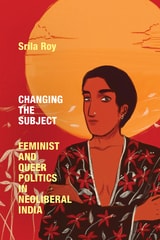
Changing the Subject
Feminist and Queer Politics in Neoliberal IndiaSrila Roy
Duke University Press, 2022

Common Ground
Democracy and Collectivity in an Age of IndividualismJeremy Gilbert
Pluto Press, 2013
Common Ground explores the philosophical relationship between collectivity, individuality, affect and agency in the neoliberal era. Jeremy Gilbert argues that individualism is forced upon us by neoliberal culture, fatally limiting our capacity to escape the current crisis of democratic politics.
The book asks how forces and ideas opposed to neoliberal hegemony, and to the individualist tradition in Western thought, might serve to protect some form of communality, and how far we must accept assumptions about the nature of individuality and collectivity which are the legacy of an elitist tradition. Along the way it examines different ideas and practices of collectivity, from conservative notions of hierarchical and patriarchal communities to the politics of ‘horizontality’ and ‘the commons’ which are at the heart of radical movements today.
Exploring this fundamental faultline in contemporary political struggle, Common Ground proposes a radically non-individualist mode of imagining social life, collective creativity and democratic possibility.

Composing Capital
Classical Music in the Neoliberal EraMarianna Ritchey
University of Chicago Press, 2019
Cores, Peripheries, and Globalization
Peter Hanns Reill
Central European University Press, 2011

Crude Chronicles
Indigenous Politics, Multinational Oil, and Neoliberalism in EcuadorSuzana Sawyer
Duke University Press, 2004
Through her rich ethnography of indigenous marches, demonstrations, occupations, and negotiations, Sawyer tracks the growing sophistication of indigenous politics as Indians subverted, re-deployed, and, at times, capitulated to the dictates and desires of a transnational neoliberal logic. At the same time, she follows the multiple maneuvers and discourses that the multinational corporation and the Ecuadorian state used to circumscribe and contain indigenous opposition. Ultimately, Sawyer reveals that indigenous struggles over land and oil operations in Ecuador were as much about reconfiguring national and transnational inequality—that is, rupturing the silence around racial injustice, exacting spaces of accountability, and rewriting narratives of national belonging—as they were about the material use and extraction of rain-forest resources.