Results by title
65 books match the query 'Netherlands' and 6 start with c
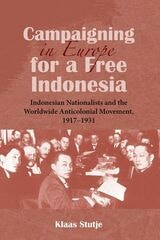
Campaigning in Europe for a Free Indonesia
Indonesian Nationalists and the Worldwide Anticolonial Movement, 1917–1932Klaas Stutje
National University of Singapore Press, 2019
‘Campaigning in Europe for a Free Indonesia’ explores Indonesian transnational political networks in the late colonial period, connecting the history of Indonesian nationalism with that of anticolonial internationalism and transnational activism. This book adds an international dimension to our understanding of the nationalist and anticolonial movement in the Netherlands Indies. Offering important new understandings of the Indonesian independence struggle, this fine-grained study explores the international activities in the capitals of interwar Europe of the Perhimpoenan Indonesia (PI), an Indonesian nationalist student organisation based in the Netherlands. Operating in a vibrant political environment, the PI interacted with different anticolonial movements in cities across Europe. Focusing on the period between 1917 and 1931, the book follows the personal journeys of different students to cities such as Zürich, Paris, Brussels and Berlin as they established contacts, joined associations and attended international conferences. Here, the complex reality of movement building is examined, going beyond superficial suggestions of contact and collaboration. The study shows that the activities of the PI reverberated in the Indonesian political landscape, where the new collaborations in Europe were followed with great interest. In this way, the book offers new findings for multiple audiences – Indonesianists and scholars of anticolonial resistance alike. However, it also demonstrates that the political awakening of Indonesian elites should be understood not just as an indigenous response to Dutch rule but also as part of global anticolonial movements and struggles.
[more]
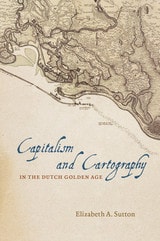
Capitalism and Cartography in the Dutch Golden Age
Elizabeth A. Sutton
University of Chicago Press, 2015
In Capitalism and Cartography in the Dutch Golden Age, Elizabeth A. Sutton explores the fascinating but previously neglected history of corporate cartography during the Dutch Golden Age, from ca. 1600 to 1650. She examines how maps were used as propaganda tools for the Dutch West India Company in order to encourage the commodification of land and an overall capitalist agenda.
Building her exploration around the central figure of Claes Jansz Vischer, an Amsterdam-based publisher closely tied to the Dutch West India Company, Sutton shows how printed maps of Dutch Atlantic territories helped rationalize the Dutch Republic’s global expansion. Maps of land reclamation projects in the Netherlands, as well as the Dutch territories of New Netherland (now New York) and New Holland (Dutch Brazil), reveal how print media were used both to increase investment and to project a common narrative of national unity. Maps of this era showed those boundaries, commodities, and topographical details that publishers and the Dutch West India Company merchants and governing Dutch elite deemed significant to their agenda. In the process, Sutton argues, they perpetuated and promoted modern state capitalism.
Building her exploration around the central figure of Claes Jansz Vischer, an Amsterdam-based publisher closely tied to the Dutch West India Company, Sutton shows how printed maps of Dutch Atlantic territories helped rationalize the Dutch Republic’s global expansion. Maps of land reclamation projects in the Netherlands, as well as the Dutch territories of New Netherland (now New York) and New Holland (Dutch Brazil), reveal how print media were used both to increase investment and to project a common narrative of national unity. Maps of this era showed those boundaries, commodities, and topographical details that publishers and the Dutch West India Company merchants and governing Dutch elite deemed significant to their agenda. In the process, Sutton argues, they perpetuated and promoted modern state capitalism.
[more]

Civic Charity in a Golden Age
ORPHAN CARE IN EARLY MODERN AMSTERDAMAnne E. C. McCants
University of Illinois Press, 1997
Using the Amsterdam Municipal Orphanage as a window through which readers
can see the start of profound social and economic changes in early modern
Amsterdam, Civic Charity in a Golden Age explores the connections
between the developing capitalist economy, the functioning of the government,
and the provision of charitable services to orphans in Amsterdam during
the seventeenth and eighteenth centuries, the period of the city's greatest
prosperity and subsequent decline.
Anne McCants skillfully interprets details of the orphanage's expenditures,
especially for food; its population; the work records of those who were
reared there; and the careers of the regents who oversaw it. The establishment
of the orphanage itself was called for by the changing economic needs
of rapidly expanding commercial centers and the potential instability
of a government that depended on taxes from a large, politically powerless
segment of the population.
[more]
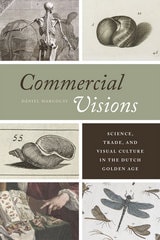
Commercial Visions
Science, Trade, and Visual Culture in the Dutch Golden AgeDániel Margócsy
University of Chicago Press, 2014
Entrepreneurial science is not new; business interests have strongly influenced science since the Scientific Revolution. In Commercial Visions, Dániel Margócsy illustrates that product marketing, patent litigation, and even ghostwriting pervaded natural history and medicine—the “big sciences” of the early modern era—and argues that the growth of global trade during the Dutch Golden Age gave rise to an entrepreneurial network of transnational science.
Margócsy introduces a number of natural historians, physicians, and curiosi in Amsterdam, London, St. Petersburg, and Paris who, in their efforts to boost their trade, developed modern taxonomy, invented color printing and anatomical preparation techniques, and contributed to philosophical debates on topics ranging from human anatomy to Newtonian optics. These scientific practitioners, including Frederik Ruysch and Albertus Seba, were out to do business: they produced and sold exotic curiosities, anatomical prints, preserved specimens, and atlases of natural history to customers all around the world. Margócsy reveals how their entrepreneurial rivalries transformed the scholarly world of the Republic of Letters into a competitive marketplace.
Margócsy’s highly readable and engaging book will be warmly welcomed by anyone interested in early modern science, global trade, art, and culture.
[more]
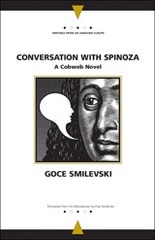
Conversation with Spinoza
A Cobweb NovelGoce Smilevski
Northwestern University Press, 2006
Prizing ideas above all else, radical thinker Baruch Spinoza left little behind in the way of personal facts and furnishings. But what of the tug of necessity, the urgings of the flesh, to which this genius philosopher (and grinder of lenses) might have been no more immune than the next man-or the next character, as Baruch Spinoza becomes in this intriguing novel by the remarkable young Macedonian author Goce Smilevski.
Smilevski's novel brings the thinker Spinoza and his inner life into conversation with the outer, all-too-real facts of his life and his day--from his connection to the Jewish community of Amsterdam, his excommunication in 1656, and the emergence of his philosophical system to his troubling feelings for his fourteen-year-old Latin teacher Clara Maria van den Enden and later his disciple Johannes Casearius. From this conversation there emerges a compelling and complex portrait of the life of an idea--and of a man who tries to live that idea.
Smilevski's novel brings the thinker Spinoza and his inner life into conversation with the outer, all-too-real facts of his life and his day--from his connection to the Jewish community of Amsterdam, his excommunication in 1656, and the emergence of his philosophical system to his troubling feelings for his fourteen-year-old Latin teacher Clara Maria van den Enden and later his disciple Johannes Casearius. From this conversation there emerges a compelling and complex portrait of the life of an idea--and of a man who tries to live that idea.
[more]
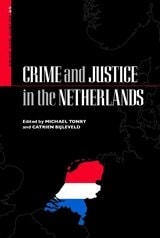
Crime and Justice, Volume 35
Crime and Justice in the NetherlandsEdited by Michael Tonry and Catrien Bijleveld
University of Chicago Press Journals, 2008
Since 1979, the Crime and Justice series has presented international crime-related research to enrich the work of sociologists, psychologists, criminal lawyers, justice scholars, and political scientists. The eleven essays in Volume 35 provide the first English-language survey of the Dutch criminal justice system, which has been the basis for many important international research initiatives, including many in the United States. Topics covered include Dutch tolerance of drugs, prostitution, and euthanasia; organized crime in the Netherlands; sex offenders and sex offending; and juvenile delinquency.
[more]