Results by title
110 books match the query 'New Mexico' and 12 start with c
Capturing Water
Puebloan Resilience and Agricultural Sustainability in Chaco CanyonR. Gwinn Vivian and Samantha G. Fladd
University of Utah Press, 2025
The ability of the inhabitants of Chaco Canyon to sustain themselves through farming in an arid environment has long been a topic of debate among scholars. Building upon the work of his father, Gordon, R. Gwinn Vivian dedicated his lifetime of archaeological work to investigating water management and practices at Chaco. These efforts provide compelling evidence of the extensive use of canal irrigation systems and other water management techniques employed by the Ancestral Puebloan people by the ninth century and continuing through recent periods by Navajo farmers.
Rich with archaeological data, ethnographic evidence, maps, and photographs, this volume challenges long-standing assumptions about Chaco Canyon's agricultural potential. By highlighting the adaptability and ingenuity of the canyon's early inhabitants, the book offers a fresh perspective on the role of water management in the development of Chaco Canyon as a sociopolitical center in the northern Southwest.
Chaco Revisited
New Research on the Prehistory of Chaco Canyon, New MexicoEdited by Carrie C. Heitman and Stephen Plog
University of Arizona Press, 2015
In each of the twelve chapters, luminaries from the field of archaeology and anthropology, such as R. Gwinn Vivian, Peter Whiteley, and Paul E. Minnis, address some of the most fundamental questions surrounding Chaco, from agriculture and craft production, to social organization and skeletal analyses. Though varied in their key questions about Chaco, each author uses previous research or new studies to ultimately blaze a trail for future research and discoveries about the canyon.
Written by both up-and-coming and well-seasoned scholars of Chaco Canyon, Chaco Revisited provides readers with a perspective that is both varied and balanced. Though a singular theory for the Chaco Canyon phenomenon is yet to be reached, Chaco Revisited brings a new understanding to scholars: that Chaco was perhaps even more productive and socially complex than previous analyses would suggest.
Chaco's Northern Prodigies
Salmon, Aztec, and the Ascendancy of the Middle San Juan Region after AD 1100Paul F Reed
University of Utah Press, 2011
Work by two groups of contributors resulted in this synthetic volume, which interprets thirty-five years of research at Salmon Ruins. Chaco’s Northern Prodigies also puts recent work at Salmon Ruins in the context of Middle San Juan archaeological research. It is a timely synopsis of the archaeology of this region of the Southwest.
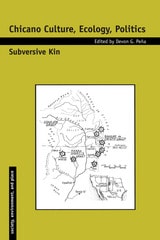
Chicano Culture, Ecology, Politics
Subversive KinDevon G. Peña
University of Arizona Press, 1998
Employing a variety of genres ranging from poetry to autobiography to theoretical and empirical essays, the voices in this collection speak to the most significant issues of environmentalism and social justice, recognizing throughout the need for a pluralism of Chicana/o philosophies. The contributors provide an excellent basis for understanding how multiple Chicana/o views on the environment play out in the context of dominant social, political and economic views. Chicano Culture, Ecology, Politics examines a number of Chicana/o ecological perspectives. How can the ethics of reciprocity present in Chicana/o agropastoral life be protected and applied on a broader scale? How can the dominant society, whose economic structure is invested in "placeless mobility," take note of the harm caused to land-based cultures, take responsibility for it, and take heed before it is too late? Will the larger society be "ecologically housebroken" before it destroys its home?
Grounded in actual political struggles waged by Chicana/o communities over issues of environmental destruction, cultural genocide, and socioeconomic domination, this volume provides an important series of snapshots of Chicana/o history. Chicano Culture, Ecology, Politics illuminates the bridges that exist—and must be understood—between race, ethnicity, class, gender, politics, and ecology.
CONTENTS
Part 1: IndoHispano Land Ethics
Los Animalitos: Culture, Ecology, and the Politics of Place in the Upper R¡o Grande, Devon G. Peña
Social Action Research, Bioregionalism, and the Upper Río Grande, Rubén O. Martínez
Notes on (Home)Land Ethics: Ideas, Values, and the Land, Reyes García
Part 2: Environmental History and Ecological Politics
Ecological Legitimacy and Cultural Essentialism: Hispano Grazing in Northern New Mexico, Laura Pulido
The Capitalist Tool, the Lawless, and the Violent: A Critique of Recent Southwestern Environmental History, Devon G. Peña and Rubén O. Martínez
Ecofeminism and Chicano Environmental Struggles: Bridges across Gender and Race, Gwyn Kirk
Philosophy Meets Practice: A Critique of Ecofeminism through the Voices of Three Chicana Activists, Malia Davis
Part 3: Alternatives to Destruction
The Pasture Poacher (a poem), Joseph C. Gallegos
Acequia Tales: Stories from a Chicano Centennial Farm, Joseph C. Gallegos
A Gold Mine, an Orchard, and an Eleventh Commandment, Devon G. Peña

Cidermaster Of Rio Oscuro
Harvey Frauenglas
University of Utah Press, 2000
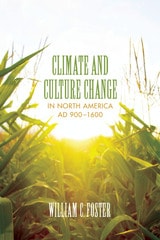
Climate and Culture Change in North America AD 900–1600
By William C. Foster
University of Texas Press, 2012
Climate change is today’s news, but it isn’t a new phenomenon. Centuries-long cycles of heating and cooling are well documented for Europe and the North Atlantic. These variations in climate, including the Medieval Warm Period (MWP), AD 900 to 1300, and the early centuries of the Little Ice Age (LIA), AD 1300 to 1600, had a substantial impact on the cultural history of Europe. In this pathfinding volume, William C. Foster marshals extensive evidence that the heating and cooling of the MWP and LIA also occurred in North America and significantly affected the cultural history of Native peoples of the American Southwest, Southern Plains, and Southeast.
Correlating climate change data with studies of archaeological sites across the Southwest, Southern Plains, and Southeast, Foster presents the first comprehensive overview of how Native American societies responded to climate variations over seven centuries. He describes how, as in Europe, the MWP ushered in a cultural renaissance, during which population levels surged and Native peoples substantially intensified agriculture, constructed monumental architecture, and produced sophisticated works of art. Foster follows the rise of three dominant cultural centers—Chaco Canyon in New Mexico, Cahokia on the middle Mississippi River, and Casas Grandes in northwestern Chihuahua, Mexico—that reached population levels comparable to those of London and Paris. Then he shows how the LIA reversed the gains of the MWP as population levels and agricultural production sharply declined; Chaco Canyon, Cahokia, and Casas Grandes collapsed; and dozens of smaller villages also collapsed or became fortresses.
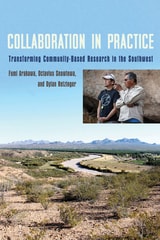
Collaboration in Practice
Transforming Community-Based Research in the SouthwestFumi Arakawa, Octavius Seowtewa, and Dylan Retzinger
University of Arizona Press, 2026
The book situates this collaboration within the broader historical and political context of archaeology and museology. It critically explores how museums and academic institutions can shift from extractive practices to ones that prioritize Indigenous sovereignty, knowledge systems, and cultural continuity. Through personal narratives, historical context, and methodological insights, the authors highlight the challenges and transformative potential of working collaboratively. They show how true collaboration requires humility, mutual respect, and a commitment to shared authority in both research and representation.
Ultimately, this work charts a path forward for community-based research that centers Indigenous voices and values. It advocates for an archaeology that is not only more inclusive but also more meaningful to the communities whose histories are being studied. A vital resource for scholars, students, and practitioners, this work seeks to engage in ethical, reciprocal, and culturally grounded research in the Southwest and beyond.
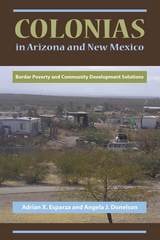
Colonias in Arizona and New Mexico
Border Poverty and Community Development SolutionsAdrian X. Esparza and Angela J. Donelson
University of Arizona Press, 2008
Beginning with an examination of the origins of border region settlement and the emergence of colonias in southern Arizona and New Mexico in the late 1800s, the book then turns to an assessment of current social, economic, and housing conditions. The authors also examine how Mexico’s recent economic crises and U.S. immigration and border security policies have shaped the quality of life in colonias, and they evaluate recent community development initiatives. By examining the challenges and successes of these recent efforts, the authors are able to provide a generalized plan for community development. Balancing analyses of these communities with a review of the positive steps taken to improve the quality of life of their inhabitants, Colonias in Arizona and New Mexico is an indispensable tool for anyone interested in public policy or immigration issues.
Connected Communities
Networks, Identity, and Social Change in the Ancient Cibola WorldMatthew A. Peeples
University of Arizona Press, 2018
In Connected Communities, Matthew A. Peeples examines a period of dramatic social and political transformation in the ancient Cibola region (ca. A.D. 1150–1325). He analyzes archaeological data generated during a century of research through the lens of new and original social theories and methods focused on exploring identity, social networks, and social transformation. In so doing, he demonstrates the value of comparative, synthetic analysis.
The book addresses some of the oldest enduring questions in archaeology: How do large-scale social identities form? How do they change? How can we study such processes using material remains? Peeples approaches these questions using a new set of methods and models from the broader comparative social sciences (relational sociology and social networks) to track the trajectories of social groups in terms of both networks of interactions (relations) and expressions of similarity or difference (categories). He argues that archaeological research has too often conflated these different kinds of social identity and that this has hindered efforts to understand the drivers of social change.
In his strikingly original approach, Peeples combines massive amounts of new data and comparative explorations of contemporary social movements to provide new insights into how social identities formed and changed during this key period.
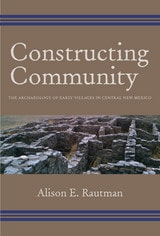
Constructing Community
The Archaeology of Early Villages in Central New MexicoAlison E. Rautman
University of Arizona Press, 2014
Rautman tackles a very broad topic: how archaeologists use material evidence to infer and imagine how people lived in the past, how they coped with everyday decisions and tensions, and how they created a sense of themselves and their place in the world. Using several different lines of evidence, she reconstructs what life was like for the Ancestral Pueblo people of Salinas, and identifies some of the specific strategies that they used to develop and sustain their villages over time.
Examining evidence of each site’s construction and developing spatial layout, Rautman traces changes in community organization across the architectural transitions from pithouses to jacal structures to unit pueblos, and finally to plaza-oriented pueblos. She finds that, in contrast to some other areas of the American Southwest, early villagers in Salinas repeatedly managed their built environment to emphasize the coherence and unity of the village as a whole. In this way, she argues, people in early farming villages across the Salinas region actively constructed and sustained a sense of social community.
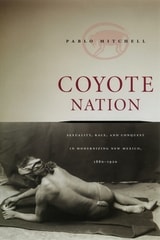
Coyote Nation
Sexuality, Race, and Conquest in Modernizing New Mexico, 1880-1920Pablo Mitchell
University of Chicago Press, 2005
Coyote Nation considers these questions as it explores how New Mexicans evaluated and categorized racial identities through bodily practices. Where ethnic groups were numerous and—in the wake of miscegenation—often difficult to discern, the ways one dressed, bathed, spoke, gestured, or even stood were largely instrumental in conveying one's race. Even such practices as cutting one's hair, shopping, drinking alcohol, or embalming a deceased loved one could inextricably link a person to a very specific racial identity.
A fascinating history of an extraordinarily plural and polyglot region, Coyote Nation will be of value to historians of race and ethnicity in American culture.
Culture in the Marketplace
Gender, Art, and Value in the American SouthwestMolly H. Mullin
Duke University Press, 2001
Drawing on fiction, memoirs, journalistic accounts, and extensive interviews with artists, collectors, and dealers, Mullin shows how anthropological notions of culture were used to valorize Indian art and create a Southwest Indian art market. By turning their attention to Indian affairs and art in Santa Fe, New Mexico, she argues, these women escaped the gender restrictions of their eastern communities and found ways of bridging public and private spheres of influence. Tourism, in turn, became a means of furthering this cultural colonization. Mullin traces the development of aesthetic worth as it was influenced not only by politics and profit but also by gender, class, and regional identities, revealing how notions of “culture” and “authenticity” are fundamentally social ones. She also shows how many of the institutions that the early patrons helped to establish continue to play an important role in the contemporary market for American Indian art.
This book will appeal to audiences in cultural anthropology, art history, American studies, women’s studies, and cultural history.