Results by title
152 books match the query 'New York (N.Y.)' and 11 start with c
Capital of the American Century
The National and International Influence of New York CityMartin Shefter
Russell Sage Foundation, 1993
Carne de Dios
A NovelHomero Aridjis; Translated by Chloe Garcia Roberts
University of Arizona Press, 2025
María Sabina, the renowned Mazatec healer, spends her days in the small town of Huautla de Jiménez selling produce at the market and foraging under the new moon for the sacred mushrooms that grow near her home—her Holy Children, Carne de Dios, or Flesh of God. But her life changes forever when an amateur mycologist from New York, with a cameraman in tow, visits her to experience for himself the mushroom ceremony, or velada, he knows only from whispers in anthropological records. When he publishes an unauthorized article about his experience in LIFE Magazine 1957, the stage is set for an explosive encounter between the burgeoning international counterculture and the woman who became an unwilling icon of the psychedelic revolution.
Homero Aridjis’s novel, vividly translated by Chloe Garcia Roberts, tells the story of the motley crew of bohemians, researchers, and holy fools, both real and imagined, who descend on the town of Huautla de Jiménez searching for inspiration, distraction, and salvation in the sacred mushrooms. These seekers melt in and out of a narrative infiltrated by the slipstream logic of dreams. As John Lennon plays jazz on the patio of the Hotel Grande, Juan Rulfo contemplates horror movies, and Allen Ginsberg recites mantras at Philip Lamantia’s wedding, María Sabina’s life is increasingly thrown into turmoil.
Carne de Dios is a masterful and often humorous blend of history, myth, and poetic imagination, captured in a translation that mirrors the hallucinatory beauty of Aridjis’s original Spanish. Aridjis’s intimate portrayal of María Sabina, informed by his personal connection to her, serves as both a tribute to her enduring legacy and a critical reflection on the wave of global interest in mushroom culture still gaining momentum today.
This English translation includes an introduction by the translator and an afterword by the author.
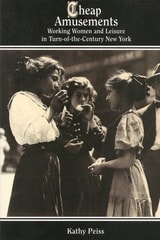
Cheap Amusements
Kathy Peiss
Temple University Press, 1987
Kathy Peiss follows working women into saloons, dance halls, Coney Island amusement parks, social clubs, and nickelodeons to explore the culture of these young women between 1880 and 1920 as expressed in leisure activities. By examining the rituals and styles they adopted and placing that culture in the larger context of urban working-class life, she offers us a complex picture of the dynamics shaping a working woman's experience and consciousness at the turn-of-the-century. Not only does her analysis lead us to new insights into working-class culture, changing social relations between single men and women, and urban courtship, but it also gives us a fuller understanding of the cultural transformations that gave rise to the commercialization of leisure.
The early twentieth century witnessed the emergence of "heterosocial companionship" as a dominant ideology of gender, affirming mixed-sex patterns of social interaction, in contrast to the nineteenth century's segregated spheres. Cheap Amusements argues that a crucial part of the "reorientation of American culture" originated from below, specifically in the subculture of working women to be found in urban dance halls and amusement resorts.
Cheap Rooms and Restless Hearts
A Study of Formula in the Urban Tales of William Sydney PorterKaren Charmaine Blansfield
University of Wisconsin Press, 1988
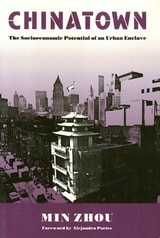
Chinatown
The Socioeconomic Potential of an Urban EnclaveMin Zhou, foreword by Alejandro Portes
Temple University Press, 1995
Min Zhou examines how an ethnic enclave works to direct its members into American society, while at the same time shielding them from it. Focusing specifically on New York's Chinatown, a community established more than a century ago, Zhou offers a thorough and modern treatment of the enclave as a socioeconomic system, distinct form, but intrinsically linked with, the larger society.
Zhou's central theme is that Chinatown does not keep immigrant Chinese from assimilating into mainstream society, but instead provides an alternative means of incorporation into society that does not conflict with cultural distinctiveness. Concentrating on the past two decades, Zhou maintains that community networks and social capital are important resources for reaching socioeconomic goals and social positions in the United States; in Chinatown, ethnic employers use family ties and ethnic resources to advance socially. Relying on her family's networks in New York's Chinatown and her fluency in both Cantonese and Mandarin, the author, who was born in the People's Republic of China, makes extensive use of personal interviews to present a rich picture of the daily work life in the community. She demonstrates that for many immigrants, low-paid menial jobs provide by the enclave are expected as a part of the time-honored path to upward social mobility of the family.
In the series Conflicts in Urban and Regional Development, edited by John R. Logan and Todd Swanstrom.
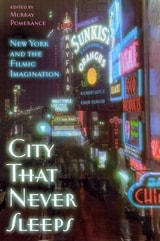
City That Never Sleeps
New York and the Filmic ImaginationPomerance, Murray
Rutgers University Press, 2007
The glittering skyscrapers of such films as On the Town have shadowed the characteristic seedy streets in which desperate, passionate stories have played out-as in Scandal Sheet and The Pawnbroker. In other films, the city is a cauldron of bright lights, technology, empire, egotism, fear, hunger, and change--the scenic epitome of America in the modern age.
From Street Scene and Breakfast at Tiffany's to Rosemary's Baby, The Warriors, and 25th Hour, the sixteen essays in this book explore the cinematic representation of New York as a city of experience, as a locus of ideographic characters and spaces, as a city of moves and traps, and as a site of allurement and danger. Contributors consider the work of Woody Allen, Blake Edwards, Alfred Hitchcock, Gregory La Cava, Spike Lee, Sidney Lumet, Vincente Minnelli, Roman Polanski, Martin Scorsese, Andy Warhol, and numerous others.
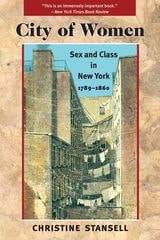
City of Women
Sex and Class in New York, 1789-1860Christine Stansell
University of Illinois Press, 1987
City of Women delves into the misfortunes that New York City's laboring women suffered and the problems that resulted. Looking at how and why a community of women workers came into existence, Christine Stansell analyzes the social conflicts surrounding laboring women and they social pressure these conflicts brought to bear on others. The result is a fascinating journey into economic relations and cultural forms that influenced working women's lives—one that reveals at last the female city concealed within America's first great metropolis.
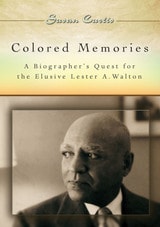
Colored Memories
A Biographer's Quest for the Elusive Lester A. WaltonSusan Curtis
University of Missouri Press, 2008
Lester A. Walton was a well-known public figure in his day. An African American journalist, cultural critic, diplomat, and political activist, he was an adviser to presidents and industrialists in a career that spanned the first six decades of the twentieth century. He was a steadfast champion of democracy and lived to see the passage of major civil rights legislation. But one word best describes Walton today: forgotten.
Exploring the contours of this extraordinary life, Susan Curtis seeks to discover why our collective memory of Walton has failed. In a unique narrative of historical research, she recounts a fifteen-year journey, from the streets of Harlem and “The Ville” in St. Louis to scattered archives and obscure public records, as she uncovers the mysterious circumstances surrounding Walton’s disappearance from national consciousness. And despite numerous roadblocks and dead ends in her quest, she tells how she came to know this emblematic citizen of the American Century in surprising ways.
In this unconventional book—a postmodern ghost story, an unprecedented experiment in life-writing—Curtis shares her discoveries as a researcher. Relating her frustrating search through long-overlooked documents to discover this forgotten man, she offers insight into how America’s obsession with race has made Walton’s story unwelcome. She explores the treachery, duplicity, and archival accidents that transformed a man dedicated to the fulfillment of American democracy into a shadowy figure.
Combining anecdotal memories with the investigative instincts of the historian, Curtis embraces the subjectivity of her research to show that what a society forgets or suppresses is just as important as what it includes in its history. Colored Memories is a highly original work that not only introduces readers to a once-influential figure but also invites us to reconsider how we view, understand, and preserve the past.
Contentious City
The Politics of Recovery in New York CityJohn Mollenkopf
Russell Sage Foundation, 2005
Counterfeiting Labor's Voice
William A. A. Carsey and the Shaping of American Reform PoliticsMark A. Lause
University of Illinois Press, 2024
Cruising the Dead River
David Wojnarowicz and New York's Ruined WaterfrontFiona Anderson
University of Chicago Press, 2019