Results by title
77 books match the query 'Nietzsche, Friedrich Wilhelm' and 3 start with c
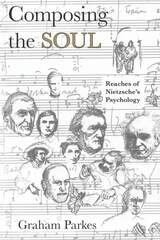
Composing the Soul
Reaches of Nietzsche's PsychologyGraham Parkes
University of Chicago Press, 1994
Nietzsche wrote in Ecce Homo (1888), "That a psychologist without equal speaks from my writings—this is perhaps the first insight gained by a good reader. . . . Who among the philosophers before me was in any way a psychologist? Before me there simply was no psychology."
Composing the Soul is the first study to pay sustained attention to this pronouncement and to examine the contours of Nietzsche's psychology in the context of his life and psychological makeup. Beginning with essays from Nietzsche's youth, Graham Parkes shows the influence of such figures as Goethe, Byron, and Emerson on Nietzsche's formidable and multiple talents. Parkes goes on to chart the development of Nietzsche's psychological ideas in terms of the imagery, drawn from the dialogues of Plato as well as from Nietzsche's own quasi-mystical experiences of nature, in which he spoke of the soul. Finally, Parkes analyzes Nietzsche's most revolutionary idea—that the soul is composed of multiple "drives," or "persons," within the psyche. The task for Nietzsche's psychology, then, was to identify and order these multiple persons within the individual—to compose the soul.
Featuring all new translations of quotations from Nietzsche's writings, Composing the Soul reveals the profundity of Nietzsche's lifelong personal and intellectual struggles to come to grips with the soul. Extremely well-written, this landmark work makes Nietzsche's life and ideas accessible to any reader interested in this much misunderstood thinker.
[more]
Contesting Nietzsche
Christa Davis Acampora
University of Chicago Press, 2013
A brilliant exploration of a significant and understudied aspect of Nietzsche’s philosophy.
In this groundbreaking work, Christa Davis Acampora offers a profound rethinking of Friedrich Nietzsche’s crucial notion of the agon. Analyzing an impressive array of primary and secondary sources and synthesizing decades of Nietzsche scholarship, she shows how the agon, or contest, organized core areas of Nietzsche’s philosophy, providing a new appreciation of the subtleties of his notorious views about power. By focusing so intensely on this particular guiding interest, she offers an exciting, original vantage from which to view this iconic thinker: Contesting Nietzsche.
In this groundbreaking work, Christa Davis Acampora offers a profound rethinking of Friedrich Nietzsche’s crucial notion of the agon. Analyzing an impressive array of primary and secondary sources and synthesizing decades of Nietzsche scholarship, she shows how the agon, or contest, organized core areas of Nietzsche’s philosophy, providing a new appreciation of the subtleties of his notorious views about power. By focusing so intensely on this particular guiding interest, she offers an exciting, original vantage from which to view this iconic thinker: Contesting Nietzsche.
Though existence—viewed through the lens of Nietzsche’s agon—is fraught with struggle, Acampora illuminates what Nietzsche recognized as the agon’s generative benefits. It imbues the human experience with significance, meaning, and value. Analyzing Nietzsche’s elaborations of agonism—his remarks on types of contests, qualities of contestants, and the conditions in which either may thrive or deteriorate—she demonstrates how much the agon shaped his philosophical projects and critical assessments of others. The agon led him from one set of concerns to the next, from aesthetics to metaphysics to ethics to psychology, via Homer, Socrates, Saint Paul, and Wagner. In showing how one obsession catalyzed so many diverse interests, Contesting Nietzsche sheds fundamentally new light on some of this philosopher’s most difficult and paradoxical ideas.
[more]
Crossings
Nietzsche and the Space of TragedyJohn Sallis
University of Chicago Press, 1991
Boldly contesting recent scholarship, Sallis argues that
The Birth of Tragedy is a rethinking of art at the
limit of metaphysics. His close reading focuses on the
complexity of the Apollinian/Dionysian dyad and on the
crossing of these basic art impulses in tragedy.
"Sallis effectively calls into question some commonly
accepted and simplistic ideas about Nietzsche's early
thinking and its debt to Schopenhauer, and proposes
alternatives that are worth considering."—Richard
Schacht, Times Literary Supplement
[more]