Results by title
83 books match the query 'Northeast' and 4 start with c
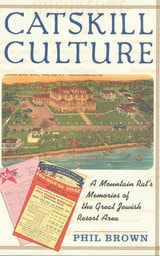
Catskill Culture
A Mountain Rat'S Memories OfPhil Brown
Temple University Press, 2003
A century ago, New Yorkers, hungry for mountain air, good food, and a Jewish environment combined with an American way of leisure, began to develop a resort area unique in the world. By the 1950s, this summer Eden of bungalow colonies, summer camps, and over 900 hotels had attracted over a million people a year. This was the Jewish Catskills of Sullivan and Ulster Counties.
Born to a small hotel-owning family who worked for decades in hotels after losing their own, Phil Brown tells a story of the many elements of this magical environment. His own waiter's tales, his mother's culinary exploits as a chef, and his father's jobs as maitre d' and coffee shop operator offer a backdrop to the vital life of Catskills summers. Catskill Culture recounts the life of guests, staff, resort owners,entertainers, and local residents through the author's memories and archival research and the memories of 120 others.
The Catskills resorts shaped American Jewish culture, enabling Jews to become more American while at the same time introducing the American public to immigrant Jewish culture. Catskills entertainment provided the nation with a rich supply of comedians, musicians, and singers. Legions of young men and women used the Catskills as a springboard to successful careers and marriages.
A decline for the resort area beginning in the 1970s has led to many changes. Today most of the hotels and bungalow colonies are gone or in ruins, while other communities, notably those of the Hasidim, have appeared. The author includes an appendix listing over 900 hotels he has been able to document and invites readers to contact him with additional entries.
[more]
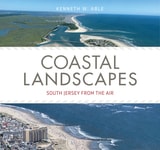
Coastal Landscapes
South Jersey from the AirKenneth W. Able
Rutgers University Press, 2023
New Jersey has roughly one hundred and thirty miles of coastline, including a wide array of habitats from marshes to ocean beaches, each hosting a unique ecosystem. Yet these coastal landscapes are quite dynamic, changing rapidly as a result of commercial development, environmental protection movements, and of course climate change. Now more than ever, it is vital to document these landscapes before they disappear.
Based on numerous aerial images from helicopter and drone flights between 2015 and 2021, this book provides extensive photographs and maps of the New Jersey coast, from the Pine Barrens to the ocean beaches. The text associated with each exceptional image describes it in detail, including its location, ecological setting, and relative position within the larger landscape. Author Kenneth Able, director of the Rutgers University Marine Field Station for over thirty years, has thoroughly ground-truthed each image by observations made through kayaks, boats, and wading through marshes. Calling upon his decades of expertise, Able paints a compelling portrait of coastal New Jersey’s stunning natural features, resources, history, and possible futures in an era of rising sea levels.
Based on numerous aerial images from helicopter and drone flights between 2015 and 2021, this book provides extensive photographs and maps of the New Jersey coast, from the Pine Barrens to the ocean beaches. The text associated with each exceptional image describes it in detail, including its location, ecological setting, and relative position within the larger landscape. Author Kenneth Able, director of the Rutgers University Marine Field Station for over thirty years, has thoroughly ground-truthed each image by observations made through kayaks, boats, and wading through marshes. Calling upon his decades of expertise, Able paints a compelling portrait of coastal New Jersey’s stunning natural features, resources, history, and possible futures in an era of rising sea levels.
[more]
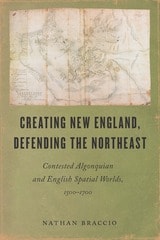
Creating New England, Defending the Northeast
Contested Algonquian and English Spatial Worlds, 1500–1700Nathan Braccio
University of Massachusetts Press, 2026
Examining maps and placemaking during negotiations between Indigenous people and colonial settlers
Between 1500 and 1700, Indigenous and English mapmakers across the North Atlantic depicted present-day New England in markedly distinct ways, highlighting how differently their communities understood the landscape. While English cartographers relied on new mathematics and other developing scientific knowledge from Europe, as well as an overhead perspective of the world, Algonquian mapmakers drew on deep knowledge of the landscape, derived from their communities’ long history upon it. Nathan Braccio refers to this phenomenon as “parallel landscapes.”
Creating New England, Defending the Northeast asserts that Algonquian knowledge of the landscape represented a powerful and persistent alternative to English surveying and mapmaking in the Northeast. When English colonists and explorers recognized the unsuitability of their techniques for understanding New England’s unfamiliar landscape, they attempted to appropriate Indigenous knowledge and maps. Algonquian sachems used this as an opportunity to control and benefit from their new English neighbors. Later, as the English became insecure in their dependence on Indigenous people, they began to remake and mark the landscape. Algonquians adapted, maintaining control of important spatial knowledge, even in a place no longer entirely of their making. This story complicates narratives of conquest and highlights the Indigenous spatial knowledge too often overlooked.
[more]
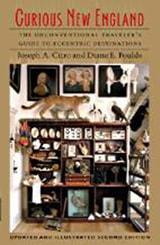
Curious New England
The Unconventional Traveler’s Guide to Eccentric DestinationsJoseph E. Citro and Diane E. Foulds
University Press of New England, 2004
New England is truly a Cabinet of Curiosities, and this indispensable guide directs you to its most bizarre, off the wall, and unsettling exhibits. Some evoke hilarity, some horror. Discover singing sand, glowing tombstones, ghostly squirrels, and a musical instrument said to cause madness. Marvel at the most mysterious manuscript in the world. Visit a miniature replica of the Holy Land or climb carved stone steps leading . . . nowhere. Curious New England points the way to all the tantalizing treats and terrifying treasures that remain tucked away in overlooked museums, private collections, and forgotten recesses of this very special region. *A cursed statue in Maine *Ageless American Megaliths *A window embedded in Vermont earth *Titus’s Arch on a New Hampshire hilltop *Artwork made from insect parts With precise directions, hours, and contact information, these fascinating pages reveal each mystery, miracle, and marvel, from world-class weirdness, to minor curiosities, to entertaining distractions. There'll be no more boring Sunday drives when you can visit a spider farm, explore the laboratory of “mad” scientist Wilhelm Reich, view the Hobo Hotel, and observe houses made from paper, wooden crates, mounds of earth—even covered bridges. And New England’s wonders never cease: discover evidence of manned flight a century before the Wright Brothers; visible phantoms manifesting from marble columns; and automobiles emerging from tarmac like dinosaurs from pits of tar. This one-of-a-kind collection spotlights all six New England states, illuminating everything that’s wicked, weird, and wonderful in every hidden corner of a region that rivals Old England in mysteries, miracles, and marvels.
[more]