Results by title
74 books match the query 'Paleontology' and 4 start with c
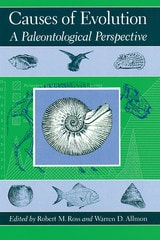
Causes of Evolution
A Paleontological PerspectiveEdited by Robert M. Ross and Warren D. Allmon
University of Chicago Press, 1990
By studying evolution across geological time, paleontologists gain a perspective that sometimes complements and sometimes conflicts with views based solely on studies of extant species. The contributors to Causes of Evolution consider whether factors exerting major influences on evolution are biotic or abiotic, intrinsic or extrinsic.
Causes of Evolution presents a broad sampling of paleontological research programs encompassing vertebrates, invertebrates, and vascular plants; empirical work and theoretical models; organisms ranging in age from Cambrian to Recent; and temporal scales from ecological time to hundreds of millions of years. The diverse array of research styles and opinions presented will acquaint scientists in related fields with the strengths and weaknesses of paleontology as an approach to evolutionary studies and will give evolutionary biologists of every stripe new bases for evaluating the scope and bias of their own work.
Causes of Evolution presents a broad sampling of paleontological research programs encompassing vertebrates, invertebrates, and vascular plants; empirical work and theoretical models; organisms ranging in age from Cambrian to Recent; and temporal scales from ecological time to hundreds of millions of years. The diverse array of research styles and opinions presented will acquaint scientists in related fields with the strengths and weaknesses of paleontology as an approach to evolutionary studies and will give evolutionary biologists of every stripe new bases for evaluating the scope and bias of their own work.
[more]
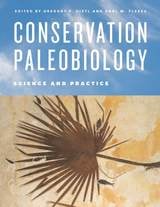
Conservation Paleobiology
Science and PracticeEdited by Gregory P. Dietl and Karl W. Flessa
University of Chicago Press, 2017
In conservation, perhaps no better example exists of the past informing the present than the return of the California condor to the Vermilion Cliffs of Arizona. Extinct in the region for nearly one hundred years, condors were successfully reintroduced starting in the 1990s in an effort informed by the fossil record—condor skeletal remains had been found in the area’s late-Pleistocene cave deposits. The potential benefits of applying such data to conservation initiatives are unquestionably great, yet integrating the relevant disciplines has proven challenging. Conservation Paleobiology gathers a remarkable array of scientists—from Jeremy B. C. Jackson to Geerat J. Vermeij—to provide an authoritative overview of how paleobiology can inform both the management of threatened species and larger conservation decisions.
Studying endangered species is difficult. They are by definition rare, some exist only in captivity, and for those still in their native habitats any experimentation can potentially have a negative effect on survival. Moreover, a lack of long-term data makes it challenging to anticipate biotic responses to environmental conditions that are outside of our immediate experience. But in the fossil and prefossil records—from natural accumulations such as reefs, shell beds, and caves to human-made deposits like kitchen middens and archaeological sites—enlightening parallels to the Anthropocene can be found that might serve as a primer for present-day predicaments. Offering both deep-time and near-time perspectives and exploring a range of ecological and evolutionary dynamics and taxa from terrestrial as well as aquatic habitats, Conservation Paleobiology is a sterling demonstration of how the past can be used to manage for the future, giving new hope for the creation and implementation of successful conservation programs.
Studying endangered species is difficult. They are by definition rare, some exist only in captivity, and for those still in their native habitats any experimentation can potentially have a negative effect on survival. Moreover, a lack of long-term data makes it challenging to anticipate biotic responses to environmental conditions that are outside of our immediate experience. But in the fossil and prefossil records—from natural accumulations such as reefs, shell beds, and caves to human-made deposits like kitchen middens and archaeological sites—enlightening parallels to the Anthropocene can be found that might serve as a primer for present-day predicaments. Offering both deep-time and near-time perspectives and exploring a range of ecological and evolutionary dynamics and taxa from terrestrial as well as aquatic habitats, Conservation Paleobiology is a sterling demonstration of how the past can be used to manage for the future, giving new hope for the creation and implementation of successful conservation programs.
[more]
Contributions from the Museum of Paleontology
Containing Papers Published between July 31, 1936, and July 1, 1939Edited by Eugene S. McCartney
University of Michigan Press, 1939
Containing papers published between July 31, 1936, and July 1, 1939, edited by Eugene S. McCartney and published by the University of Michigan Press in 1939, is a comprehensive compilation of influential paleontological research. Among the notable articles included are E. C. Case's study on a nothosaur from the Triassic of Wyoming, Chester A. Arnold's multi-part observations on fossil plants from the Devonian of Eastern North America, and K. G. Brill's description of Productella waynensis, a new brachiopod from the New Providence Shale of Kentucky. The volume also features detailed examinations such as Chester A. Arnold's work on some fossil species of Mavonia from Oregon, E. C. Case's analysis of a specimen of Stylemys nebrascensis showing the bones of the feet and limbs, and Andrew H. McNair's study on cryptostomatous bryozoa from the Middle Devonian Traverse Group of Michigan. Helen Duncan contributes with her research on trepostomatous bryozoa from the Traverse Group of Michigan, and John A. Wilson describes a new species of dog from the Miocene of Colorado. This collection is an invaluable resource for paleontologists and researchers dedicated to the study of fossil plants and animals, providing detailed descriptions and insights into ancient life forms and their geological contexts.
[more]
Contributions from the Museum of Paleontology
Containing Papers Published between November 10, 1928, and April 9, 1932Edited by Eugene S. McCartney
University of Michigan Press, 1932
Containing papers published between November 10, 1928, and April 9, 1932, features significant paleontological research. Edited by Eugene S. McCartney and published by the University of Michigan Press in 1932, this volume includes groundbreaking contributions such as E. C. Case's study on indications of a cotylosaur and a new form of fish from the Triassic beds of Texas, Aldred S. Warthin Jr.'s research on fossil fishes from the Triassic of Texas, and the collaborative work of Laurence M. Gould, Aug. F. Foerste, and Russell C. Hussey on the geology of Foxe Land, Baffin Island. Other notable entries include Russell C. Hussey's examination of cystoids from the Trenton Rocks of Michigan, E. C. Case's detailed description of the skeleton of Ostodolepis brevispinatus, and Aug. F. Foerste's studies on the color patterns of fossil cephalopods and brachiopods, as well as additional notes on nephritic erina. E. C. Case also provides insights into the lower jaw of Brachysuchus megalodon, arthrodiran remains from the Devonian of Michigan, limb movement patterns in phytosaurs, and the description of a new species of Buettneria. Chester A. Arnold discusses Calamites newberryi, while Charles F. Deiss offers a description and stratigraphic correlation of the Fenestellidae from the Devonian of Michigan. This volume is an invaluable resource for paleontologists and researchers interested in furthering their understanding of fossil organisms and geological history.
[more]