Results by title
96 books match the query 'Penology' and 8 start with c
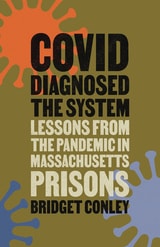
COVID Diagnosed the System
Lessons from the Pandemic in Massachusetts PrisonsBridget Conley
Rutgers University Press, 0
The American criminal justice system was in flux in 2020, a clash of possibilities for reform, retrenchment, and radical change—nowhere more so than in Massachusetts, which had just passed major criminal justice reform. The COVID-19 pandemic interrupted the moment with life-threatening force, ravaging people held in prisons and jails across the country. However, it did not so much create new deprivations and suffering as it exposed prisons as sites of physical, institutional, and psychological violence that do not make communities safer. At the same time, advocates for people in prisons—including many incarcerated and formerly incarcerated people—seized on the pandemic’s disruptions to demand change. Detailing the first year of the pandemic inside the Massachusetts state prison system, this book argues that the history of the pandemic inside prisons exposed both the cruelties of incarceration and the power of change when it is led by directly affected people.
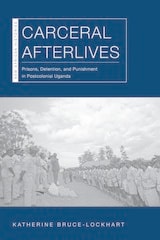
Carceral Afterlives
Prisons, Detention, and Punishment in Postcolonial UgandaKatherine Bruce-Lockhart
Ohio University Press, 2022
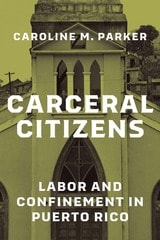
Carceral Citizens
Labor and Confinement in Puerto RicoCaroline M. Parker
University of Chicago Press, 2024
In Carceral Citizens, anthropologist Caroline M. Parker offers an ethnographic portrait of therapeutic communities in Puerto Rico, the oldest colony in the Americas. As nonprofits nested within the carceral state, therapeutic communities serve as reeducation and recovery centers for the mostly male drug offenders who serve out their sentences engaged in manual labor and prayer. The most surprising aspect of these centers, however, is that their “graduates” often remain long after the completion of their term, working as self-appointed peer counselors in a mixture of volunteer and low-wage positions.
Parker seeks to explain this dynamic by showing how, in these therapeutic communities, criminalized men find new and meaningful ways of living in the shadow of the prison. Through their participation in the day-to-day functioning of the centers, they discover and cultivate alternative forms of belonging, livelihood, and citizenship, despite living within the restrictions of the carceral state. Situating her study against the backdrop of Puerto Rico’s colonial history, and with findings that extend across Latin America, Parker challenges common assumptions about confinement, labor, and rehabilitation. By delving into lives shaped by the convergence of imperialism, the carceral state, and self-help, she offers a fresh understanding of the transformations of labor and social life brought about by mass incarceration.
Carceral Citizens
Labor and Confinement in Puerto RicoCaroline M. Parker
University of Chicago Press, 2024
In Carceral Citizens, anthropologist Caroline M. Parker offers an ethnographic portrait of therapeutic communities in Puerto Rico, the oldest colony in the Americas. As nonprofits nested within the carceral state, therapeutic communities serve as reeducation and recovery centers for the mostly male drug offenders who serve out their sentences engaged in manual labor and prayer. The most surprising aspect of these centers, however, is that their “graduates” often remain long after the completion of their term, working as self-appointed peer counselors in a mixture of volunteer and low-wage positions.
Parker seeks to explain this dynamic by showing how, in these therapeutic communities, criminalized men find new and meaningful ways of living in the shadow of the prison. Through their participation in the day-to-day functioning of the centers, they discover and cultivate alternative forms of belonging, livelihood, and citizenship, despite living within the restrictions of the carceral state. Situating her study against the backdrop of Puerto Rico’s colonial history, and with findings that extend across Latin America, Parker challenges common assumptions about confinement, labor, and rehabilitation. By delving into lives shaped by the convergence of imperialism, the carceral state, and self-help, she offers a fresh understanding of the transformations of labor and social life brought about by mass incarceration.
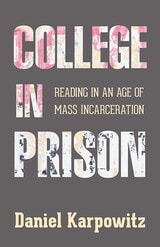
College in Prison
Reading in an Age of Mass IncarcerationKarpowitz, Daniel
Rutgers University Press, 2017
College in Prison chronicles how, since 2001, Bard College has provided hundreds of incarcerated men and women across the country access to a high-quality liberal arts education. Earning degrees in subjects ranging from Mandarin to advanced mathematics, graduates have, upon release, gone on to rewarding careers and elite graduate and professional programs. Yet this is more than just a story of exceptional individuals triumphing against the odds. It is a study in how the liberal arts can alter the landscape of some of our most important public institutions giving people from all walks of life a chance to enrich their minds and expand their opportunities.
Drawing on fifteen years of experience as a director of and teacher within the Bard Prison Initiative, Daniel Karpowitz tells the story of BPI’s development from a small pilot project to a nationwide network. At the same time, he recounts dramatic scenes from in and around college-in-prison classrooms pinpointing the contested meanings that emerge in moments of highly-charged reading, writing, and public speaking. Through examining the transformative encounter between two characteristically American institutions—the undergraduate college and the modern penitentiary—College in Prison makes a powerful case for why liberal arts education is still vital to the future of democracy in the United States.
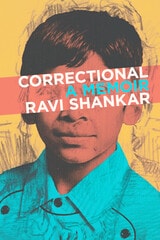
Correctional
Ravi Shankar
University of Wisconsin Press, 2021
Shankar’s bold and complex self-portrait—and portrait of America—challenges us to rethink our complicity in the criminal justice system and mental health policies that perpetuate inequity and harm. Correctional dives into the inner workings of his mind and heart, framing his unexpected encounters with law and order through the lenses of race, class, privilege, and his bicultural upbringing as the first and only son of South Indian immigrants. Vignettes from his early life set the scene for his spectacular fall and subsequent struggle to come to terms with his own demons. Many of them, it turns out, are also our own.

Crime and Justice, Volume 26
PrisonsEdited by Michael Tonry and Joan Petersilia
University of Chicago Press Journals, 1999
Featuring articles by Alfred Blumstein and Allen Beck, Joan Petersilia, Anthony Bottoms, Douglas McDonald and others, Prisons provides reliable, up-to-date, and comprehensive overviews of policy issues and research developments concerning prisons and imprisonment. This timely collection of essays will benefit scholars, administrators, and policy makers alike.
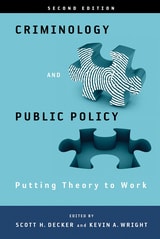
Criminology and Public Policy
Putting Theory to WorkScott H. Decker and Kevin A. Wright
Temple University Press, 2018
In the field of criminal justice, public policy is designed to address the problems brought on by criminal behavior and the response to that behavior. However, too often, the theories carefully developed in the academy fail to make their way into programs and policy. The editors and contributors to this second edition of Criminology and Public Policy highlight the recent development of “translational criminology” to address the growing movement in criminology to use the results of criminological research and theory to better inform policy and practice.
The essays in Criminology and Public Policy propose an in-depth look at both theory and practice and how they are integrated across a number of key criminal justice problems—from racial and environmental concerns to gun control and recidivism rates as well as police use of force and mass incarceration. The end result is an essential volume that blends both theory and practice in an effort to address the critical problems in explaining, preventing, responding to, and correcting criminal behavior.
Contributors include: Robert K. Ax, Michelle N. Block, Anthony A. Braga, Rod K. Brunson, Jennifer Carlson, Ronald V. Clarke, Shea Cronin, Megan Denver, Kevin M. Drakulich, Grant Duwe, Amy Farrell, Cheryl Jonson, Charis E. Kubrin, Justin Kurland, Megan Kurlychek, Shannon Magnuson, Daniel P. Mears, Robert D. Morgan, Kathleen Powell, Danielle Rudes, Cassia Spohn, Cody Telep, Natalie Todak, Glenn Trager, Jillian J. Turanovic, Sara Wakefield, Patricia Warren, David Weisburd, Michael D. White, Rob White, Lauren Wilson and the editors