Results by title
68 books match the query 'Performance art' and 6 start with c
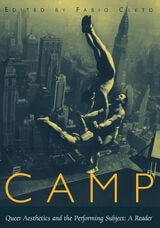
Camp
Queer Aesthetics and the Performing Subject--A ReaderFabio Cleto, Editor
University of Michigan Press, 1999
This groundbreaking collection addresses the multi-layered issue of camp, whose inexhaustible breadth of reference and theoretical relevance have made it one of the most salient and challenging issues on the contemporary critical stage. Reassessing the role and significance of the finest essays on camp written by leading intellectuals in cultural studies, lesbian and gay studies and queer theory, this critical anthology both "queers" camp as an issue and offers an excellent key to rethinking the history, theory, and practice of camp.
The anthology is divided into five thematic/historical sections: Tasting It; Flaunting the Closet; Gender, and Other Spectacles; Pop Camp, Surplus Counter-Value, or the Camp of Cultural Economy; and The Queer Issue. These groupings help the reader situate the critical debates around the subject. Fabio Cleto's introduction brings new theoretical insights to the subject of camp while tracing its history as an object of intellectual and cultural critique and analysis.
A comprehensive bibliography that traces the earliest use of the word 'camp' to the present completes this unique and exciting volume.
“Is ‘camp’ a kind of irony, an effect of one’s historic vantage point, an art form or an elitist aesthetic? … From landmark early works by Christopher Isherwood and Susan Sontag to influential contemporary pieces by Esther Newton, Andrew Ross and Judith Butler, this anthology encapsulates the philosophical discussion of this slippery postmodern concept.”
--Publishers Weekly
“As an object of critical inquiry, camp has proven notoriously difficult to define. Fabio Cleto takes this difficulty as his point of departure in the most recent anthology of a growing body of scholarly literature on the topic…Cleto resists defining camp [but] does not abandon the task of framing, in a coherent but flexible way, camp as a problematic.”
--Semiotica
“Fabio Cleto’s collection variously associates ‘camp’ with the 1960s, aestheticism, androgyny, cross-dressing, the cultural figure of the dandy, decadence, drag, exaggeration, kitsch, parody, pastiche, postmodernism, the sentimental, and the transvestite… The essayists in Camp disagree freely and fiercely over definitions. This is to be expected in a queer reader, one whose contributors endeavor to ‘read across’ the meanings of camp.”
--The Gay & Lesbian Review
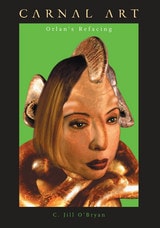
Carnal Art
Orlan’s RefacingC. Jill O'Bryan
University of Minnesota Press, 2005

Clairvoyance (For Those In The Desert)
Performance Pieces, 1979–2004Joanna Frueh
Duke University Press, 2008
Frueh’s performances are unabashedly autobiographical, as likely to reflect her scholarship as a feminist art historian as her love affairs or childhood memories. For Frueh, eros and self-love are part of a revolutionary feminist strategy; her work exemplifies the physicality and embrace of pleasure that she finds wanting in contemporary feminist theory. Scholarly and rigorous yet playful in tone, her performances are joyful, filled with eroticism, flowers, sexy costumes, and beautiful colors, textures, and scents. Recurring themes include Frueh’s passionate attachment to the desert landscape and the idea of transformation: a continual reaching for clarity of thought and feeling.
In an afterword as lyrical and breathless as her performance pieces, Frueh explores her identification with the desert and its influence on her art. Clairvoyance (For Those In The Desert) includes a detailed chronology of Frueh’s performances.
Contract With The Skin
Masochism, Performance Art, and the 1970sKathy O'Dell
University of Minnesota Press, 1998
Places masochistic performance within a social and historical context.
Having yourself shot. Putting out fires with your bare hands and feet. Biting your own body and photographing the marks. Sewing your own mouth shut. These seemingly aberrant acts were committed by performance artists during the 1970s. Why would anyone do these things? What do these kinds of masochistic performances tell us about the social and historical context in which they occurred? Fascinating and accessibly written, Contract with the Skin addresses such questions through a reconsideration of these acts in relation to psychoanalytic and legal concepts of masochism.
O’Dell argues that the growth of masochistic performance during the 1970s must be seen in the context of society’s response to the Vietnam War and contemporaneous changes in theories of contract. She contends that the dynamic that exists between audience and performer during these masochistic acts relates to tensions resulting from ruptures in the social contract. Indeed, as the war in Vietnam waned, so did masochistic performance, only to reemerge in the 1980s in relation to the “war on AIDS” and the censorious “culture wars.”Focusing on 1970s performance artists Vito Acconci, Chris Burden, Gina Pane, and collaborators Marina Abramovi´c/Ulay as well as those with similar sensibilities from the late 1980s onward (Bob Flanagan, David Wojnarowicz, Simon Leung, Catherine Opie, Ron Athey, Lutz Bacher, and Robby Garfinkel), O’Dell provides photographic documentation of performances and quotations from interviews with many of the artists. Throughout, O’Dell asks what we can do about the institutionalized forms of masochism for which these performances are metaphors. Contract with the Skin is a provocative guide to this little-studied area, and offers new ways of thinking about performance art and artistic production.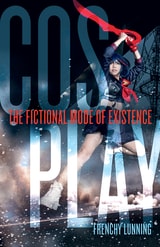
Cosplay
The Fictional Mode of ExistenceFrenchy Lunning
University of Minnesota Press, 2022
An exploration of cosplay and its relationship with the realms of its global fandom, performance, and the modes of fictional existence
Flourishing far beyond its Japanese roots, cosplay has become an international phenomenon with fervid fans who gather at enormous, worldwide conventions annually. Here, author Frenchy Lunning offers an intimate, sensational tour through cosplay’s past and present, as well as its global lure.
Through a culmination of years of personal research on cosplay, and growing out of Lunning’s wealth of scholarship, conference presentations, and cosplayer interviews, Cosplay is a unique and necessary examination of identity, performance, play, and otaku fandom and culture in relation to contemporary theories. With discussions covering construction, masquerades, and community through performance, Lunning presents cosplay as a dynamic and ever-evolving global practice. She combines the fascinating viewpoints of cosplayers with observational, in-depth research on cosplay history and practice, and a deep dive into critical theory involving the modes of fictional existence, in order to understand its global expansion.
Augmented with beautiful photographs, this is an engrossing, lively read that explores a complicated and often misunderstood history and meditates on how cosplay allows its participants to create and construct meaning and identity.
Curating the Commons
Socially Engaged Public ArtKatia Arfara
University of Michigan Press, 2025
By sharing critical insights, Arfara immerses the reader in the working processes of artists and collectives, showing how public art can address ecosocial concerns in aesthetic forms. Curating the Commons offers a grounded perspective on the making of cutting-edge, socially engaged public artworks and contributes to the larger effort to craft more-than-human narratives in response to global events.