130 books match the query 'Philosophers' and 10 start with c
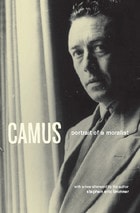
cover of Camus: Portrait of a Moralist

Camus

Portrait of a Moralist

Stephen Eric Bronner

University of Chicago Press, 2009

Decades after his death, Albert Camus (1913–1960) is still regarded as one of the most influential and fascinating intellectuals of the twentieth century. This biography by Stephen Eric Bronner explores the connections between his literary work, his philosophical writings, and his politics.

Camus illuminates his impoverished childhood, his existential concerns, his activities in the antifascist resistance, and the controversies in which he was engaged. Beautifully written and incisively argued, this study offers new insights—and above all—highlights the contemporary relevance of an extraordinary man.

“A model of a kind of intelligent writing that should be in greater supply. Bronner manages judiciously to combine an appreciation for the strengths of Camus and nonrancorous criticism of his weaknesses. . . . As a personal and opinionated book, it invites the reader into an engaging and informative dialogue.”—American Political Science Review


“This concise, lively, and remarkably evenhanded treatment of the life and work of Albert Camus weaves together biography, philosophical analysis, and political commentary.”—Science & Society
[more]
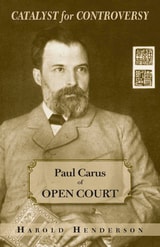
cover of Catalyst for Controversy: Paul Carus of Open Court

Catalyst for Controversy

Paul Carus of Open Court

Harold Henderson

Southern Illinois University Press, 2009

"I am not a common atheist; I am an atheist who loves God."—Paul Carus, "The God of Science," 1904

In the summer of 1880, while teaching at the military academy of the Royal Corps of Cadets of Saxony in Dresden, Paul Carus published a brief pamphlet denying the literal truth of scripture and describing the Bible as a great literary work comparable to the Odyssey.

This unremarkable document was Carus’s first step in a wide-ranging intellectual voyage in which he traversed philosophy, science, religion, mathematics, history, music, literature, and social and political issues. The Royal Corps, Carus later reported, found his published views "not in harmony with the Christian spirit, in accordance with which the training and education of the Corps of Cadets should be conducted." And so the corps offered the young teacher the choice of asking "most humbly for forgiveness for daring to have an opinion of my own and to express it, perhaps even promise to publish nothing more on religious matters, or to give up my post. I chose the latter. . . . There was thus no other choice for me but to emigrate and, trusting in my own powers, to establish for myself a new home." His resignation was effective on Easter Sunday, 1881.

Carus toured the Rhine, lived briefly in Belgium, and taught in a military college in England to learn English well enough to "thrive in the United States." By late 1884 or early 1885 he was on his way to the New World. Thriving in the United States proved more difficult than it had in England, but before 1885 ended he had published his first philosophical work in English, Monism and Meliorism. The book was not widely read, but it did reach Edward C. Hegeler, a La Salle, Illinois, zinc processor who became his father-in-law as well as his ideological and financial backer.

Established in La Salle, Carus began the work that would place him among the prominent American philosophers of his day and make the Open Court Publishing Company a leading publisher of philosophical, scientific, and religious books. He edited The Open Court and The Monist, offering the finest view of Oriental thought and religion then available in the West, and sought unsuccessfully to bring about a second World Parliament of Religions. He befriended physicist-philosopher Ernst Mach. For eleven years he employed D. T. Suzuki, who later became a great Zen Buddhist teacher. He published more articles by Charles S. Peirce, now viewed as one of the great world philosophers, in The Monist than appeared in any other publication.

Biographer Harold Henderson concludes his study of this remarkable man: "Whenever anyone is so fired with an idea that he or she can’t wait to write it down, there the spirit of Paul Carus remains, as he would have wished, active in the world."
[more]
cover of Conscience and Community: Sterling M. McMurrin, Obert C. Tanner, and Lowell L. Bennion

Conscience and Community

Sterling M. McMurrin, Obert C. Tanner, and Lowell L. Bennion

Edited by Robert Alan Goldberg, L. Jackson Newell, and Linda K. Newell

University of Utah Press, 2018

Lowell Bennion, Sterling McMurrin, and Obert Tanner were colleagues whose lives often intertwined. All professors at the University of Utah, these three scholars addressed issues and events of their time; each influenced the thought and culture of Mormonism, helping to institute a period of intellectual life and social activism. In Conscience and Community multiple scholars, family members, and others look at the private and public aspects of three lives and examine the roles they played in shaping their communities inside and out of their university and church.
 
Lowell Bennion was founding director of the LDS Institute of Religion and professor of sociology at the University of Utah. He established multiple community service entities. Sterling McMurrin was distinguished professor of philosophy and history, dean of the graduate school, and former commissioner of education under JFK. He dismissed dogma and doctrine as barriers to a search for moral and spiritual understanding. Obert Tanner, also of the university’s Philosophy Department, excelled in teaching and business and became especially well known for philanthropy. The lives and work of these three men reveal the tensions between faith and reason, conscience and obedience. Their stories speak to us today because their concerns remain our concerns: racial justice, women’s equality, gay rights, and the meaning of integrity and conscience. 
[more]
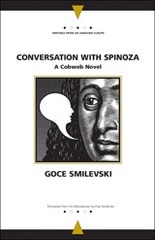
cover of Conversation with Spinoza: A Cobweb Novel

Conversation with Spinoza

A Cobweb Novel

Goce Smilevski

Northwestern University Press, 2006

Prizing ideas above all else, radical thinker Baruch Spinoza left little behind in the way of personal facts and furnishings. But what of the tug of necessity, the urgings of the flesh, to which this genius philosopher (and grinder of lenses) might have been no more immune than the next man-or the next character, as Baruch Spinoza becomes in this intriguing novel by the remarkable young Macedonian author Goce Smilevski.

Smilevski's novel brings the thinker Spinoza and his inner life into conversation with the outer, all-too-real facts of his life and his day--from his connection to the Jewish community of Amsterdam, his excommunication in 1656, and the emergence of his philosophical system to his troubling feelings for his fourteen-year-old Latin teacher Clara Maria van den Enden and later his disciple Johannes Casearius. From this conversation there emerges a compelling and complex portrait of the life of an idea--and of a man who tries to live that idea.
[more]
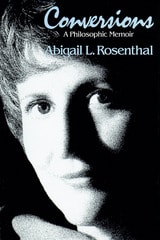
cover of Conversions

Conversions

Abigail Rosenthal

Temple University Press, 1995
Conversions: A Philosophic Memoir belongs to the tradition of Augustine and Rousseau: the "confession" of a life that is a quest for truth. It is in large part the story of two major episodes from Abigail Rosenthal's early adulthood, bought putting personal identity dramatically at risk. As a young Fulbright scholar in Paris, Rosenthal met and entered reluctantly into a love affair with a young Greek communist philosopher who believed (along with many Parisian intellectuals of that era) that force and deception were justified by a utopian vision of world history. In the inevitable collision of values--between Jew and Greek, liberal and revolutionary, theist and atheist, woman and man in unequal truggle--they separated. Suffering in the aftermath, she at last turned for help to a young African American woman graduate student whom she met in London. This woman's Gnostic Christian rejection of personal and cultural history eventually left Rosenthal without defense against her new mentor's remarkable use of charisma, ridicule, and moralistic reproach to usurp the author's life story. These stratagems of mind control reached a climactic phase in Portugal, where the two went--Rosenthal to paint the other woman to write--in what would turn out to be the terrifying reverse of a summer idyll. With the U.S. State Department, the Portuguese Policía Internacional devised an extraordinary rescue. This arresting narrative, which deals with relations between blacks and whites, Christians and Jews, and men and women, delivers its own philosophic theory of the individual in history. "Rosenthal's work belongs to the classical tradition of the life that is a quest for truth. Pertinent to the genre is its relation to the tradition of Augustine and Rousseau. She is also anti-Augustinian in that her depiction of history is oriented by the standpoint of Judaism rather than Christianity and is bound up with a quest for the historical realization of justice. "The first of the two episodes she recounts is a love affair (entered into reluctantly) with a young Greek communist philosopher whom she met in Paris while a Fulbright student in the late 1950s. The second, darker, episode is a later Pygmalion-like involvement with an African American woman graduate student whom Rosenthal first encountered in London, where she worked on a Hegel dissertation, and with whom she entered into a life-threatening reverse, as it were, idyll in a small Portuguese village. The saga is replete with details that could have been dreamt up by Le Carre: Salazar's Portugal, its intelligence arm, the U.S. State Department. Her depiction of these complex relations raises in unsettling ways the question of what counts as freedom, as racism, as terror. "Her in-passing observations about analytic philosophy, existentialism, and postmodernism (and I am far from being in her camp on many issues) are worth the price of the book. Hers is an original philosophic mind." --Edith Wyschogrod, 1993 President of the American Academy of Religion and Jay Newton Rayzor Professor of Philosophy and Religious Thought, Rice University
[more]
cover of Correspondence of Jeremy Bentham Volume 5: January 1794 to December 1797

Correspondence of Jeremy Bentham Volume 5

January 1794 to December 1797

Jeremy Bentham, edited by Alexander Taylor Milne, and series edited by J.H. Burns

University College London, 2017
The first five volumes of the Correspondence of Jeremy Bentham contain more than 1,300 letters written to and from Bentham over fifty years, beginning in 1752 at the age of three and ending in 1797 with correspondence concerning his attempts to set up a national plan for the provision of poor relief. The letters in Volume 1 (1752-1776) document his difficult relationship with his father—Bentham lost five infant siblings and his mother—and his increasing attachment to his surviving brother, Samuel. We also see an early glimpse of Bentham’s education, as he committed himself to philosophy and legal reform. The exchanges in Volume 2 (1777-1780) cover a major event: a trip by Samuel to Russia. This volume also reveals Bentham working intensively on the development of a code of penal law, enhancing his reputation as a legal thinker. Volume 3 (1781-1788) shows that despite developing a host of original ideas, Bentham actually published little during this time. Nevertheless, this volume also reveals how the foundations were being laid for the rise of Benthamite utilitarianism. The letters in Volume 4 (1788-1793) coincide with the publication of An Introduction to the Principles of Morals and Legislation, which had little impact at the time. In 1791 he published The Panopticon: or, The Inspection-House, which he proposed the building of a circular penitentiary house. Bentham’s letters unfold against the backdrop of the French Revolution and show that his initial sympathy for France began to turn into hostility. Bentham’s life during the years in Volume 5 (1794-1797) was dominated by the panopticon, both as a prison and as an indigent workhouse. The letters in this volume document in great detail Bentham’s attempt to build a panopticon prison in London, and the opposition he faced from local aristocratic landowners. 
[more]
cover of Correspondence of Jeremy Bentham, Volume 1: 1752 to 1776

Correspondence of Jeremy Bentham, Volume 1

1752 to 1776

Jeremy Bentham, edited by Timothy L. S. Sprigge, and series edited by J.H. Burns

University College London, 2017
The first five volumes of the Correspondence of Jeremy Bentham contain more than 1,300 letters written to and from Bentham over fifty years, beginning in 1752 at the age of three and ending in 1797 with correspondence concerning his attempts to set up a national plan for the provision of poor relief. The letters in Volume 1 (1752-1776) document his difficult relationship with his father—Bentham lost five infant siblings and his mother—and his increasing attachment to his surviving brother, Samuel. We also see an early glimpse of Bentham’s education, as he committed himself to philosophy and legal reform. The exchanges in Volume 2 (1777-1780) cover a major event: a trip by Samuel to Russia. This volume also reveals Bentham working intensively on the development of a code of penal law, enhancing his reputation as a legal thinker. Volume 3 (1781-1788) shows that despite developing a host of original ideas, Bentham actually published little during this time. Nevertheless, this volume also reveals how the foundations were being laid for the rise of Benthamite utilitarianism. The letters in Volume 4 (1788-1793) coincide with the publication of An Introduction to the Principles of Morals and Legislation, which had little impact at the time. In 1791 he published The Panopticon: or, The Inspection-House, which he proposed the building of a circular penitentiary house. Bentham’s letters unfold against the backdrop of the French Revolution and show that his initial sympathy for France began to turn into hostility. Bentham’s life during the years in Volume 5 (1794-1797) was dominated by the panopticon, both as a prison and as an indigent workhouse. The letters in this volume document in great detail Bentham’s attempt to build a panopticon prison in London, and the opposition he faced from local aristocratic landowners. 
[more]
cover of Correspondence of Jeremy Bentham, Volume 2: 1777 to 1780

Correspondence of Jeremy Bentham, Volume 2

1777 to 1780

Jeremy Bentham, edited by Timothy L. S. Sprigge, and series edited by J.H. Burns

University College London, 2017
The first five volumes of the Correspondence of Jeremy Bentham contain more than 1,300 letters written to and from Bentham over fifty years, beginning in 1752 at the age of three and ending in 1797 with correspondence concerning his attempts to set up a national plan for the provision of poor relief. The letters in Volume 1 (1752-1776) document his difficult relationship with his father—Bentham lost five infant siblings and his mother—and his increasing attachment to his surviving brother, Samuel. We also see an early glimpse of Bentham’s education, as he committed himself to philosophy and legal reform. The exchanges in Volume 2 (1777-1780) cover a major event: a trip by Samuel to Russia. This volume also reveals Bentham working intensively on the development of a code of penal law, enhancing his reputation as a legal thinker. Volume 3 (1781-1788) shows that despite developing a host of original ideas, Bentham actually published little during this time. Nevertheless, this volume also reveals how the foundations were being laid for the rise of Benthamite utilitarianism. The letters in Volume 4 (1788-1793) coincide with the publication of An Introduction to the Principles of Morals and Legislation, which had little impact at the time. In 1791 he published The Panopticon: or, The Inspection-House, which he proposed the building of a circular penitentiary house. Bentham’s letters unfold against the backdrop of the French Revolution and show that his initial sympathy for France began to turn into hostility. Bentham’s life during the years in Volume 5 (1794-1797) was dominated by the panopticon, both as a prison and as an indigent workhouse. The letters in this volume document in great detail Bentham’s attempt to build a panopticon prison in London, and the opposition he faced from local aristocratic landowners. 
[more]
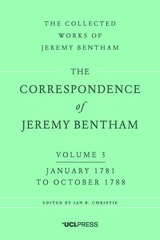
cover of Correspondence of Jeremy Bentham, Volume 3: January 1781 to October 1788

Correspondence of Jeremy Bentham, Volume 3

January 1781 to October 1788

Jeremy Bentham, edited by Ian R. Christie, and series edited by J.H. Burns

University College London, 2017
The first five volumes of the Correspondence of Jeremy Bentham contain more than 1,300 letters written to and from Bentham over fifty years, beginning in 1752 at the age of three and ending in 1797 with correspondence concerning his attempts to set up a national plan for the provision of poor relief. The letters in Volume 1 (1752-1776) document his difficult relationship with his father—Bentham lost five infant siblings and his mother—and his increasing attachment to his surviving brother, Samuel. We also see an early glimpse of Bentham’s education, as he committed himself to philosophy and legal reform. The exchanges in Volume 2 (1777-1780) cover a major event: a trip by Samuel to Russia. This volume also reveals Bentham working intensively on the development of a code of penal law, enhancing his reputation as a legal thinker. Volume 3 (1781-1788) shows that despite developing a host of original ideas, Bentham actually published little during this time. Nevertheless, this volume also reveals how the foundations were being laid for the rise of Benthamite utilitarianism. The letters in Volume 4 (1788-1793) coincide with the publication of An Introduction to the Principles of Morals and Legislation, which had little impact at the time. In 1791 he published The Panopticon: or, The Inspection-House, which he proposed the building of a circular penitentiary house. Bentham’s letters unfold against the backdrop of the French Revolution and show that his initial sympathy for France began to turn into hostility. Bentham’s life during the years in Volume 5 (1794-1797) was dominated by the panopticon, both as a prison and as an indigent workhouse. The letters in this volume document in great detail Bentham’s attempt to build a panopticon prison in London, and the opposition he faced from local aristocratic landowners. 
[more]
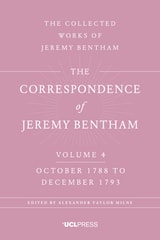
cover of Correspondence of Jeremy Bentham, Volume 4: October 1788 to December 1793

Correspondence of Jeremy Bentham, Volume 4

October 1788 to December 1793

Jeremy Bentham, edited by Alexander Taylor Milne, and general editor John R. Dinwiddy

University College London, 2017

The first five volumes of the Correspondence of Jeremy Bentham contain more than 1,300 letters written to and from Bentham over fifty years, beginning in 1752 at the age of three and ending in 1797 with correspondence concerning his attempts to set up a national plan for the provision of poor relief. The letters in Volume 1 (1752-1776) document his difficult relationship with his father—Bentham lost five infant siblings and his mother—and his increasing attachment to his surviving brother, Samuel. We also see an early glimpse of Bentham’s education, as he committed himself to philosophy and legal reform. The exchanges in Volume 2 (1777-1780) cover a major event: a trip by Samuel to Russia. This volume also reveals Bentham working intensively on the development of a code of penal law, enhancing his reputation as a legal thinker. Volume 3 (1781-1788) shows that despite developing a host of original ideas, Bentham actually published little during this time. Nevertheless, this volume also reveals how the foundations were being laid for the rise of Benthamite utilitarianism. The letters in Volume 4 (1788-1793) coincide with the publication of An Introduction to the Principles of Morals and Legislation, which had little impact at the time. In 1791 he published The Panopticon: or, The Inspection-House, in which he proposed the building of a circular penitentiary house. Bentham’s letters unfold against the backdrop of the French Revolution and show that his initial sympathy for France began to turn into hostility. Bentham’s life during the years in Volume 5 (1794-1797) was dominated by the panopticon, both as a prison and as an indigent workhouse. The letters in this volume document in great detail Bentham’s attempt to build a panopticon prison in London, and the opposition he faced from local aristocratic landowners. 
[more]