Results by title
103 books match the query 'Philosophy, Modern' and 7 start with c
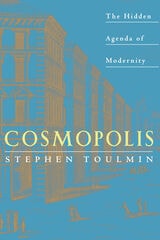
Cosmopolis
The Hidden Agenda of ModernityStephen Toulmin
University of Chicago Press, 1992
A daring account of the philosophical development of the idea of a rational society and its consequences for the present
In the seventeenth century, a vision arose which was to captivate the Western imagination for the next three hundred years: the vision of Cosmopolis, a society as rationally ordered as the Newtonian view of nature. While fueling extraordinary advances in all fields of human endeavor, this vision perpetuated a hidden yet persistent agenda: the delusion that human nature and society could be fitted into precise and manageable rational categories. Stephen Toulmin confronts that agenda—its illusions and its consequences for our present and future world.
In the seventeenth century, a vision arose which was to captivate the Western imagination for the next three hundred years: the vision of Cosmopolis, a society as rationally ordered as the Newtonian view of nature. While fueling extraordinary advances in all fields of human endeavor, this vision perpetuated a hidden yet persistent agenda: the delusion that human nature and society could be fitted into precise and manageable rational categories. Stephen Toulmin confronts that agenda—its illusions and its consequences for our present and future world.
[more]
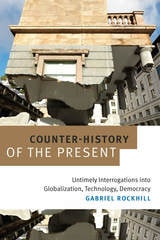
Counter-History of the Present
Untimely Interrogations into Globalization, Technology, DemocracyGabriel Rockhill
Duke University Press, 2017
In Counter-History of the Present Gabriel Rockhill contests, dismantles, and displaces one of the most widespread understandings of the contemporary world: that we are all living in a democratized and globalized era intimately connected by a single, overarching economic and technological network. Noting how such a narrative fails to account for the experiences of the billions of people who lack economic security, digital access, and real political power, Rockhill interrogates the ways in which this grand narrative has emerged in the same historical, economic, and cultural context as the fervid expansion of neoliberalism. He also critiques the concurrent valorization of democracy, which is often used to justify U.S. military interventions on the behalf of capital. Developing an alternative account of the current conjuncture that acknowledges the plurality of lived experiences around the globe and in different social strata, he shifts the foundations upon which debates about the contemporary world can be staged. Rockhill's counter-history thereby offers a new grammar for historical narratives, creating space for the articulation of futures no longer engulfed in the perpetuation of the present.
[more]

Crash Cultures
Modernity, Mediation and the MaterialEdited by Jane Arthurs and Iain Grant
Intellect Books, 1995
Since Diana's car crash in August 1997, media interest in the crash as an event needing explanation has proliferated. A glut of documentaries on television have investigated the social and scientific history of our responses to the car crash, as well as showing the personal impact of the crash on individual lives.
In trying to give meaning to one celebrity crash, the more general significance of the car crash, its challenge to rational control or explanation, its disregard for the subject and its will, became the focus for attention. Coincidentally, the two most newsworthy films of 1997 were David Cronenberg's Crash and James Cameron's Titanic, both of which generated intense popular interest.
The principal purpose of this collection of essays is to subject texts, within which crashes figure, to well-defined cultural study. The themes that emerge from this collection, which is truly experimental in attempting to draw together the resources for a cultural study of events, are many and varied. Moreover, they vary in format, in order to bring as many modes of address as possible to bear on the crashes that catastrophically and fantastically punctuate the fabric of everyday life.
[more]
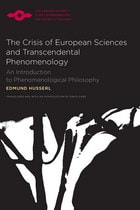
Crisis of European Sciences and Transcendental Phenomenology
Edmund Husserl
Northwestern University Press, 1970
The Crisis of European Sciences and Transcendental Phenomenology, Husserl's last great work, is important both for its content and for the influence it has had on other philosophers. In this book, which remained unfinished at his death, Husserl attempts to forge a union between phenomenology and existentialism.
Husserl provides not only a history of philosophy but a philosophy of history. As he says in Part I, "The genuine spiritual struggles of European humanity as such take the form of struggles between the philosophies, that is, between the skeptical philosophies--or nonphilosophies, which retain the word but not the task—and the actual and still vital philosophies. But the vitality of the latter consists in the fact that they are struggling for their true and genuine meaning and thus for the meaning of a genuine humanity."
Husserl provides not only a history of philosophy but a philosophy of history. As he says in Part I, "The genuine spiritual struggles of European humanity as such take the form of struggles between the philosophies, that is, between the skeptical philosophies--or nonphilosophies, which retain the word but not the task—and the actual and still vital philosophies. But the vitality of the latter consists in the fact that they are struggling for their true and genuine meaning and thus for the meaning of a genuine humanity."
[more]
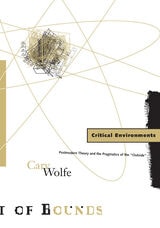
Critical Environments
Postmodern Theory and the Pragmatics of the “Outside”Cary Wolfe
University of Minnesota Press, 1998
Argues for a pragmatist orientation for postmodern theory.
Taking up the problem that has stalled contemporary theory—its treatment of the object of knowledge, the “outside,” as nothing but what a particular discourse makes of it—this book suggests a solution: a reinvigorated, posthumanist form of pragmatism.
Author Cary Wolfe investigates three of the most significant strains of postmodern theory (pragmatism, systems theory, and poststructuralism) and shows how each confronts the specter of an “outside” not wholly constituted by discourses, language games, and interpretive communities. He then assesses these confrontations in light of an essentially pragmatic view of theory, one that constantly asks what practical and material difference it makes, and to whom, how these issues are negotiated. Wolfe concludes by comparing the pragmatist view of the relation of theory to politics with important work in contemporary post-Marxism. In arguing for a pragmatist orientation for postmodern theory, Wolfe deploys continental critical theory to avoid the nativism and “American exceptionalism” that has traditionally accompanied pragmatist philosophy. Unique in its collation of major theorists rarely considered together, Critical Environments incorporates detailed discussions of the work of Richard Rorty, Walter Benn Michaels, Stanley Cavell, Humberto Maturana, Francisco Varela, Niklas Luhmann, Michel Foucault, Gilles Deleuze, Fredric Jameson, and others, and ranges across fields from feminist philosophy of science to the theory of ideology. Wolfe draws on recent work in systems theory to articulate a properly postmodern pragmatism. In doing so, he offers American readers a detailed introduction to systems theory, which he situates and critiques in the broader context of philosophical pragmatism, the theory of democratic social antagonism, and materialist theories of ideology, knowledge, and power. An answer to the widespread charge of relativism leveled against postmodern theory, his work will enhance and inspire new kinds of critical thought.[more]
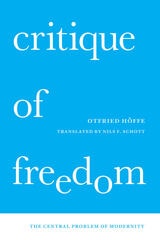
Critique of Freedom
The Central Problem of ModernityOtfried Höffe
University of Chicago Press, 2020
In this ambitious book, philosopher Otfried Höffe provides a sophisticated account of the principle of freedom and its role in the project of modernity. Höffe addresses a set of complex questions concerning the possibility of political justice and equity in the modern world, the destruction of nature, the dissolving of social cohesion, and the deregulation of uncontrollable markets. Through these considerations, he shows how the idea of freedom is central to modernity, and he assesses freedom’s influence in a number of cultural dimensions, including the natural, economic and social, artistic and scientific, political, ethical, and personal-metaphysical.
Neither rejecting nor defending freedom and modernity, he instead explores both from a Kantian point of view, looking closely at the facets of freedom’s role and the fundamental position it has taken at the heart of modern life. Expanding beyond traditional philosophy, Critique of Freedom develops the building blocks of a critical theory of technology, environmental protection, economics, politics, medicine, and education. With a sophisticated yet straightforward style, Höffe draws on a range of disciplines in order to clearly distinguish and appreciate the many meanings of freedom and the indispensable role they play in liberal society.
Neither rejecting nor defending freedom and modernity, he instead explores both from a Kantian point of view, looking closely at the facets of freedom’s role and the fundamental position it has taken at the heart of modern life. Expanding beyond traditional philosophy, Critique of Freedom develops the building blocks of a critical theory of technology, environmental protection, economics, politics, medicine, and education. With a sophisticated yet straightforward style, Höffe draws on a range of disciplines in order to clearly distinguish and appreciate the many meanings of freedom and the indispensable role they play in liberal society.
[more]
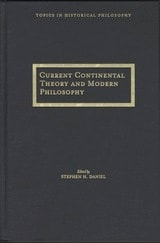
Current Continental Theory and Modern Philosophy
Stephen Daniel
Northwestern University Press, 2006
For decades Continental theorists from Derrida to Deleuze have engaged in provocative, penetrating, and often extensive examinations of modern philosophers-studies that have opened up new ways to think about figures such as Descartes, Spinoza, Leibniz, Locke, Hume, Rousseau, and Kant. This volume, for the first time, gives this work its due. A systematic rereading of early modern philosophers in the light of recent Continental philosophy, it exposes overlooked but critical aspects of sixteenth- through eighteenth-century philosophy even as it brings to light certain historical assumptions that have colored-and distorted-our understanding of modernist thought. This volume thus retrieves modern thinkers from the modernistic ways in which they have been portrayed since the nineteenth century; at the same time, it enhances our view of the roots and concerns of current Continental thought.
What claims does the early modern period have on contemporary philosophy? How have recent theorists engaged this material, and why? In answer, some of these essays explore how major Continental theorists such as Derrida, Deleuze, Le Doeuff, Irigaray, Kristeva, and Althusser explicate the ideas of classical modern thinkers; others draw on recent Continental insights to examine the doctrines of modern philosophers beginning with Machiavelli and ending with Kant. Together they show how current Continental theory reinvigorates the study of the history of modern philosophers by transforming not only how we interpret their answers to certain questions, but also how we understand the very nature of these questions.
What claims does the early modern period have on contemporary philosophy? How have recent theorists engaged this material, and why? In answer, some of these essays explore how major Continental theorists such as Derrida, Deleuze, Le Doeuff, Irigaray, Kristeva, and Althusser explicate the ideas of classical modern thinkers; others draw on recent Continental insights to examine the doctrines of modern philosophers beginning with Machiavelli and ending with Kant. Together they show how current Continental theory reinvigorates the study of the history of modern philosophers by transforming not only how we interpret their answers to certain questions, but also how we understand the very nature of these questions.
[more]