Results by title
210 books match the query 'Philosophy, Theory & Social Aspects' and 9 start with c
Cancel Wars
How Universities Can Foster Free Speech, Promote Inclusion, and Renew DemocracySigal R. Ben-Porath
University of Chicago Press, 2023
College campuses have become flashpoints of the current culture war and, consequently, much ink has been spilled over the relationship between universities and the cultivation or coddling of young American minds. Philosopher Sigal R. Ben-Porath takes head-on arguments that infantilize students who speak out against violent and racist discourse on campus or rehash interpretations of the First Amendment. Ben-Porath sets out to demonstrate the role of the university in American society and, specifically, how it can model free speech in ways that promote democratic ideals.
In Cancel Wars, she argues that the escalating struggles over “cancel culture,” “safe spaces,” and free speech on campus are a manifestation of broader democratic erosion in the United States. At the same time, she takes a nuanced approach to the legitimate claims of harm put forward by those who are targeted by hate speech. Ben-Porath’s focus on the boundaries of acceptable speech (and on the disproportional impact that hate speech has on marginalized groups) sheds light on the responsibility of institutions to respond to extreme speech in ways that proactively establish conversations across difference. Establishing these conversations has profound implications for political discourse beyond the boundaries of collegiate institutions. If we can draw on the truth, expertise, and reliable sources of information that are within the work of academic institutions, we might harness the shared construction of knowledge that takes place at schools, colleges, and universities against truth decay. Of interest to teachers and school leaders, this book shows that by expanding and disseminating knowledge, universities can help rekindle the civic trust that is necessary for revitalizing democracy.
Cancel Wars
How Universities Can Foster Free Speech, Promote Inclusion, and Renew DemocracySigal R. Ben-Porath
University of Chicago Press, 2023
An even-handed exploration of the polarized state of campus politics that suggests ways for schools and universities to encourage discourse across difference.
College campuses have become flashpoints of the current culture war and, consequently, much ink has been spilled over the relationship between universities and the cultivation or coddling of young American minds. Philosopher Sigal R. Ben-Porath takes head-on arguments that infantilize students who speak out against violent and racist discourse on campus or rehash interpretations of the First Amendment. Ben-Porath sets out to demonstrate the role of the university in American society and, specifically, how it can model free speech in ways that promote democratic ideals.
In Cancel Wars, she argues that the escalating struggles over “cancel culture,” “safe spaces,” and free speech on campus are a manifestation of broader democratic erosion in the United States. At the same time, she takes a nuanced approach to the legitimate claims of harm put forward by those who are targeted by hate speech. Ben-Porath’s focus on the boundaries of acceptable speech (and on the disproportional impact that hate speech has on marginalized groups) sheds light on the responsibility of institutions to respond to extreme speech in ways that proactively establish conversations across difference. Establishing these conversations has profound implications for political discourse beyond the boundaries of collegiate institutions. If we can draw on the truth, expertise, and reliable sources of information that are within the work of academic institutions, we might harness the shared construction of knowledge that takes place at schools, colleges, and universities against truth decay. Of interest to teachers and school leaders, this book shows that by expanding and disseminating knowledge, universities can help rekindle the civic trust that is necessary for revitalizing democracy.
Capital of Mind
The Idea of a Modern American UniversityAdam R. Nelson
University of Chicago Press, 2024
Capital of Mind is the second volume in a breathtakingly ambitious new economic history of American higher education. Picking up from the first volume, Exchange of Ideas, Adam R. Nelson looks at the early decades of the nineteenth century, explaining how the idea of the modern university arose from a set of institutional and ideological reforms designed to foster the mass production and mass consumption of knowledge. This “industrialization of ideas” mirrored the industrialization of the American economy and catered to the demands of a new industrial middle class for practical and professional education. From Harvard in the north to the University of Virginia in the south, new experiments with the idea of a university elicited intense debate about the role of scholarship in national development and international competition, and whether higher education should be supported by public funds, especially in periods of fiscal austerity. The history of capitalism and the history of the university, Nelson reveals, are intimately intertwined—which raises a host of important questions that remain salient today. How do we understand knowledge and education as commercial goods? Should they be public or private? Who should pay for them? And, fundamentally, what is the optimal system of higher education for a capitalist democracy?
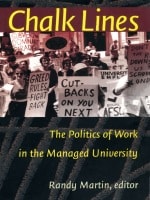
Chalk Lines
The Politics of Work in the Managed UniversityRandy Martin, ed.
Duke University Press, 1999
While tracing the socioeconomic conditions that have led to the present labor situation on campuses, the contributors consider such topics as the political implications of managerialism and the conceptual status of academic labor.
They examine the trend toward restructuring and downsizing, the particular plight of the adjunct professor, the growing emphasis on vocational training in the classroom, and union organizing among university faculty, staff, and graduate students. Placing such issues within the context of the history of labor movements as well as governmental initiatives to train a workforce capable of competing in the global economy, Chalk Lines explores how universities have attempted to remake themselves in the image of the corporate sector. Originally published as an issue of Social Text, this expanded volume, which includes four new essays, offers a broad view of academic labor in the United States.
With its important, timely contribution to debates concerning the future of higher education, Chalk Lines will interest a wide array of academics, administrators, policymakers, and others invested in the state—and fate—of academia.
Contributors. Stanley Aronowitz, Jan Currie, Zelda F. Gamson, Emily Hacker, Stefano Harney, Randy Martin, Bart Meyers, David Montgomery, Frederick Moten, Christopher Newfield, Gary Rhoades, Sheila Slaughter, Jeremy Smith, Vincent Tirelli, William Vaughn, Lesley Vidovich, Ira Yankwitt
College Belonging
How First-Year and First-Generation Students Navigate Campus LifeLisa M. Nunn
Rutgers University Press, 2021
College in Prison
Reading in an Age of Mass IncarcerationKarpowitz, Daniel
Rutgers University Press, 2017
College in Prison chronicles how, since 2001, Bard College has provided hundreds of incarcerated men and women across the country access to a high-quality liberal arts education. Earning degrees in subjects ranging from Mandarin to advanced mathematics, graduates have, upon release, gone on to rewarding careers and elite graduate and professional programs. Yet this is more than just a story of exceptional individuals triumphing against the odds. It is a study in how the liberal arts can alter the landscape of some of our most important public institutions giving people from all walks of life a chance to enrich their minds and expand their opportunities.
Drawing on fifteen years of experience as a director of and teacher within the Bard Prison Initiative, Daniel Karpowitz tells the story of BPI’s development from a small pilot project to a nationwide network. At the same time, he recounts dramatic scenes from in and around college-in-prison classrooms pinpointing the contested meanings that emerge in moments of highly-charged reading, writing, and public speaking. Through examining the transformative encounter between two characteristically American institutions—the undergraduate college and the modern penitentiary—College in Prison makes a powerful case for why liberal arts education is still vital to the future of democracy in the United States.
Complacency
Classics and Its Displacement in Higher EducationJohn T. Hamilton
University of Chicago Press, 2022
In response to philosopher Simon Blackburn’s portrayal of complacency as a vice that impairs university study at its core, John T. Hamilton examines the history of complacency in classics and its implications for our contemporary moment.
The subjects, philosophies, and literatures of ancient Greece and Rome were once treated as the foundation of learning, with everything else devolving from them. Hamilton investigates what this model of superiority, derived from the golden age of the classical tradition, shares with the current hegemony of mathematics and the natural sciences. He considers how the qualitative methods of classics relate to the quantitative positivism of big data, statistical reasoning, and presumably neutral abstraction, which often dismiss humanist subjectivity, legitimize self-sufficiency, and promote a fresh brand of academic complacency. In acknowledging the reduced status of classics in higher education today, he questions how scholarly striation and stagnation continue to bolster personal, ethical, and political complacency in our present era.
Critical Teaching and Everyday Life
Ira Shor
University of Chicago Press, 1987
Curiosity Studies
A New Ecology of KnowledgePerry Zurn
University of Minnesota Press, 2020
The first English-language collection to establish curiosity studies as a unique field
From science and technology to business and education, curiosity is often taken for granted as an unquestioned good. And yet, few people can define curiosity. Curiosity Studies marshals scholars from more than a dozen fields not only to define curiosity but also to grapple with its ethics as well as its role in technological advancement and global citizenship. While intriguing research on curiosity has occurred in numerous disciplines for decades, no rigorously cross-disciplinary study has existed—until now.
Curiosity Studies stages an interdisciplinary conversation about what curiosity is and what resources it holds for human and ecological flourishing. These engaging essays are integrated into four clusters: scientific inquiry, educational practice, social relations, and transformative power. By exploring curiosity through the practice of scientific inquiry, the contours of human learning, the stakes of social difference, and the potential of radical imagination, these clusters focus and reinvigorate the study of this universal but slippery phenomenon: the desire to know.
Against the assumption that curiosity is neutral, this volume insists that curiosity has a history and a political import and requires precision to define and operationalize. As various fields deepen its analysis, a new ecosystem for knowledge production can flourish, driven by real-world problems and a commitment to solve them in collaboration. By paying particular attention to pedagogy throughout, Curiosity Studies equips us to live critically and creatively in what might be called our new Age of Curiosity.
Contributors: Danielle S. Bassett, U of Pennsylvania; Barbara M. Benedict, Trinity College; Susan Engel, Williams College; Ellen K. Feder, American U; Kristina T. Johnson, Massachusetts Institute of Technology; Narendra Keval; Christina León, Princeton U; Tyson Lewis, U of North Texas; Amy Marvin, U of Oregon; Hilary M. Schor, U of Southern California; Seeta Sistla, Hampshire College; Heather Anne Swanson, Aarhus U.