230 books match the query 'Physics' and 12 start with c

cover of Cable Construction and Shielding Termination Techniques for Control of EM Interference

Cable Construction and Shielding Termination Techniques for Control of EM Interference

Robert Scully

The Institution of Engineering and Technology, 2025
This technical reference describes the underlying principles of how and why electrical cables function, why they might or might not require shielding, what sort of shielding might be required, and how that shielding should be terminated. The content is directed towards applications in the areas of hardware and system design, integration, and operation, including computer hardware, communications, industrial instrumentation, and automotive and aerospace industries.
[more]
cover of Cauldrons in the Cosmos: Nuclear Astrophysics

Cauldrons in the Cosmos

Nuclear Astrophysics

Claus E. Rolfs and William S. Rodney

University of Chicago Press, 1988

Nuclear astrophysics is, in essence, a science that attempts to understand and explain the physical universe beyond the Earth by studying its smallest particles. Cauldrons in the Cosmos, by Claus E. Rolfs and William S. Rodney, serves as a basic introduction to these endeavors. From the major discoveries in the field to a discussion of the makeup of stars to an explanation of standard lab techniques, this text provides students and scientists alike a thorough and fascinating survey of the accomplishments, goals, and methods of nuclear astrophysics. A classic in its field, Cauldrons in the Cosmos will surely remain an important reference in nuclear astrophysics for years to come.

"One could not wish for a better account of the current state of knowledge (and uncertainty) about nuclear reactions in stars."—B. E. J. Pagel, Nature

"Written in an informal style that those uninitiated into the jargon of nuclear astrophysics and astronomy will find readable and illuminating. . . . A useful and long-awaited introduction to nuclear astrophysics."—G. J. Mathews, Science
[more]
cover of Charge Acceleration and the Spatial Distribution of Radiation Emitted by Antennas and Scatterers

Charge Acceleration and the Spatial Distribution of Radiation Emitted by Antennas and Scatterers

Edmund K. Miller

The Institution of Engineering and Technology, 2022

Given that charge acceleration is the cause of all electromagnetic radiation, the question arises about where such acceleration occurs on objects typically modelled and analysed by electromagnetic engineers. Charge acceleration, as the cause of radiation from these typical kinds of objects (antennas, radars etc) is examined in this book on a quantitative basis.
[more]
cover of Computational Electromagnetics for Metamaterial Modelling

Computational Electromagnetics for Metamaterial Modelling

Toru Uno

The Institution of Engineering and Technology, 2027
Electromagnetic metamaterials are a class of artificial media that exhibit electromagnetic properties not found in naturally occurring materials. The field of metamaterials has advanced rapidly, driven by theoretical and experimental investigations conducted predominantly in the optical field. Subsequent progress in microwave and terahertz component design has further accelerated this development, and numerous applications have since emerged in antenna engineering and electromagnetic compatibility. As a result, there is a strong demand for accurate and computationally efficient numerical techniques that support the design of electromagnetic devices incorporating metamaterials while ensuring satisfactory performance and reliability.
[more]
cover of Constitutions of Matter: Mathematically Modeling the Most Everyday of Physical Phenomena

Constitutions of Matter

Mathematically Modeling the Most Everyday of Physical Phenomena

Martin H. Krieger

University of Chicago Press, 1996

In this insightful work, Martin H. Krieger shows what physicists are really doing when they employ mathematical models as research tools. He argues that the technical details of these complex calculations serve not only as a means to an end, but also reveal key aspects of the physical properties they model.

Krieger's lucid discussions will help readers to appreciate the larger physical issues behind the mathematical detail of modern physics and gain deeper insights into how theoretical physicists work. Constitutions of Matter is a rare, behind-the-scenes glimpse into the world of modern physics.

"[Krieger] provides students of physics and applied mathematics with a view of the physical forest behind the mathematical trees, historians and philosophers of science with insights into how theoretical physicists go about their work, and technically advanced general readers with a glimpse into the discipline."—Scitech Book News
[more]
cover of Constructing Quarks: A Sociological History of Particle Physics

Constructing Quarks

A Sociological History of Particle Physics

Andrew Pickering

University of Chicago Press, 1984

Widely regarded as a classic in its field, Constructing Quarks recounts the history of the post-war conceptual development of elementary-particle physics. Inviting a reappraisal of the status of scientific knowledge, Andrew Pickering suggests that scientists are not mere passive observers and reporters of nature. Rather they are social beings as well as active constructors of natural phenomena who engage in both experimental and theoretical practice.

"A prodigious piece of scholarship that I can heartily recommend."—Michael Riordan, New Scientist

"An admirable history. . . . Detailed and so accurate."—Hugh N. Pendleton, Physics Today
[more]
cover of Contemporary Physics and the Limits of Knowledge

Contemporary Physics and the Limits of Knowledge

Tavel, Morton

Rutgers University Press, 2002
"An elegant read for anyone interested in understanding modern physics. Tavel has a genuine knack for making the difficult and obscure clear and exciting." --Joseph C. Pitt, author of Thinking about Technology "You will never look at scientific theories in the same way again." --John Hubiscz, North Carolina State University Introductory physics is not often a popular class among liberal arts majors. With its lively prose and analogies from the arts, humanities, and social sciences, however, Contemporary Physics and the Limits of Knowledge is guaranteed to enlighten and delight nonscience majors. Morton Tavel contends that every one of the six topics that he explores--symmetry, special and general relativity, statistical physics, quantum mechanics, and chaos--has played a role in telling us what we are unable to know about the physical world. He explains what each of the topics reveals about our attempts to pinpoint reality, and how each scientific revelation forces us to acknowledge a narrowing rather than a broadening of our knowledge. Chaos theory, for example, reveals a way to understand the randomness that seems so prevalent in natural phenomena such as weather. This development unifies our understanding of many phenomena that had been previously thought unrelated. Yet, chaos represents a significant diminution in what we can hope to predict about the course of natural events. It has increased our knowledge or understanding of a phenomena, but has seriously eroded our long-held, Newtonian vision of prediction and control. Tavel emphasizes the features of physics that make it a very human endeavor and serve to build bridges to all other intellectual disciplicnes.
[more]
cover of Cosmic Impressions: Traces of God in the Laws of Nature

Cosmic Impressions

Traces of God in the Laws of Nature

Walter Thirring

Templeton Press, 2007

Walter Thirring is an internationally renowned scientist who took part in and worked among those involved in many of the scientific developments of the twentieth century. His book, about the knowledge of the world as illuminated by twentieth century science, was originally published in German. This is the first English translation and is a book that is easily accessible to readers of popular science books and magazines.
Professor Thirring starts with cosmology as he examines scientific questions and theories concerning the intricacy of nature and the universe. He branches into an exposition of chaos and its connection to the macroscopic world, as well as to life sciences, touching on such diverse related subjects as the structure of the water molecule. He speaks of advances with which he was personally involved, and offers priceless vignettes of great scientists with whom he exchanged discussions, including Albert Einstein, Werner Heisenberg, Erwin Schrödinger, and Wolfgang Pauli.
His study of scientific theory and the intricacy of nature and the universe illuminates his argument for the role of a Creator. "Reflections on the creation of the universe lead to reflections about the creator," he writes. And arguing against atheism, he points out:
“When we are moved by a fantastic building, a cathedral or a mosque and have finally realized what is behind the glorious proportions, who would then say, ‘Now we don't need the architect anymore. There might not even be one, that could all just be the random product of circumstance.’”
Furthermore, in making humankind special in his creation, the Creator gave us the responsibility of seeking an understanding of creation and protecting it.
Tackling complex issues in science and religion, Professor Thirring presents a compelling argument for their synthesis. His tenure and influence in the scientific field make this argument even more compelling.
[more]
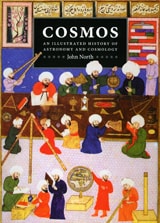
cover of Cosmos: An Illustrated History of Astronomy and Cosmology

Cosmos

An Illustrated History of Astronomy and Cosmology

John North

University of Chicago Press, 2008

For millennia humans have studied the skies to help them grow crops, navigate the seas, and earn favor from their gods. We still look to the stars today for answers to fundamental questions: How did the universe begin? Will it end, and if so, how? What is our place within it? John North has been examining such questions for decades. In Cosmos, he offers a sweeping historical survey of the two sciences that help define our place in the universe: astronomy and cosmology.
            Organizing his history chronologically, North begins by examining Paleolithic cave drawings that clearly chart the phases of the moon. He then investigates scientific practices in the early civilizations of Egypt, Greece, China, and the Americas (among others), whose inhabitants developed sophisticated methods to record the movements of the planets and stars. Trade routes and religious movements, North notes, brought these ancient styles of scientific thinking to the attention of later astronomers, whose own theories—such as Copernicus’ planetary theory—led to the Scientific Revolution.
            The work of master astronomers, including Ptolemy, Galileo, Kepler, and Newton, is described in detail, as are modern-day developments in astrophysics, such as the advent of radio astronomy, the brilliant innovations of Einstein, and the many recent discoveries brought about with the help of the Hubble telescope. This new edition brings North’s seminal book right up to the present day, as North takes a closer look at last year’s reclassification of Pluto as a “dwarf” planet and gives a thorough overview of current research.
            With more than two hundred illustrations and a comprehensive bibliography, Cosmos is the definitive history of astronomy and cosmology. It is sure to find an eager audience among historians of science and astronomers alike.
[more]
cover of Cracking the Einstein Code: Relativity and the Birth of Black Hole Physics

Cracking the Einstein Code

Relativity and the Birth of Black Hole Physics

Fulvio Melia

University of Chicago Press, 2009

Albert Einstein’s theory of general relativity describes the effect of gravitation on the shape of space and the flow of time. But for more than four decades after its publication, the theory remained largely a curiosity for scientists; however accurate it seemed, Einstein’s mathematical code—represented by six interlocking equations—was one of the most difficult to crack in all of science. That is, until a twenty-nine-year-old Cambridge graduate solved the great riddle in 1963. Roy Kerr’s solution emerged coincidentally with the discovery of black holes that same year and provided fertile testing ground—at long last—for general relativity. Today, scientists routinely cite the Kerr solution, but even among specialists, few know the story of how Kerr cracked Einstein’s code.

Fulvio Melia here offers an eyewitness account of the events leading up to Kerr’s great discovery. Cracking the Einstein Code vividly describes how luminaries such as Karl Schwarzschild, David Hilbert, and Emmy Noether set the stage for the Kerr solution; how Kerr came to make his breakthrough; and how scientists such as Roger Penrose, Kip Thorne, and Stephen Hawking used the accomplishment to refine and expand modern astronomy and physics. Today more than 300 million supermassive black holes are suspected of anchoring their host galaxies across the cosmos, and the Kerr solution is what astronomers and astrophysicists use to describe much of their behavior.

By unmasking the history behind the search for a real world solution to Einstein’s field equations, Melia offers a first-hand account of an important but untold story. Sometimes dramatic, often exhilarating, but always attuned to the human element, Cracking the Einstein Code is ultimately a showcase of how important science gets done.
[more]
cover of Creative Understanding

Creative Understanding

Roberto Torretti

University of Chicago Press, 1990
"A pleasure to read. Gracefully written by a scholar well grounded in the relevant philosophical, historical, and technical background. . . . a helpfully clarifying review and analysis of some issues of importance to recent philosophy of science and a source of some illuminating insights."—Burke Townsend, Philosophy of Science
[more]
cover of Currents and Mesons

Currents and Mesons

J. J. Sakurai

University of Chicago Press, 1969

Current and Mesons is the most recent publication in the Chicago Lectures in Physics series. The book presents Professor Sakurai's introduction to a new field of elementary particle physics which has become increasingly important in the past few years. It is based on a course given to his advanced graduate students in theoretical high-energy physics at the University of Chicago.

The author begins with a brief review of SU (3). The major topics then treated are the divergence condition and current commutation relations, vector meson universality, PCAC and the Goldberger-Treiman relation, soft pion processes, and asymptotic symmetries and spectral-function sum rules. The book concludes with a discussion of notation and of normalization convention.

Professor Sakurai's work deals with topics on which much of current discussion on the theory of elementary particles is focused. The material is designed for the advanced student who is seriously interested in doing original work, and as such provides a much needed introduction to the present literature in the field.
[more]