Results by title
267 books match the query 'Poetics' and 14 start with c
Capturing the Beat Moment
Cultural Politics and the Poetics of PresenceErik Mortenson
Southern Illinois University Press, 2010
CHOICE Outstanding Academic Title
Examining “the moment” as one of the primary motifs of Beat writing, Erik Mortenson offers the first book to investigate immediacy and its presence and importance in Beat writing. Capturing the Beat Moment: Cultural Politics and the Poetics of Presence places an expanded canon of Beat writers in an early postmodern context that highlights their importance in American poetics and provides an account of Beat practices that reveal how gender and race affect Beat politics of the moment.
Mortenson argues that Beat writers focused on action, desire, and spontaneity to establish an authentic connection to the world around them and believed that “living in the moment” was the only way in which they might establish the kind of life that led to good writing. With this in mind, he explores the possibility that, far from being the antithesis of their times, the Beats actually were a product of them. Mortenson outlines the effects of gender and race on Beat writing in the postwar years, as well as the Beats’ attempts to break free of the constrictive notions of time and space prevalent during the 1950s.
Mortenson discusses such topics as the importance of personal visionary experiences; the embodiment of sexuality and the moment of ecstasy in Beat writing; how the Beats used photographs to evoke the past; and the ways that Beat culture was designed to offer alternatives to existing political and social structures. Throughout the volume, Mortenson moves beyond the Kerouac-Ginsberg-Burroughs triumvirate commonly associated with Beat literature, discussing women—such as Diane di Prima, Janine Pommy Vega, and Joyce Johnson—and African American writers, including Bob Kaufman and Amiri Baraka. With the inclusion of these authors comes a richer understanding of the Beat writers’ value and influence in American literary history.
Caribbean Inhospitality
The Poetics of Strangers at HomeNatalie Lauren Belisle
Rutgers University Press, 2025
Carnal Rhetoric
Milton’s Iconoclasm and the Poetics of DesireLana Cable
Duke University Press, 1995
Cable traces the development of Milton’s iconoclastic poetics from its roots in the antiprelatical tracts, through the divorce tracts and Areopagitica, to its fullest dramatic representation in Eikonoklastes and Samson Agonistes. Arguing that, like every creative act, metaphor is by nature a radical and self-transgressing agent of change, she explores the site where metaphoric language and imaginative desire merge. Examining the demands Milton places on metaphor, particularly his emphasis on language as a vehicle for mortal redemption, Cable demonstrates the ways in which metaphor acts for him as that creative and radical agent of change. In the process, she reveals Milton’s engagement, at the deepest levels of linguistic creativity, with the early modern commitment to an imaginative and historic remaking of the world.
An insightful and synthetic book, Carnal Rhetoric will appeal to scholars of English literature, Milton, and the Renaissance, as well as to those with an interest in the theory of affective stylistics as it pertains to reader-response criticism, semantics, epistemology, and the philosophy and psychology of language.
Cartesian Poetics
The Art of ThinkingAndrea Gadberry
University of Chicago Press, 2020
Gadberry’s approach to seventeenth-century writings poses questions urgent for the twenty-first. Bringing literature and philosophy into rich dialogue, Gadberry centers close reading as a method uniquely equipped to manage skepticism, tolerate critical ambivalence, and detect feeling in philosophy. Helping us read classic moments of philosophical argumentation in a new light, this elegant study also expands outward to redefine thinking in light of its poetic formations.
Casuistry and Modern Ethics
A Poetics of Practical ReasoningRichard B. Miller
University of Chicago Press, 1996
Rejecting the packaging of moral experience within simple descriptions and inflexible principles, Miller argues instead for identifying and making sense of the ethically salient features of individual cases. Because this practical approach must cope with a diverse array of experiences, Miller draws on a wide variety of diagnostic tools from such fields as philosophy of science, legal reasoning, theology, literary theory, hermeneutics, and moral philosophy.
Opening new avenues for practical reasoning, Miller's interdisciplinary work will challenge scholars who are interested in the intersections of ethics and political philosophy, cultural criticism, and debates about method in religion and morality.
Chekhov and Russian Religious Culture
Poetics of the Marian ParadigmJulie de Sherbinin
Northwestern University Press, 1997
Civilizing War
Imperial Politics and the Poetics of National RuptureNasser Mufti
Northwestern University Press, 2018
Honorable Mention for the 2019 Sonya Rudikoff Prize, awarded by the Northeast Victorian Studies Association
Civilizing War traces the historical transformation of civil war from a civil affair into an uncivil crisis. Civil war is today synonymous with the global refugee crisis, often serving as grounds for liberal-humanitarian intervention and nationalist protectionism.
In Civilizing War, Nasser Mufti situates this contemporary conjuncture in the long history of British imperialism, demonstrating how civil war has been and continues to be integral to the politics of empire. Through comparative readings of literature, criticism, historiography, and social analysis, Civilizing War shows how writers and intellectuals of Britain’s Anglophone empire articulated a “poetics of national rupture” that defined the metropolitan nation and its colonial others.
Mufti’s tour de force marshals a wealth of examples as diverse as Thomas Carlyle, Benjamin Disraeli, Friedrich Engels, Arthur Conan Doyle, Rudyard Kipling, Joseph Conrad, V. S. Naipaul, Nadine Gordimer, and Michael Ondaatje to examine the variety of forms this poetics takes—metaphors, figures, tropes, puns, and plot—all of which have played a central role in Britain’s civilizing mission and its afterlife. In doing so, Civilizing War shifts the terms of Edward Said’s influential Orientalism to suggest that imperialism was not only organized around the norms of civility but also around narratives of civil war.
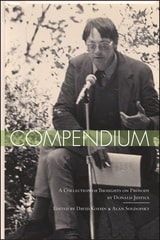
Compendium
A Collection of Thoughts on ProsodyDonald Justice
Omnidawn, 2017
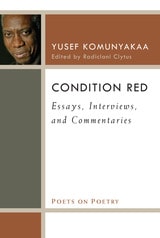
Condition Red
Essays, Interviews, and CommentariesYusef Komunyakaa; Edited by Radiclani Clytus
University of Michigan Press, 2017

Considering Watchmen
Poetics, Property, PoliticsHoberek, Andrew
Rutgers University Press, 2014
Demonstrating a keen eye for historical detail, Considering Watchmen gives readers a new appreciation of just how radical Moore and Gibbons’s blend of gritty realism and formal experimentation was back in 1986. The book also considers Watchmen’s place in the history of the comics industry, reading the graphic novel’s playful critique of superhero marketing alongside Alan Moore’s public statements about the rights to the franchise. Andrew Hoberek examines how Moore and Gibbons engaged with the emerging discourses of neoconservatism and neoliberal capitalism, ideologies that have only become more prominent in subsequent years.
Watchmen’s influences on the superhero comic and graphic novel are undeniable, but Hoberek reveals how it has also had profound effects on literature as a whole. He suggests that Watchmen not only proved that superhero comics could rise to the status of literature—it also helped to inspire a generation of writers who are redefining the boundaries of the literary, from Jonathan Lethem to Junot Díaz. Hoberek delivers insight and analysis worthy of satisfying serious readers of the genre while shedding new light on Watchmen as both an artistic accomplishment and a book of ideas.
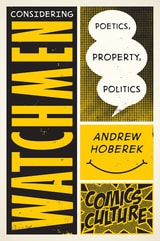
Considering Watchmen
Poetics, Property, Politics: New edition with full color illustrationsHoberek, Andrew
Rutgers University Press, 2017
Demonstrating a keen eye for historical detail, Considering Watchmen gives readers a new appreciation of just how radical Moore and Gibbons’s blend of gritty realism and formal experimentation was back in 1986. The book also considers Watchmen’s place in the history of the comics industry, reading the graphic novel’s playful critique of superhero marketing alongside Alan Moore’s public statements about the rights to the franchise. Andrew Hoberek examines how Moore and Gibbons engaged with the emerging discourses of neoconservatism and neoliberal capitalism, ideologies that have only become more prominent in subsequent years.
Watchmen’s influences on the superhero comic and graphic novel are undeniable, but Hoberek reveals how it has also had profound effects on literature as a whole. He suggests that Watchmen not only proved that superhero comics could rise to the status of literature—it also helped to inspire a generation of writers who are redefining the boundaries of the literary, from Jonathan Lethem to Junot Díaz. Hoberek delivers insight and analysis worthy of satisfying serious readers of the genre while shedding new light on Watchmen as both an artistic accomplishment and a book of ideas.
Contemporary Poetics
Louis Armand
Northwestern University Press, 2007
Charles Bernstein's Swiftian satire of generative poetics and the textual apparatus, together with Marjorie Perloff's critical-historical treatment of "writing after" Bernstein and other proponents of language poetry, provides an itinerary of contemporary poetics in terms of both theory and practice. The other essays consider "precursors," recognizable figures within the histories or prehistories of contemporary poetics, from Kafka and Joyce to Wallace Stevens and Kathy Acker; "conjunctions," in which more strictly theoretical and poetical texts enact a concerted engagement with rhetoric, prosody, and the vicissitudes of "intelligibility"; "cursors," which points to the open possibilities of invention, from Augusto de Campos's "concrete poetics" to the "codework" of Alan Sondheim; and "transpositions," defining the limits of poetic invention by way of technology.
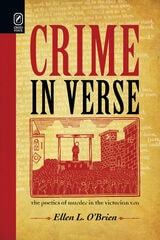
Crime in Verse
The Poetics of Murder in the Victorian EraEllen L. O’Brien
The Ohio State University Press, 2008
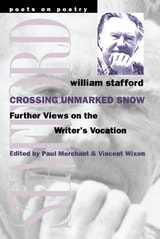
Crossing Unmarked Snow
Further Views on the Writer's VocationWilliam Stafford
University of Michigan Press, 1998
--William Stafford
A plain-spoken but eminently effective poet, the late William Stafford (1914-1993) has managed to shape part of the mainstream of American poetry by distancing himself from its trends and politics. Though his work has always inspired controversy, he was widely admired by students and poetry lovers as well as his own peers. His fascination with the process of writing joined with his love of the land and his faith in the teaching power of nature to produce a unique poetic voice in the last third of the twentieth century.
Crossing Unmarked Snow continues--in the tradition of Stafford's well-loved collections Writing the Australian Crawl and You Must Revise Your Life-- collecting prose and poetry on the writer's profession. The book includes reviews and reflections on poets from Theodore Roethke to Carolyn Forche, from May Sarton to Philip Levine; conversations on the making of poems; and a selection of Stafford's own poetry. The book also includes a section on the art of teaching, featuring interviews, writing exercises, and essays on the writer's vocation.
William Stafford authored more than thirty-five books of poetry and prose during his lifetime, including the highly acclaimed Writing the Australian Crawl: Views on the Writer's Vocation and You Must Revise Your Life.