Results by title
72 books match the query 'Police' and 13 start with c
CRIME, JUSTICE, HISTORY
ERIC MONKKONEN
The Ohio State University Press, 2002
Crime in the U.S. and the institutions for its control are deeply embedded in and shaped by history. The historical origins have often become invisible, and their recovery difficult, but any understanding of the contemporary situation requires historical context. For over twenty-five years Eric H. Monkkonen has worked on some of the puzzles and problems in recovering the history of crime and police.
Much of his work has appeared in articles, often in specialized journals or not in English, which this book collects for the first time. In addition to Monkkonen’s major published articles, this volume includes several new ones. The topics embrace violence, public disorder, policing, popular culture, and contrasts between the U.S. and Europe. Some articles illuminate special methodological and source issues that challenge historians of criminal justice. As well as dealing with serious crime, this book includes several articles on specifically urban problems and solutions associated with disorder, crime, and poverty.
In contrast to the more technical articles, several chapters, which originally appeared as op-ed pieces, show how historical understanding can help address current policy issues in crime and crime control. All too often, current policy debates occur without proper historical background. As a result, old ideas that have been tried and rejected are re-introduced, or new and sometimes simple ideas are ignored.
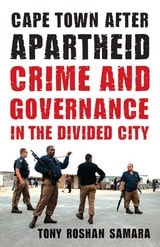
Cape Town after Apartheid
Crime and Governance in the Divided CityTony Roshan Samara
University of Minnesota Press, 2010
Cape Town after Apartheid focuses on urban renewal and urban security policies and practices in the city center and townships as this aspiring world-class city actively pursues a neoliberal approach to development. The city’s attempt to escape its past is, however, constrained by crippling inequalities, racial and ethnic tensions, political turmoil, and persistent insecurity. Samara shows how governance in Cape Town remains rooted in the perceived need to control dangerous populations and protect a somewhat fragile and unpopular economic system. In urban areas around the world, where the affluent minority and poor majority live in relative proximity to each other, aggressive security practices and strict governance reflect and reproduce the divided city.
A critical case for understanding a transnational view of urban governance, especially in highly unequal, majority-poor cities, this closely observed study of postapartheid Cape Town affords valuable insight into how security and governance technologies from the global North combine with local forms to create new approaches to social control in cities across the global South.
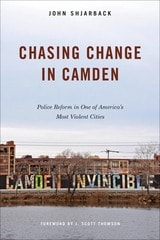
Chasing Change in Camden
Police Reform in One of America's Most Violent CitiesJohn Shjarback
Temple University Press, 2025
In Chasing Change in Camden, John Shjarback investigates how Camden’s police department re-formed and questions whether it can serve as a model for other cities. He analyzes successful policies—from innovative police training to advancements in technology—and evidence-based policing strategies.
Shjarback explains how the changes were implemented and then adjusted in response to community backlash. Chasing Change in Camden concludes with a discussion of threats to the reform and accountability efforts in both the CCPD and American policing more broadly. Ultimately, Camden’s case study offers valuable lessons for cities seeking effective police reform.
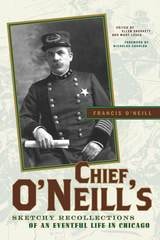
Chief O'Neill's Sketchy Recollections of an Eventful Life in Chicago
Francis O'Neill, Edited by Ellen Skerrett and Mary Lesch with a foreword by Nicholas Carolan
Northwestern University Press, 2008
This remarkable memoir of immigration and assimilation provides a rare view of urban life in Chicago in the late 1800s by a newcomer to the city and the Midwest, and the nation as well. Francis O’Neill left Ireland in 1865. After five years traveling the world as a sailor, he and his family settled in Chicago just shortly before the Great Fire of 1871.
As O’Neill looked back on his life, writing in Chicago at the age of 83, he could give first-hand accounts of the Pullman strike of 1894, the railway strike of 1903, and the packing-house strike of 1904. He could also reflect on the corruption that kept him, in spite of his innovations, extremely high exam scores, and performance, subject to powerful aldermen who prevented his advance as a member of the Chicago Police Department. Despite these obstacles, O’Neill eventually rose to be chief of police—a position from which he could enact much-needed civil service reform. In addition to his professional success, O’Neill is also remembered and beloved for his hobby, preserving traditional Irish music.
O’Neill’s story offers perspective on the inner workings of the police department at the turn of the twentieth century. His memoir also brings to life the challenges involved in succeeding in a new land, providing for his family, and integrating into a new culture. Francis O’Neill serves as a fine documentarian of the Irish immigrant experience in Chicago.
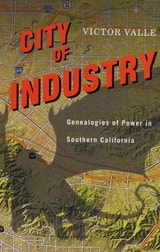
City of Industry
Genealogies of Power in Southern CaliforniaValle, Victor
Rutgers University Press, 2011
Valle investigated an untapped archive of Industry's built landscape, media coverage, and public records, including sealed FBI reports, to uncover a cascading series of scandals. A kaleidoscopic view of the corruption that resulted when local land owners, media barons, and railroads converged to build the city, this suspenseful narrative explores how new governmental technologies and engineering feats propelled the rationality of privatization using their property-owning servants as tools.
Valle's tale of corporate greed begins with the city's founder James M. Stafford and ends with present day corporate heir, Edward Roski Jr., the nation's biggest industrial developerùco-owner of the L.A. Staples Arena and possible future owner of California's next NFL franchise. Not to be forgotten in Valle's captivating story are Latino working class communities living within Los Angeles's distribution corridors, who suffer wealth disparities and exposure to air pollution as a result of diesel-burning trucks, trains, and container ships that bring global trade to their very doorsteps. They are among the many victims of City of Industry.
Common Sense Police Review
Douglas Perez
Temple University Press, 1995
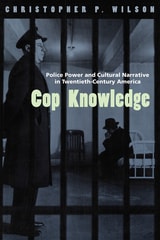
Cop Knowledge
Police Power and Cultural Narrative in Twentieth-Century AmericaChristopher P. Wilson
University of Chicago Press, 2000
Christopher P. Wilson explores these questions by examining narratives of police power in crime news, popular fiction, and film, showing how they both reflect and influence the real strategies of law enforcement on the beat, in the squad room, and in urban politics. He takes us from Theodore Roosevelt's year of reform with the 1890s NYPD to the rise of "community policing," from the classic "police procedural" film The Naked City to the bestselling novels of LAPD veteran Joseph Wambaugh. Wilson concludes by demonstrating the ways in which popular storytelling about police power has been intimately tied to the course of modern liberalism, and to the rising tide of neoconservatism today.
"A thorough, brilliant blend that crosses disciplines."—Choice
"[S]ophisticated, highly theoretical and ambitious. . . . Connects the history of policing to cultural representations of crime, criminals and cops."—Times Literary Supplement
"[A] deeply satisfying approach to the crime narrative. . . . [Wilson] focuses, ultimately, on the role of police power in cultural storytelling."—American Quarterly

Cops and Constables
American and British Fictional PolicemenEdited by Earl F. Bargainnier and George N. Dove
University of Wisconsin Press, 1986
Cops, Teachers, Counselors
Stories from the Front Lines of Public ServiceSteven Maynard-Moody and Michael Musheno
University of Michigan Press, 2003
Steven Maynard-Moody is Director of the Policy Research Institute and Professor of Public Administration at the University of Kansas.
Michael Musheno is Professor of Justice and Policy Studies at Lycoming College and Professor Emeritus of Justice Studies, Arizona State University.
Cops, Teachers, Counselors
Stories from the Front Lines of Public ServiceSteven Maynard-Moody and Michael Musheno
University of Michigan Press, 2022
The new edition of Cops, Teachers, Counselors furthers the exploration of forces that shape the contours of frontline work. This line of inquiry is at the heart of street-level bureaucracy research, a field of study cutting across disciplines, including public administration, political science, social work, law and society, education, and criminal justice. The oft-cited 2003 edition pioneered a qualitative method of inquiry using workers’ own voices and storytelling about fairness in the delivery of services. This NSF-supported field research reveals the ways workers engage in moral judgments, more than implementing laws and policies, to account for their decisions and actions.
The new edition wraps an expanded framing around the original chapters, while maintaining a lively, approachable presentation style. It takes on a more enriched perspective of legality than the original, while retaining a focus on frontline work as a powerful source of cultural ordering. In addition to examining workers’ stories of encounters, attention is given to the agency of the governed during interactional moments, the power dynamics in play during both interpersonal and group encounters, and patterns of practice that converge across distinctive service domains. The original edition describes two narratives that shape frontline workers’ decisional judgments and the interplay between legality and morality: the state-agent and citizen-agent narratives. This edition adds the knowledge-agent narrative that stresses the importance of professional and field learning to decisional judgments.
The book examines routine encounters of cops, teachers, and counselors with diverse publics when questions of justice and fairness are at play. This new edition speaks to contemporary issues at a time when frontline workers gained broad recognition for their heroic contributions to communities during the Covid 19 pandemic, as well as sustained condemnation for their embodiment of the brutal expression of racialized state power in police actions. The authors conclude with a focus on the significance of place and trust in building social inclusion on the frontlines of public service.

Crime and Justice, Volume 15
Modern PolicingEdited by Michael Tonry and Norval Morris
University of Chicago Press Journals, 1993
Crime and Justice, Volume 46
Reinventing American Criminal JusticeEdited by Michael Tonry
University of Chicago Press Journals, 2017

Crisis and Control
The Militarization of Protest PolicingLesley J. Wood
Pluto Press, 2014
Crisis and Control explains how neoliberal transformations of political and economic systems are militarising the policing of protest, based on a compelling empirical study of police agencies and practices from 1995 until the present.
Lesley J. Wood shows that the increasing role of the security and defense industries, professional police associations, anti-terrorism initiatives and ‘best practices’ in policing networks have accelerated the use of less lethal weapons, pre-emptive arrests, infiltration and barricading strategies against protesters.
The book uses Bourdieu and Boltanski to analyse court transcripts, police reports, policy, training materials and the conference programs of professional police organisations to argue that police agencies are neither omnipotent strategists, nor simple tools of the elite, but institutions struggling to maintain legitimacy, resources and autonomy in a changing field.