Results by title
355 books match the query 'Political and social views' and 15 start with c
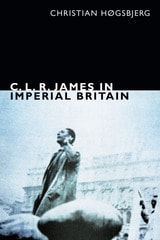
C. L. R. James in Imperial Britain
Christian Høgsbjerg
Duke University Press, 2014

Carey Act and Conservation in Colorado
Gerald C. Morton
University Press of Colorado, 2024
Morton contextualizes the Carey Act’s significance in Colorado through a study of the Two Buttes and Muddy Creek projects in the state’s southeastern corner—tragic examples of the disconnect among developers seeking windfall profits in the face of financial rollercoasters, the challenge of reclaiming remote sagebrush country, and settlers seeking viable livelihoods that eventually led conservationists to reimagine the failures as public wildlife refuges. A collision of values between developers and settlers lay at the center of those wildlife habitat conservation efforts, forcing people to rethink their relationship with the land and ephemeral streams—an awareness that correlated with the advent of modern ecology.
The Carey Act and Conservation in Colorado is the untold story of the manipulation of nature and the reconceived use of land for public wildlife areas on the southern plains of the American West. Offering original research on arid lands policy, federal and state agency oversight, irrigation bond financing, heartbroken settlers’ grievances, individual developers’ motives, and the rise of wildlife conservation, this compelling tale of misfortune will appeal to scholars and general readers interested in conservationist and environmental history in the American West.
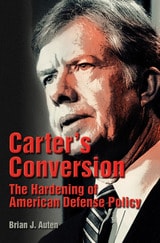
Carter's Conversion
The Hardening of American Defense PolicyBrian J. Auten
University of Missouri Press, 2008
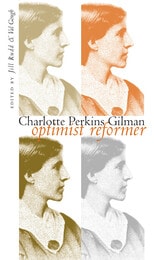
Charlotte Perkins Gilman
Optimist ReformerJill Rudd
University of Iowa Press, 1999
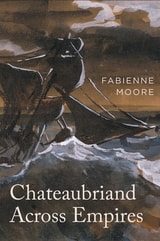
Chateaubriand Across Empires
Fabienne Moore
Bucknell University Press, 0
What happens when the liberty of ancient nobility collides with the revolutionary ideals of equality? This groundbreaking study explores how the American, French, Haitian, and Greek Revolutions redefined freedom—and how French Romantic figure Chateaubriand grappled with that transformation. Tracing his travels across England, North America, and the Mediterranean, this book uncovers Chateaubriand’s seductive visions of “paradises lost,” which were taken up, challenged, and reimagined by Anglophone and Hispanic writers.
From Charlotte Brontë to Harriet Beecher Stowe, from Byron to Bolaño authors found in Chateaubriand a conflicted but powerful voice at the crossroads of liberty, race, religion, and empire. This is the first comprehensive study to situate Chateaubriand within the histories of colonialism and global revolution, revealing a literary legacy that remains startlingly relevant in today’s struggles over equality.
Published by Bucknell University Press. Distributed worldwide by Rutgers University Press.
Chaucer and the Subject of History
Lee Patterson
University of Wisconsin Press, 1991
Renowned scholar of medieval literature, Lee Patterson, presents a compelling vision of the shape and direction of Geoffrey Chaucer’s entire career in Chaucer and the Subject of History.
Chaucer's interest in individuality was strikingly modern. At the same time he was profoundly aware of the pressures on individuality exerted by the past and by society—by history. This tension between the subject and history is Patterson's topic. He begins by showing how Chaucer’s understanding of history as a subject for poetry—a world to be represented and a cultural force affecting human action—began to take shape in his poems on classical themes, especially in Troilus and Criseyde. Patterson's extended analysis of this profound yet deeply conflicted exploration of the relationship between "history" and "the subject" provides the basis for understanding Chaucer's shift to his contemporary world in the Canterbury Tales. There, in the shrewdest and most wide-ranging analysis of late medieval society we possess, Chaucer investigated not just the idea of history but the historical world intimately related to his own political and literary career.
Patterson's chapters on individual tales clarify and confirm his provocative arguments. He shows, for example, how the Knight's Tale represents the contemporary crisis of governance in terms of a crisis in chivalric identity itself; how the Miller’s Tale reflects the social pressures and rhetoric of peasant movements generally and the Rising of 1381 in particular; and how the tales of the Merchant and Shipman register the paradoxical placement of a bourgeois class lacking class identity. And Patterson's brilliant readings of the Wife of Bath’s Tale—"the triumph of the subject"—and the Pardoner’s Tale —"the subject of confession"—reveal how Chaucer reworked traditional materials to accomplish stunning innovations that make visible unmistakably social meanings. Chaucer and the Subject of History is a landmark book, one that will shape the way that Chaucer is read for years to come.
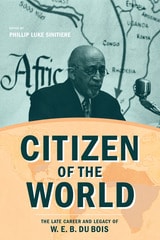
Citizen of the World
The Late Career and Legacy of W. E. B. Du BoisEdited by Phillip Luke Sinitiere
Northwestern University Press, 2019
From his birth in 1868 until his death in 1963, Du Bois sought the liberation of black people in the United States and across the world through intellectual and political labor. His tireless efforts documented and demonstrated connections between freedom for African-descended people abroad and black freedom at home.
In concert with growing scholarship on his twilight years, the essays in this volume assert the fundamental importance of considering Du Bois’s later decades not as a life in decline that descended into blind ideological allegiance to socialism and communism but as the life of a productive, generative intellectual who responded rationally, imaginatively, and radically to massive mid-century changes around the world, and who remained committed to freedom’s realization until his final hour.
Citizen-Saints
Shakespeare and Political TheologyJulia Reinhard Lupton
University of Chicago Press, 2005
Among the many questions Julia Reinhard Lupton attempts to answer under the rubric of the citizen-saint are: how did states of emergency, acts of sovereign exception, and Messianic anticipations lead to new forms of religious and political law? What styles of universality were implied by the abject state of the pure creature, at sea in a creation abandoned by its creator? And how did circumcision operate as both a marker of ethnicity and a means of conversion and civic naturalization?
Written with clarity and grace, Citizen-Saints will be of enormous interest to students of English literature, religion, and early modern culture.
Communication Ethics in Dark Times
Hannah Arendt's Rhetoric of Warning and HopeRonald C. Arnett
Southern Illinois University Press, 2013
Renowned in the disciplines of political theory and philosophy, Hannah Arendt’s searing critiques of modernity continue to resonate in other fields of thought decades after she wrote them. In Communication Ethics in Dark Times: Hannah Arendt’s Rhetoric of Warning and Hope, author Ronald C. Arnett offers a groundbreaking examination of fifteen of Arendt’s major scholarly works, considering the German writer’s contributions to the areas of rhetoric and communication ethics for the first time.
Arnett focuses on Arendt’s use of the phrase “dark times” to describe the mistakes of modernity, defined by Arendt as the post-Enlightenment social conditions, discourses, and processes ruled by principles of efficiency, progress, and individual autonomy. These principles, Arendt argues, have led humanity down a path of folly, banality, and hubris. Throughout his interpretive evaluation, Arnett illuminates the implications of Arendt’s persistent metaphor of “dark times” and engages the question, How might communication ethics counter the tenets of dark times and their consequences? A compelling study of Hannah Arendt’s most noteworthy works and their connections to the fields of rhetoric and communication ethics, Communication Ethics in Dark Times provides an illuminating introduction for students and scholars of communication ethics and rhetoric, and a tool with which experts may discover new insights, connections, and applications to these fields.
Top Book Award for Philosophy of Communication Ethics by Communication Ethics Division of the National Communication Association, 2013
Composition and Cornel West
Notes toward a Deep DemocracyKeith Gilyard
Southern Illinois University Press, 2008
Composition and Cornel West: Notes toward a Deep Democracy identifies and explains key aspects of the work of Cornel West—the highly regarded scholar of religion, philosophy, and African American studies—as they relate to composition studies, focusing especially on three rhetorical strategies that West suggests we use in our questioning lives as scholars, teachers, students, and citizens.
In this study, author Keith Gilyard examines the strategies of Socratic Commitment (a relentless examination of received wisdom), Prophetic Witness (an abiding concern with justice and the plight of the oppressed), and Tragicomic Hope (a keep-on-pushing sensibility reflective of the African American freedom struggle). Together, these rhetorical strategies comprise an updated form of cultural criticism that West calls prophetic pragmatism.
This volume, which contains the only interview in which Cornel West directly addresses the field of composition,sketches the development of Cornel West’s theories of philosophy, political science, religion, and cultural studies and restates the link between Deweyan notions of critical intelligence and the notion of critical literacy developed by Ann Berthoff, Ira Shor, and Henry Giroux. Gilyard provides examples from the classroom to illustrate the possibilities of Socratic Commitment as part of composition pedagogy, shows the alignment of Prophetic Witness with traditional aims of critical composition, and in his chapter on Tragicomic Hope, addresses African American expressive culture with an emphasis on music and artists such as Curtis Mayfield, Marvin Gaye, Aretha Franklin, and Kanye West.
The first book to comprehensively connect the ideas of one of America's premier scholars of religion, philosophy and African American studies with composition theory and pedagogy, Composition and Cornel West will be valuable to scholars, teachers, and students interested in race, class, critical literacy, and the teaching of writing.
Conrad and Empire
Stephen Ross
University of Missouri Press, 2004

Conservative Thought in Twentieth Century Latin America
The Ideas of Laureano GomezJames D. Henderson
Ohio University Press, 1988
Laureano Gómez was president of Colombia in the early 1950s until overthrown by a military coup. He was also, for some fifty years, the leading exponent of Latin American conservatism, a political philosophy with roots in both nineteenth–century politics and religion. Focusing on Gómez, and other prominent conservative politicians, Henderson traces the evolution of Latin American conservatism and demonstrates the scope of its influence throughout the continent.
While much has been written about particular Marxist movements and right–wing regimes in contemporary Latin America, little attention has been devoted, in recent years, to the more moderate political institutions and individuals which dominate twentieth–century Latin America. This first account of Latin American conservatism should be of interest to all students of the history and politics of the region.
Cosmopolitan Minds
Literature, Emotion, and the Transnational ImaginationBy Alexa Weik von Mossner
University of Texas Press, 2014
During World War II and the early Cold War period, factors such as race, gender, sexual orientation, or class made a number of American writers feel marginalized in U.S. society. Cosmopolitan Minds focuses on a core of transnational writers—Kay Boyle, Pearl S. Buck, William Gardner Smith, Richard Wright, and Paul Bowles—who found themselves prompted to seek experiences outside of their home country, experiences that profoundly changed their self-understanding and creative imagination as they encountered alternative points of views and cultural practices in Europe, Asia, and Africa.
Alexa Weik von Mossner offers a new perspective on the affective underpinnings of critical and reflexive cosmopolitanism by drawing on theories of emotion and literary imagination from cognitive psychology, philosophy, and cognitive literary studies. She analyzes how physical dislocation, and the sometimes violent shifts in understanding that result from our affective encounters with others, led Boyle, Buck, Smith, Wright, and Bowles to develop new, cosmopolitan solidarities across national, ethnic, and religious boundaries. She also shows how, in their literary texts, these writers employed strategic empathy to provoke strong emotions such as love, sympathy, compassion, fear, anger, guilt, shame, and disgust in their readers in order to challenge their parochial worldviews and practices. Reading these texts as emotionally powerful indictments of institutionalized racism and national violence inside and outside of the United States, Weik von Mossner demonstrates that our emotional engagements with others—real and imagined—are crucially important for the development of transnational and cosmopolitan imaginations.
Crime in Verse
The Poetics of Murder in the Victorian EraEllen L. O’Brien
The Ohio State University Press, 2008
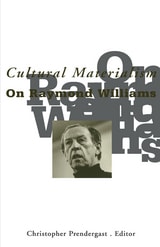
Cultural Materialism
On Raymond WilliamsChristopher Prendergast
University of Minnesota Press, 1995
"Raymond Williams was the last of the great European male revolutionary socialist intellectuals born before the end of the age of Europe (1492-1945)."-Cornel West
The work of Raymond Williams is of seminal importance in rethinking the idea of culture. He is widely regarded as one of the founding figures of international cultural studies. In tribute to his legacy, this edited volume is devoted to his theories of cultural materialism and is the most substantial and wide-ranging collection of essays on his work to be offered since his death in 1988. For all readers grappling with Williams's complex legacy, this volume is not to be missed.Contributors include Stanley Aronowitz, Graduate School, CUNY; John Brenkman, Baruch College, CUNY; Peter de Bolla, Cambridge University; Catherine Gallagher, University of California, Berkeley; Stephen Heath, University of California, Santa Cruz; John Higgins, University of Cape Town; Peter Hitchcock, Baruch College, CUNY; Cora Kaplan, Rutgers University; David Lloyd, University of California, Berkeley; Robert Miklitsch, Ohio University; Michael Moriarty, Cambridge University; Morag Shiach, Queen Mary and Westfield College, University of London; David Simpson, University of Colorado, Boulder; Gillian Skirrow; Kenneth Surin, Duke University; Paul Thomas, University of California, Berkeley; Gauri Viswanathan, Columbia University; and Cornel West, Harvard University.