Results by title
101 books match the query 'Publishers & Publishing Industry' and 6 start with c
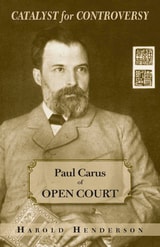
Catalyst for Controversy
Paul Carus of Open CourtHarold Henderson
Southern Illinois University Press, 2009
"I am not a common atheist; I am an atheist who loves God."—Paul Carus, "The God of Science," 1904
In the summer of 1880, while teaching at the military academy of the Royal Corps of Cadets of Saxony in Dresden, Paul Carus published a brief pamphlet denying the literal truth of scripture and describing the Bible as a great literary work comparable to the Odyssey.
This unremarkable document was Carus’s first step in a wide-ranging intellectual voyage in which he traversed philosophy, science, religion, mathematics, history, music, literature, and social and political issues. The Royal Corps, Carus later reported, found his published views "not in harmony with the Christian spirit, in accordance with which the training and education of the Corps of Cadets should be conducted." And so the corps offered the young teacher the choice of asking "most humbly for forgiveness for daring to have an opinion of my own and to express it, perhaps even promise to publish nothing more on religious matters, or to give up my post. I chose the latter. . . . There was thus no other choice for me but to emigrate and, trusting in my own powers, to establish for myself a new home." His resignation was effective on Easter Sunday, 1881.
Carus toured the Rhine, lived briefly in Belgium, and taught in a military college in England to learn English well enough to "thrive in the United States." By late 1884 or early 1885 he was on his way to the New World. Thriving in the United States proved more difficult than it had in England, but before 1885 ended he had published his first philosophical work in English, Monism and Meliorism. The book was not widely read, but it did reach Edward C. Hegeler, a La Salle, Illinois, zinc processor who became his father-in-law as well as his ideological and financial backer.
Established in La Salle, Carus began the work that would place him among the prominent American philosophers of his day and make the Open Court Publishing Company a leading publisher of philosophical, scientific, and religious books. He edited The Open Court and The Monist, offering the finest view of Oriental thought and religion then available in the West, and sought unsuccessfully to bring about a second World Parliament of Religions. He befriended physicist-philosopher Ernst Mach. For eleven years he employed D. T. Suzuki, who later became a great Zen Buddhist teacher. He published more articles by Charles S. Peirce, now viewed as one of the great world philosophers, in The Monist than appeared in any other publication.
Biographer Harold Henderson concludes his study of this remarkable man: "Whenever anyone is so fired with an idea that he or she can’t wait to write it down, there the spirit of Paul Carus remains, as he would have wished, active in the world."
Charleston Voices
Perspectives from the 2017 ConferenceEdited by Lars Meyer
Against the Grain, LLC, 2018
TESTIMONIALS
“The best library gathering around. I look forward to it.”
“The Charleston Conference is an incredibly stimulating venue. I am tired afterwards, but get so many great ideas, network with my colleagues, and learn what is going on. I recommend it highly.”
“Charleston is the only conference that is worth attending.”
https://www.charlestonlibraryconference.com/about/
Charleston Voices
Perspectives from the 2018 ConferenceEdited by Lars Meyer
Against the Grain, LLC, 2019
TESTIMONIALS
“The best library gathering around. I look forward to it.”
“The Charleston Conference is an incredibly stimulating venue. I am tired afterwards, but get so many great ideas, network with my colleagues, and learn what is going on. I recommend it highly.”
“Charleston is the only conference that is worth attending.”
https://www.charlestonlibraryconference.com/about/
Charleston Voices
Perspectives from the 2019 ConferenceEdited by Lars Meyer
Against the Grain, LLC, 2020
TESTIMONIALS
“The best library gathering around. I look forward to it.”
“The Charleston Conference is an incredibly stimulating venue. I am tired afterwards, but get so many great ideas, network with my colleagues, and learn what is going on. I recommend it highly.”
“Charleston is the only conference that is worth attending.”
https://www.charlestonlibraryconference.com/about/

Chicago Guide to Preparing Electronic Manuscripts
The University of Chicago Press
University of Chicago Press, 1987
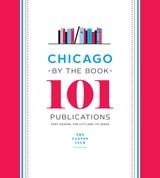
Chicago by the Book
101 Publications That Shaped the City and Its ImageCaxton Club
University of Chicago Press, 2018
Chicago by the Book profiles 101 landmark publications about Chicago from the past 170 years that have helped define the city and its image. Each title—carefully selected by the Caxton Club, a venerable Chicago bibliophilic organization—is the focus of an illustrated essay by a leading scholar, writer, or bibliophile.
Arranged chronologically to show the history of both the city and its books, the essays can be read in order from Mrs. John H. Kinzie’s 1844 Narrative of the Massacre of Chicago to Sara Paretsky’s 2015 crime novel Brush Back. Or one can dip in and out, savoring reflections on the arts, sports, crime, race relations, urban planning, politics, and even Mrs. O’Leary’s legendary cow. The selections do not shy from the underside of the city, recognizing that its grit and graft have as much a place in the written imagination as soaring odes and boosterism. As Neil Harris observes in his introduction, “Even when Chicagoans celebrate their hearth and home, they do so while acknowledging deep-seated flaws.” At the same time, this collection heartily reminds us all of what makes Chicago, as Norman Mailer called it, the “great American city.”
With essays from, among others, Ira Berkow, Thomas Dyja, Ann Durkin Keating, Alex Kotlowitz, Toni Preckwinkle, Frank Rich, Don Share, Carl Smith, Regina Taylor, Garry Wills, and William Julius Wilson; and featuring works by Saul Bellow, Gwendolyn Brooks, Sandra Cisneros, Clarence Darrow, Erik Larson, David Mamet, Studs Terkel, Ida B. Wells-Barnett, Frank Lloyd Wright, and many more.