Results by title
70 books match the query 'Pueblo Indians' and 8 start with c
Capturing Water
Puebloan Resilience and Agricultural Sustainability in Chaco CanyonR. Gwinn Vivian and Samantha G. Fladd
University of Utah Press, 2025
The ability of the inhabitants of Chaco Canyon to sustain themselves through farming in an arid environment has long been a topic of debate among scholars. Building upon the work of his father, Gordon, R. Gwinn Vivian dedicated his lifetime of archaeological work to investigating water management and practices at Chaco. These efforts provide compelling evidence of the extensive use of canal irrigation systems and other water management techniques employed by the Ancestral Puebloan people by the ninth century and continuing through recent periods by Navajo farmers.
Rich with archaeological data, ethnographic evidence, maps, and photographs, this volume challenges long-standing assumptions about Chaco Canyon's agricultural potential. By highlighting the adaptability and ingenuity of the canyon's early inhabitants, the book offers a fresh perspective on the role of water management in the development of Chaco Canyon as a sociopolitical center in the northern Southwest.
Ceramic Commodities and Common Containers
The Production and Distribution of White Mountain Red Ware in the Grasshopper Region, ArizonaDaniela Triadan
University of Arizona Press, 1997
Relying primarily on stylistic analyses and the relative abundance of this ceramic ware in site assemblages, most scholars have assumed that it was manufactured within a restricted area on the southeastern edge of the Colorado Plateau and distributed via trade and exchange networks that may have involved controlled access to these ceramics.
This monograph critically evaluates these traditional interpretations, utilizing large-scale compositional and petrographic analyses that established multiple production zones for White Mountain Red Ware—including one in the Grasshopper region—during Pueblo IV times. The compositional data combined with settlement data and an analysis of archaeological contexts demonstrates that White Mountain Red Ware vessels were readily accessible and widely used household goods, and that migration and subsequent local production in the destinaton areas were important factors in their wide distribution during the 14th century.
Ceramic Commodities and Common Containers provides new insights into the organization of ceramic production and distribution in the northern Southwest and into the processes of social reorganization that characterized the late 13th and 14th century Western Pueblo world. As one of the few studies that integrate materials analysis into archaeological research, Triadan's monograph marks a crucial contribution to the reconstruction of these prehistoric societies.
Chaco's Northern Prodigies
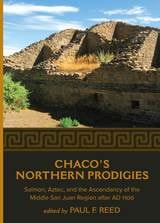
Salmon, Aztec, and the Ascendancy of the Middle San Juan Region after AD 1100Paul F Reed
University of Utah Press, 2011
Work by two groups of contributors resulted in this synthetic volume, which interprets thirty-five years of research at Salmon Ruins. Chaco’s Northern Prodigies also puts recent work at Salmon Ruins in the context of Middle San Juan archaeological research. It is a timely synopsis of the archaeology of this region of the Southwest.
Children in Prehistoric Puebloan Southwest
Kathryn Kamp
University of Utah Press, 2002
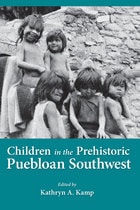
Is there evidence of children in the archaeological record? Some would answer no, that "subadults" can only be distinguished when there is osteological confirmation. Others might suggest that the reason children don’t exist in prehistory is because no one has looked for them, much as no one had looked for women in the same context until recently.
Focusing on the Southwest, contributors to this volume attempt to find some of those children, or at least show how they might be found. They address two issues: what was the cultural construction of childhood? What were childrens' lives like?
Determining how cultures with written records have constructed childhood in the past is hard enough, but the difficulty is magnified in the case of ancient Puebloan societies. The contributors here offer approaches from careful analysis of artifacts and skeletal remains to ethnographic evidence in rock art. Topics include ceramics and evidence of child manufacture and painting, cradleboards, evidence of child labor, and osteological evidence of health conditions.
Chronological Analysis of Tsegi Phase Sites in Northeastern Arizona
Jeffrey S. Dean
University of Arizona Press, 1970
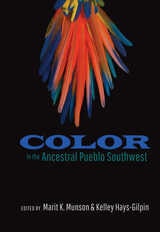
Color in the Ancestral Pueblo Southwest
Edited by Marit K. Munson and Kelley Hays-Gilpin
University of Utah Press, 2019
Beginning with the technical and practical concerns of acquiring pigments and using them to create paints, the authors explore how connections to landscapes and sacred places are embodied by many colorful materials. Contributors examine the development of polychromes and their juxtaposition with black-on-white vessels; document how color was used in rock paintings and architecture; and consider the inherent properties of materials, arguing that shell, minerals, and stone were valued not only for color but for other visual properties as well. The book concludes by considering the technological, economic, social, and ideological factors at play and demonstrates the significant role color played in aesthetic choices.
Connected Communities
Networks, Identity, and Social Change in the Ancient Cibola WorldMatthew A. Peeples
University of Arizona Press, 2018
In Connected Communities, Matthew A. Peeples examines a period of dramatic social and political transformation in the ancient Cibola region (ca. A.D. 1150–1325). He analyzes archaeological data generated during a century of research through the lens of new and original social theories and methods focused on exploring identity, social networks, and social transformation. In so doing, he demonstrates the value of comparative, synthetic analysis.
The book addresses some of the oldest enduring questions in archaeology: How do large-scale social identities form? How do they change? How can we study such processes using material remains? Peeples approaches these questions using a new set of methods and models from the broader comparative social sciences (relational sociology and social networks) to track the trajectories of social groups in terms of both networks of interactions (relations) and expressions of similarity or difference (categories). He argues that archaeological research has too often conflated these different kinds of social identity and that this has hindered efforts to understand the drivers of social change.
In his strikingly original approach, Peeples combines massive amounts of new data and comparative explorations of contemporary social movements to provide new insights into how social identities formed and changed during this key period.
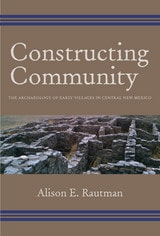
Constructing Community
The Archaeology of Early Villages in Central New MexicoAlison E. Rautman
University of Arizona Press, 2014
Rautman tackles a very broad topic: how archaeologists use material evidence to infer and imagine how people lived in the past, how they coped with everyday decisions and tensions, and how they created a sense of themselves and their place in the world. Using several different lines of evidence, she reconstructs what life was like for the Ancestral Pueblo people of Salinas, and identifies some of the specific strategies that they used to develop and sustain their villages over time.
Examining evidence of each site’s construction and developing spatial layout, Rautman traces changes in community organization across the architectural transitions from pithouses to jacal structures to unit pueblos, and finally to plaza-oriented pueblos. She finds that, in contrast to some other areas of the American Southwest, early villagers in Salinas repeatedly managed their built environment to emphasize the coherence and unity of the village as a whole. In this way, she argues, people in early farming villages across the Salinas region actively constructed and sustained a sense of social community.