Results by title
119 books match the query 'Race in literature' and 11 start with c
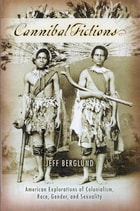
Cannibal Fictions
American Explorations of Colonialism, Race, Gender, and SexualityJeff Berglund
University of Wisconsin Press, 2006
Cannibal Fictions brings together two discrete periods in U.S. history: the years between the Civil War and World War I, the high-water mark in America's imperial presence, and the post-Vietnam era, when the nation was beginning to seriously question its own global agenda. Berglund shows how P. T. Barnum, in a traveling exhibit featuring so-called "Fiji cannibals," served up an alien "other" for popular consumption, while Edgar Rice Burroughs in his Tarzan of the Apes series tapped into similar anxieties about the eruption of foreign elements into a homogeneous culture. Turning to the last decades of the twentieth century, Berglund considers how treatments of cannibalism variously perpetuated or subverted racist, sexist, and homophobic ideologies rooted in earlier times. Fannie Flagg's novel Fried Green Tomatoes invokes cannibalism to new effect, offering an explicit critique of racial, gender, and sexual politics (an element to a large extent suppressed in the movie adaptation). Recurring motifs in contemporary Native American writing suggest how Western expansion has, cannibalistically, laid the seeds of its own destruction. And James Dobson's recent efforts to link the pro-life agenda to allegations of cannibalism in China testify still further to the currency and pervasiveness of this powerful trope.
By highlighting practices that preclude the many from becoming one, these representations of cannibalism, Berglund argues, call into question the comforting national narrative of e pluribus unum.
Caribbean Crusaders and the Harlem Renaissance
Joyce Moore Turner
University of Illinois Press, 2005
To explore the roots of the Caribbean emigres' radical ideology and the strategies used to extend agitation from Harlem to national and international platforms, the study draws on the papers and writings of Hermina Huiswoud, Cyril Briggs, the Reverend E. Ethelred Brown, Langston Hughes, and Richard B. Moore, as well as from interviews and biographies of related contemporary figures. It also incorporates census records, FBI files, and hundreds of documents from the recently opened Russian Archive.
Through a focus on Otto Huiswoud, the sole African American charter member of the Communist Party, and his wife, Hermina, Turner exposes the complex developments within the socialist and communist parties on the question of race. The account ranges beyond Harlem to Europe, Africa, and the Soviet Union to reveal the breadth, depth, and nearly global reach of the Afro-Caribbean activists' activities.

Caste War Now and Never
Unreading Gender, Race, and Land in YucatánS. B. West
University of Arizona Press, 2026
In Caste War Now and Never scholar S. B. West considers Yucatán’s nineteenth-century Caste War, the longest and most violent Indigenous uprising of the Western Hemisphere, to argue that it actually never occurred.
Instead, West writes that the violent events grouped under the “Caste War” label must be understood through alternative frameworks that resist the emergent logics of race war and include related regulatory matrices like gender and land. Through this lens, the Caste War emerges as a discursive construct rooted in an anti-Indigenous archive that served the political interests of a frustrated regional elite during the rise of liberalism and nationhood. West argues that Caste War discourse unfolds as a technology that mobilized and legitimized genocidal actions against racialized rebels and inspired assimilation into hegemonic political and social structures.
In the second half of the book, West looks at the Caste War to engage its contemporary polysemic nature through close readings of Yucatec Maya texts, stories, and other forms of knowledge production. These sources reframe the Caste War as an important part of a framework of resistance that defies colonial time and reclaims narrative control of its events.
Caste War Now and Never captures how Maya communities understand the conflict as ongoing and demonstrates that although the Caste War never occurred as such, it continues to endure presently.
Challenges of Diversity
Essays on AmericaSollors, Werner
Rutgers University Press, 2017
What unites and what divides Americans as a nation? Who are we, and can we strike a balance between an emphasis on our divergent ethnic origins and what we have in common? Opening with a survey of American literature through the vantage point of ethnicity, Werner Sollors examines our evolving understanding of ourselves as an Anglo-American nation to a multicultural one and the key role writing has played in that process.
Challenges of Diversity contains stories of American myths of arrival (pilgrims at Plymouth Rock, slave ships at Jamestown, steerage passengers at Ellis Island), the powerful rhetoric of egalitarian promise in the Declaration of Independence and the heterogeneous ends to which it has been put, and the recurring tropes of multiculturalism over time (e pluribus unum, melting pot, cultural pluralism). Sollors suggests that although the transformation of this settler country into a polyethnic and self-consciously multicultural nation may appear as a story of great progress toward the fulfillment of egalitarian ideals, deepening economic inequality actually exacerbates the divisions among Americans today.

Claiming Others
Transracial Adoption and National BelongingMark C. Jerng
University of Minnesota Press, 2010
Jerng considers how adoption makes us rethink the parent-child bond as central to issues of race and nationality, showing the ways adoption also speaks to broader questions about our history and identity. He analyzes adoption through a diverse set of texts, including the 1851 Massachusetts statute that established adoption as we understand it today, early adoption manuals, the New York Times blog Relative Choices, and the work of John Tanner, Lydia Maria Child, William Faulkner, Charles Chesnutt, Chang-rae Lee, and David Henry Hwang.
Imaginative and social practices of transracial adoption have shaped major controversies, Jerng argues, from Native American removal to slavery to cold war expansionism in the twentieth century and the contemporary global market in children. As Claiming Others makes clear, understanding adoption is crucial not just to understanding the history between races in the United States, but also the meaning of emancipation and the role of family in nationhood.
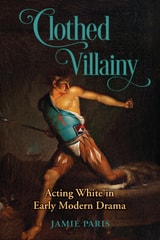
Clothed Villainy
Acting White in Early Modern DramaJamie Paris
University of Alabama Press, 2026
Examines how centuries-old stagecraft shaped modern racial politics—and why the performance of whiteness still commands the spotlight.
From Shakespearean blackface to the alt-right’s khaki-clad protests, Clothed Villainy: Acting White in in Early Modern Drama by Jamie Paris confronts the uncomfortable truths of racial performance across centuries. Paris argues that whiteness is not a fixed identity but a precarious and performative construct—shaped and sustained through actions, appearances, and cultural scripts.
Drawing on critical race theory, performance studies, and Indigenous scholarship, Clothed Villainy traces how racial scripts—whether “playing Black,” “playing Indian,” or especially “playing white”—have been used to uphold white supremacy and erase marginalized identities. By examining the costuming and characterization of white actors portraying Black villains on the early modern stage, Paris reveals how these theatrical traditions continue to echo in contemporary racial politics.
Written with bold clarity and personal insight, this book opens space for reimagining race, history, and identity through a more critical and inclusive lens. Clothed Villainy is essential reading for scholars, students, and anyone seeking to understand the deep-rooted performance of race in society and how we might reimagine it for a more equitable future.
Colonialism and Race in Luso-Hispanic Literature
Jerome C. Branche
University of Missouri Press, 2006
Colorblind Tools
Global Technologies of Racial PowerMarzia Milazzo
Northwestern University Press, 2023
Winner of the 2023 Association for Ethnic Studies Outstanding Book Award
A study of anti-Blackness and white supremacy across four continents demonstrates that colorblindness is neither new nor a subtype of racist ideology, but a constitutive technology of racism
In Colorblind Tools, Marzia Milazzo offers a transnational account of anti-Blackness and white supremacy that pushes against the dominant emphasis on historical change pervading current racial theory. This emphasis on change, she contends, misses critical lessons from the past.
Bringing together a capacious archive of texts on race produced in Brazil, Cuba, Mexico, Panama, the United States, and South Africa from multiple disciplines and genres, Milazzo uncovers transnational continuities in structural racism and white supremacist discourse from the inception of colonial modernity to the present. In the process, she traces the global workings of what she calls colorblind tools: technologies and strategies that at once camouflage and reproduce white domination. Whether examining Rijno van der Riet’s defense of slavery in the Cape Colony, discourses of racial mixture in Latin American eugenics and their reverberations in contemporary scholarship, the pitfalls of white “antiracism,” or Chicana indigenist aesthetics, Milazzo illustrates how white people collectively disavow racism to maintain power across national boundaries, and how anti-Black and colonial logics can be reproduced even in some decolonial literatures. Milazzo’s groundbreaking study proves that colorblindness is not new, nor is it a subtype of racist ideology or a hallmark of our era. It is a constitutive technology of racism—a tool the master cannot do without.
Coloring Locals
Racial Formation in Katie Chopin's "Youth's Companion" StoriesBonnie James Shaker
University of Iowa Press, 2003
Chopin's canonical status as a feminist rebel and reformer conflicts with the fact that one of her most supportive publishers throughout her life was the Youth's Companion, a juvenile periodical whose thoroughly orthodox “family values” contributed to its success as the longest-running and, at one time, most widely circulating periodical in nineteenth-century America. Not surprisingly, Chopin’s Youth’s Companion stories differ from her canonical texts in that they embrace and advance ideals of orthodox white femininity and masculinity. Rather than viewing these two representations as being at odds with each other, Bonnie Shaker asserts that Chopin's endorsement of conventional gender norms is done in the service of a second political agenda beyond her feminism, one that can help the reader appreciate nuances of identity construction previously misunderstood or overlooked in the body of her work.
Contesting the Past, Reconstructing the Nation
American Literature and Culture in the Gilded Age, 1876-1893Benjamin A. Railton
University of Alabama Press, 2007
In this study of Gilded Age literature and culture, Ben Railton proposes that in the years after Reconstruction, America’s identity was often contested through distinct and competing conceptions of the nation’s history. He argues that the United States moved toward unifying and univocal historical narratives in the years between the Centennial and Columbian Expositions, that ongoing social conflict provided sites for complications of those narratives, and that works of historical literature offer some of the most revealing glimpses into the nature of those competing visions.
Gilded Age scholarship often connects the period to the 20th-century American future, but Railton argues that it is just as crucial to see how the era relates to the American past. He closely analyzes the 1876 and 1893 Expositions, finding that many of the period’s central trends, from technology to imperialism, were intimately connected to particular visions of the nation’s history. Railton’s concern is with four key social questions: race, Native Americans, women, and the South. He provides close readings of a number of texts for the ways they highlight these issues. He examines established classics (The Adventures of Huck Finn and The Bostonians); newer additions to the canon (The Conjure Woman, Life Among the Piutes, The Story of Avis); largely forgotten best-sellers (Uncle Remus, The Grandissimes); unrecovered gems (Ploughed Under, Where the Battle Was Fought); and autobiographical works by Douglass and Truth, poems by Harper and Piatt, and short stories by Woolson and Cook.
These readings, while illuminating the authors themselves, contribute to ongoing conversations over historical literature’s definition and value, and a greater understanding of not only American society in the Gilded Age, but also debates on our shared but contested history that remain very much alive in the present.
Crossing the Line
Racial Passing in Twentieth-Century U.S. Literature and CultureGayle Wald
Duke University Press, 2000
Wald begins her reading of twentieth-century passing narratives by analyzing works by African American writers James Weldon Johnson, Jessie Fauset, and Nella Larsen, showing how they use the “passing plot” to explore the negotiation of identity, agency, and freedom within the context of their protagonists' restricted choices. She then examines the 1946 autobiography Really the Blues, which details the transformation of Milton Mesirow, middle-class son of Russian-Jewish immigrants, into Mezz Mezzrow, jazz musician and self-described “voluntary Negro.” Turning to the 1949 films Pinky and Lost Boundaries, which imagine African American citizenship within class-specific protocols of race and gender, she interrogates the complicated representation of racial passing in a visual medium. Her investigation of “post-passing” testimonials in postwar African American magazines, which strove to foster black consumerism while constructing “positive” images of black achievement and affluence in the postwar years, focuses on neglected texts within the archives of black popular culture. Finally, after a look at liberal contradictions of John Howard Griffin’s 1961 auto-ethnography Black Like Me, Wald concludes with an epilogue that considers the idea of passing in the context of the recent discourse of “color blindness.”
Wald’s analysis of the moral, political, and theoretical dimensions of racial passing makes Crossing the Line important reading as we approach the twenty-first century. Her engaging and dynamic book will be of particular interest to scholars of American studies, African American studies, cultural studies, and literary criticism.