57 books match the query 'Readings' and 5 start with c
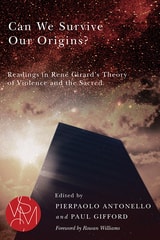
cover of Can We Survive Our Origins?: Readings in René Girard's Theory of Violence and the Sacred

Can We Survive Our Origins?

Readings in René Girard's Theory of Violence and the Sacred

Pierpaolo Antonello

Michigan State University Press, 2015
Are religions intrinsically violent (as is strenuously argued by the ‘new atheists’)? Or, as Girard argues, have they been functionally rational instruments developed to manage and cope with the intrinsically violent runaway dynamic that characterizes human social organization in all periods of human history? Is violence decreasing in this time of secular modernity post-Christendom (as argued by Steven Pinker and others)? Or are we, rather, at increased and even apocalyptic risk from our enhanced powers of action and our decreased socio-symbolic protections? Rene Girard’s mimetic theory has been slowly but progressively recognized as one of the most striking breakthrough contributions to twentieth-century critical thinking in fundamental anthropology: in particular for its power to model and explain violent sacralities, ancient and modern. The present volume sets this power of explanation in an evolutionary and Darwinian frame. It asks: How far do cultural mechanisms of controlling violence, which allowed humankind to cross the threshold of hominization—i.e., to survive and develop in its evolutionary emergence—still represent today a default setting that threatens to destroy us? Can we transcend them and escape their field of gravity? Should we look to—or should we look beyond—Darwinian survival? What—and where (if anywhere)—is salvation?
[more]
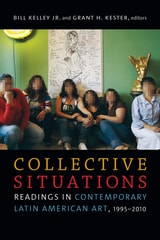
cover of Collective Situations: Readings in Contemporary Latin American Art, 1995–2010

Collective Situations

Readings in Contemporary Latin American Art, 1995–2010

Bill Kelley Jr. and Grant H. Kester, editors

Duke University Press, 2017

In Collective Situations scholars, artists, and art collectives present a range of socially engaged art practices that emerged in Latin America during the Pink Tide period, between 1995 and 2010. This volume's essays, interviews, and artist's statements—many of which are appearing in English for the first time—demonstrate the complex relationship between moments of political transformation and artistic production. Whether addressing human rights in Colombia, the politics of urban spaces in Brazil, the violent legacy of military dictatorships in the region, or art’s intersection with public policy, health, and the environment, the contributors outline the region’s long-standing tradition of challenging ideas about art and the social sphere through experimentation. Introducing English-language readers to some of the most dynamic and innovative contemporary art in Latin America, Collective Situations documents new possibilities for artistic practice, collaboration, and creativity in ways that have the capacity to foster vibrant forms of democratic citizenship.

Contributors
Gavin Adams, Mariola V. Alvarez, Gustavo Buntinx, María Fernanda Cartagena, David Gutiérrez Castañeda, Fabian Cereijido, Paloma Checa-Gismero, Kency Cornejo, Raquel de Anda, Bill Kelley Jr., Grant H. Kester, Suzanne Lacy, Ana Longoni, Rodrigo Martí, Elize Mazadiego, Annie Mendoza, Alberto Muenala, Prerana Reddy, Maria Reyes Franco, Pilar Riaño-Alcalá, Juan Carlos Rodríguez
[more]
cover of Compassion and Responsibility: Readings in the History of Social Welfare Policy in the United States

Compassion and Responsibility

Readings in the History of Social Welfare Policy in the United States

Frank R. Breul and Steven J. Diner

University of Chicago Press, 1985
[more]
cover of Crime And Capitalism: Readings in Marxist Crimonology

Crime And Capitalism

Readings in Marxist Crimonology

edited by David F. Greenberg

Temple University Press, 1993
"This book is superb in every way.... [It] is the only book that attempts to put into perspective just what the possible relationship between praxis and Marxist criminology might (should) be." --Eleanor Miller, University of Wisconsin, Milwaukee In this expanded and updated second edition of a revered reader in Marxist criminology, editor David F. Greenberg brings together writings about crime that range from classic articles by Karl Marx and Friedrich Engels to a variety of contemporary essays. Taking an explicitly Marxist point of view, the articles deal with various aspects of criminology, including organized crime, delinquency, urban crime, criminal law, and criminal justice. To the original text, Greenberg has added pieces on race and crime, gender and crime, rape, arson for profit, and auto theft. With extensive prefatory material prepared by Greenberg, as well as editorial notes, and a glossary of Marxist terminology, Crime and Capitalism is an indispensable text for students and professionals in the fields of criminology, criminal justice, social history, and sociology.
[more]
cover of Cultural Melancholy: Readings of Race, Impossible Mourning, and African American Ritual

Cultural Melancholy

Readings of Race, Impossible Mourning, and African American Ritual

Jermaine Singleton

University of Illinois Press, 2015

A daring cultural and literary studies investigation, Cultural Melancholy explores the legacy of unresolved grief produced by ongoing racial oppression and resistance in the United States. Using acute analysis of literature, drama, musical performance, and film, Singleton demonstrates how rituals of racialization and resistance transfer and transform melancholy discreetly across time, consolidating racial identities and communities along the way. He also argues that this form of impossible mourning binds racialized identities across time and social space by way of cultural resistance efforts.

Singleton develops the concept of "cultural melancholy" as a response to scholarship that calls for the separation of critical race studies and psychoanalysis, excludes queer theoretical approaches from readings of African American literatures and cultures, and overlooks the status of racialized performance culture as a site of serious academic theorization. In doing so, he weaves critical race studies, psychoanalysis, queer theory, and performance studies into conversation to uncover a host of hidden dialogues—psychic and social, personal and political, individual and collective—for the purpose of promoting a culture of racial grieving, critical race consciousness, and collective agency.

Wide-ranging and theoretically bold, Cultural Melancholy counteracts the racial legacy effects that plague our twenty-first century multiculture.

[more]