Results by title
62 books match the query 'Reality' and 2 start with c
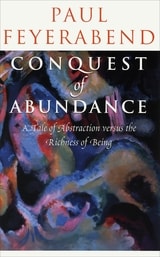
Conquest of Abundance
A Tale of Abstraction versus the Richness of BeingPaul Feyerabend
University of Chicago Press, 1999
From flea bites to galaxies, from love affairs to shadows, Paul Feyerabend reveled in the sensory and intellectual abundance that surrounds us. He found it equally striking that human senses and human intelligence are able to take in only a fraction of these riches. "This a blessing, not a drawback," he writes. "A superconscious organism would not be superwise, it would be paralyzed." This human reduction of experience to a manageable level is the heart of Conquest of Abundance, the book on which Feyerabend was at work when he died in 1994.
Prepared from drafts of the manuscript left at his death, working notes, and lectures and articles Feyerabend wrote while the larger work was in progress, Conquest of Abundance offers up rich exploration and startling insights with the charm, lucidity, and sense of mischief that are his hallmarks. Feyerabend is fascinated by how we attempt to explain and predict the mysteries of the natural world, and he looks at the ways in which we abstract experience, explain anomalies, and reduce wonder to formulas and equations. Through his exploration of the positive and negative consequences of these efforts, Feyerabend reveals the "conquest of abundance" as an integral part of the history and character of Western civilization.
"Paul Feyerabend . . . was the Norman Mailer of philosophy. . . . brilliant, brave, adventurous, original and quirky."—Richard Rorty, New Republic
"As much a smudged icon as a philosophical position holder, [Feyerabend] was alluring and erotic, a torch singer for philosophical anarchy."—Nancy Maull, New York Times Book Review
"[A] kind of final testament of Feyerabend's thought . . . Conquest of Abundance is as much the product of a brilliant, scintillating style as of an immense erudition and culture. . . . This book is as abundant and rich as the world it envisions."—Arkady Plotnitsky, Chicago Tribune
[more]

Crash Cultures
Modernity, Mediation and the MaterialEdited by Jane Arthurs and Iain Grant
Intellect Books, 1995
Since Diana's car crash in August 1997, media interest in the crash as an event needing explanation has proliferated. A glut of documentaries on television have investigated the social and scientific history of our responses to the car crash, as well as showing the personal impact of the crash on individual lives.
In trying to give meaning to one celebrity crash, the more general significance of the car crash, its challenge to rational control or explanation, its disregard for the subject and its will, became the focus for attention. Coincidentally, the two most newsworthy films of 1997 were David Cronenberg's Crash and James Cameron's Titanic, both of which generated intense popular interest.
The principal purpose of this collection of essays is to subject texts, within which crashes figure, to well-defined cultural study. The themes that emerge from this collection, which is truly experimental in attempting to draw together the resources for a cultural study of events, are many and varied. Moreover, they vary in format, in order to bring as many modes of address as possible to bear on the crashes that catastrophically and fantastically punctuate the fabric of everyday life.
[more]