Results by title
167 books match the query 'Reform' and 15 start with c
CCAR JOURNAL - SPRING 2020
HALACHAH AND REFORM JUDAISMElaine Rose Glickman
Central Conference of American Rabbis, 2020
CCAR Journal - Fall 2025
The Reform Jewish Quarterly: AI and the RabbinateRabbanit Sara Tillinger Wolkenfeld and Rabbi Geoffrey A. Mitelman
Central Conference of American Rabbis, 2025
This issue of the CCAR Journal explores the rapidly evolving intersection of artificial intelligence and the rabbinate. Through a range of reflective articles, contributors examine how AI is shaping Jewish life, leadership, and ethical discourse. The issue also contains general articles, new book reviews, and poetry.
CCAR Journal - Spring 2025
The Reform Jewish QuarterlyRabbi Edwin C. Goldberg
Central Conference of American Rabbis, 2025
This edition of CCAR Journal considers various topics, including loneliness and the rabbinate, Judah and Tamar's encounter, and Jewish brides' breads. The issue also contains new book reviews, poetry and a CCAR responsum on removing a pacemaker from a corpse for reuse.
CCAR Journal - Spring 2026
The Reform Jewish Quarterly: The World Union for Progressive Judaism at One HundredRabbi Edwin C. Goldberg, Rabbi Daniel H. Freelander, Rabbi Professor Deborah Kahn-Harris
Central Conference of American Rabbis, 2026
This issue, which celebrates the centenary of the founding of the World Union for Progressive Judaism in 1926, examines the impact of the WUPJ on the growth of Progressive Judaism around the globe. The articles explore the early history of the WUPJ and the creation of rabbinic seminaries, youth movements, and liturgies, as well as key regions of the movement: the United Kingdom, Europe, South Africa, South America, Australia and Aotearoa-New Zealand, and Israel. The issue also contains new book reviews and poetry.
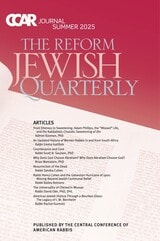
CCAR Journal - Summer 2025
The Reform Jewish QuarterlyRabbi Edwin C. Goldberg
Central Conference of American Rabbis, 2025
This edition of CCAR Journal includes articles on women rabbis in South Africa, resurrection of the dead, chesed in Mussar, the Jewish history of bourbon, and much more. The issue also contains a book review, poetry, and a CCAR responsum on splitting cremated ashes for burial in two places.
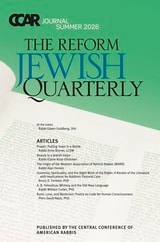
CCAR Journal - Summer 2026
The Reform Jewish QuarterlyRabbi Edwin C. Goldberg
Central Conference of American Rabbis, 2026
The Summer issue of CCAR Journal: The Reform Jewish Quarterly contains articles on prayer, beauty the Western Association of Reform Rabbis, a review of literature with implications for pastoral care, A.B. Yehoshua, and Rumi, along with book reviews and poetry.
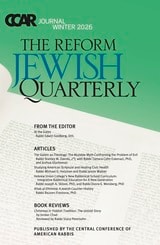
CCAR Journal - Winter 2026
The Reform Jewish QuarterlyRabbi Edwin C. Goldberg
Central Conference of American Rabbis, 2026
The Winter 2026 issue of CCAR Journal: The Reform Jewish Quarterly contains articles on the golem, American civic health, Hebrew Union College's new rabbinical curriculum, and Jewish history in the Islamic world. A responsum on burial of a person in a pet cemetery and a translation of the preface to Jacob Sasportas’s Tol’dot Yaakov are also included, along with book reviews and poetry.
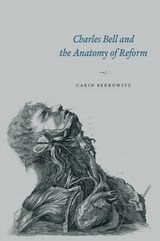
Charles Bell and the Anatomy of Reform
Carin Berkowitz
University of Chicago Press, 2015
In Charles Bell and the Anatomy of Reform, Carin Berkowitz takes readers into Bell’s world, helping us understand the life of medicine before the modern separation of classroom, laboratory, and clinic. Through Bell’s story, we witness the age when modern medical science, with its practical universities, set curricula, and medical professionals, was born.
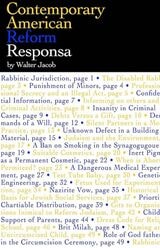
Contemporary American Reform Responsa - PDF Electronic Version
Rabbi Walter Jacob
Central Conference of American Rabbis, 1987
When is abortion permitted? Should smoking be banned in synagogue buildings? Do we recite Kaddish for a convicted criminal? May human blood be sold for medical purposes? What is the Reform position on the use of mikvah? These questions and more are the topic of this volume, edited by Rabbi Walter Jacob and originally published in 1987. The questions included in this volume reflect the concerns of Reform Jews at the time the book was published, and much of it is still relevant today.
Contemporary Reform Responsa - PDF Electronic Version
Rabbi Solomon B. Freehof
Central Conference of American Rabbis, 1974
Can a synagogue share a building with a Unitarian Church? Can a religious marriage be performed without a civil marriage? Is it allowed to photocopy from books? Must a convert be buried in a Jewish cemetery?
These questions and more are the topic of this volume, edited by Dr. Solomon Freehof and originally published in 1974. The questions included in this volume reflect the concerns of Reform Jews at the time the book was published, much of which is still relevant today.
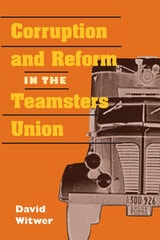
Corruption and Reform in the Teamsters Union
David Witwer
University of Illinois Press, 2002
Almost since its creation, recurring problems with corruption bedeviled the Teamsters Union. David Witwer provides the first in-depth historical study of the forces that contributed to the Teamsters' troubled past and the mechanisms the union employed--from top-down directives to grassroots measures--to combat corruption.
Witwer draws on the perspectives of rank-and-file members, union leaders, and the criminal element to explain the processes that allowed organized crime to seize power inside the union. His account includes the infamous links between the Mafia and union head Jimmy Hoffa, but he also tells the little-known story of the McClellan Committee investigation that first brought those links to light. Witwer also examines how anti-labor forces used the Teamsters' unsavory reputation to influence popular and legislative opinion in a broad attack on workers' rights.
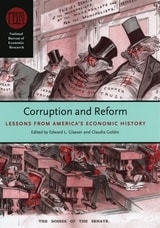
Corruption and Reform
Lessons from America's Economic HistoryEdited by Edward L. Glaeser and Claudia Goldin
University of Chicago Press, 2006
Contributors to this volume address the measurement and consequences of fraud and corruption and the forces that ultimately led to their decline within the United States. They show that various approaches to reducing corruption have met with success, such as deregulation, particularly “free banking,” in the 1830s. In the 1930s, corruption was kept in check when new federal bureaucracies replaced local administrations in doling out relief. Another deterrent to corruption was the independent press, which kept a watchful eye over government and business. These and other facets of American history analyzed in this volume make it indispensable as background for anyone interested in corruption today.
Covenant of Justice
Prayers, Poems, and Meditations from Women of Reform JudaismWomen of Reform Judaism
Central Conference of American Rabbis, 2025
Copublished with Women of Reform Judaism
Current Reform Responsa - PDF Electronic Version
Rabbi Solomon B. Freehof
Central Conference of American Rabbis, 2021
This volume of Responsa was originally published in 1969 by Dr. Solomon Freehof, a leading scholar and Chair of the Responsa Committee of the Central Conference of American Rabbis. In these Responsa, Dr. Freehof presents his responses to questions concerning the observance and interpretation of traditional Jewish customs and law. Topics include conversion, holiday observance, medical ethics, ritual concerns, drug use, gambling, and much more.
Cárdenas Compromised
The Failure of Reform in Postrevolutionary YucatánBen Fallaw
Duke University Press, 2001
For historical, geographical, and ethnic reasons, Yucatán was the center of large-scale land reform after the Mexican Revolution. A long-standing revolutionary tradition, combined with a harsh division between a powerful white minority and a poor, Maya-speaking majority, made the region the perfect site for Cárdenas to experiment by launching an ambitious top-down project to mobilize the rural poor along ethnic and class lines. The regime encouraged rural peasants to form collectives, hacienda workers to unionize, and urban laborers to strike. It also attempted to mobilize young people and women, to challenge Yucatán’s traditional, patriarchal social structure, to reach out to Mayan communities, and to democratize the political process. Although the project ultimately failed, political dialogue over Cárdenas’s efforts continues. Rejecting both revisionist (anti-Cárdenas) and neopopulist (pro-Cárdenas) interpretations, Fallaw overturns the notion that the state allowed no room for the agency of local actors. By focusing on historical connections across class, political, and regional lines, Fallaw transforms ideas on Cardenismo that have long been accepted not only in Yucatán but throughout Mexico.
This book will appeal to scholars of Mexican history and of Latin American state formation, as well as to sociologists and political scientists interested in modern Mexico.