Results by title
76 books match the query 'Representation' and 6 start with c

Cannibal Democracy
Race and Representation in the Literature of the AmericasZita Nunes
University of Minnesota Press, 2008
Zita Nunes argues that the prevailing narratives of identity formation throughout the Americas share a dependence on metaphors of incorporation and, often, of cannibalism. From the position of the incorporating body, the construction of a national and racial identity through a process of assimilation presupposes a remainder, a residue.
Nunes addresses works by writers and artists who explore what is left behind in the formation of national identities and speak to the limits of the contemporary discourse of democracy. Cannibal Democracy tracks its central metaphor’s circulation through the work of writers such as Mário de Andrade, W. E. B. Du Bois, and Toni Morrison and journalists of the black press, as well as work by visual artists including Magdalena Campos-Pons and Keith Piper, and reveals how exclusion-understood in terms of what is left out-can be fruitfully understood in terms of what is left over from a process of unification or incorporation.
Nunes shows that while this remainder can be deferred into the future-lurking as a threat to the desired stability of the present-the residue haunts discourses of national unity, undermining the ideologies of democracy that claim to resolve issues of race.
Zita Nunes is associate professor of English at the University of Maryland, College Park.

Chicanos And Film
Representation and ResistanceChon A. Noriega
University of Minnesota Press, 1992
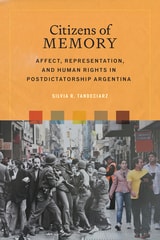
Citizens of Memory
Affect, Representation, and Human Rights in Postdictatorship ArgentinaSilvia R. Tandeciarz
Bucknell University Press, 2026
Published by Bucknell University Press. Distributed worldwide by Rutgers University Press.
Civilization And Violence
Regimes of Representation in Nineteenth-Century ColombiaCristina Rojas
University of Minnesota Press, 2001
Civilization and violence are not necessarily the antagonists we presume-withcivilization taming violence, and violence unmaking civilization. Focusing on postindependence Colombia, this book brings to light the ways in which violenceand civilization actually intertwined and reinforced each other in the development of postcolonial capitalism.
The narratives of civilization and violence, Cristina Rojas contends, play key roles in the formation of racial, gender, and class identities; they also provide pivotal logic to both the formation of the nation and the processes of capitalist development. During the Liberal era of Colombian history (1849-1878), a dominant creole elite enforced a "will to civilization" that sought to create a new world in its own image. Rojas explores different arenas in which this pursuit meant the violent imposition of white, liberal, laissez-faire capitalism. Drawing on a wide range of social theory, Rojas develops a new way of understanding the relationship between violence and the formation of national identity-not just in the history of Colombia, but also in the broader narratives of civilization.
Confronting AIDS through Literature
The Responsibilities of RepresentationEdited by Judith Laurence Pastore
University of Illinois Press, 1993
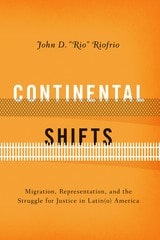
Continental Shifts
Migration, Representation, and the Struggle for Justice in Latin(o) AmericaBy John D. "Rio" Riofrio
University of Texas Press, 2015
Applying a broad geographical approach to comparative Latino literary and cultural studies, Continental Shifts illuminates how the discursive treatment of Latinos changed dramatically following the enactment of NAFTA—a shift exacerbated by 9/11. While previous studies of immigrant representation have focused on single regions (the US/Mexico border in particular), specific genres (literature vs. political rhetoric), or individual groups, Continental Shifts unites these disparate discussions in a provocative, in-depth examination.
Bringing together a wide range of groups and genres, this intercultural study explores novels by Latin American and Latino writers, a border film by Tommy Lee Jones and Guillermo Arriaga, “viral” videos of political speeches, popular television programming (particularly shows that feature incarceration and public shaming), and user-generated YouTube videos. These cultural products reveal the complexity of Latino representations in contemporary discourse. While tropes of Latino migrants as threatening, diseased foreign bodies date back to the nineteenth century, Continental Shifts marks the more pernicious, recent images of Latino laborers (legal and not) in a variety of contemporary media. Using vivid examples, John Riofrio demonstrates the connections between rhetorical and ideological violence and the physical and psychological violence that has more intensely plagued Latino communities in recent decades. Culminating with a consideration of the “American” identity, this eye-opening work ultimately probes the nation’s ongoing struggle to uphold democratic ideals amid dehumanizing multiethnic tension.