Results by title
53 books match the query 'Revolutionaries' and 3 start with c
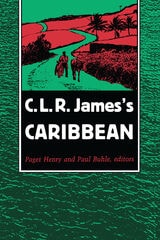
C. L. R. James's Caribbean
Paget Henry and Paul Buhle, eds.
Duke University Press, 1992
For more than half a century, C. L. R. James (1901–1989)—"the Black Plato," as coined by the London Times—has been an internationally renowned revolutionary thinker, writer, and activist. Born in Trinidad, his lifelong work was devoted to understanding and transforming race and class exploitation in his native West Indies, as well as in Britain and the United States. In C. L. R. James's Caribbean, noted scholars examine the roots of both James's life and oeuvre in connection with the economic, social, and political environment of the West Indies.
Drawing upon James's observations of his own life as revealed to interviewers and close friends, this volume provides an examination of James's childhood and early years as colonial literatteur and his massive contribution to West Indian political-cultural understanding. Moving beyond previous biographical interpretations, the contributors here take up the problem of reading James's texts in light of poststructuralist criticism, the implications of his texts for Marxist discourse, and for problems of Caribbean development.
[more]
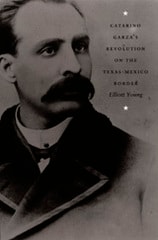
Catarino Garza's Revolution on the Texas-Mexico Border
Elliott Young
Duke University Press, 2004
Catarino Garza’s Revolution on the Texas-Mexico Border rescues an understudied episode from the footnotes of history. On September 15, 1891, Garza, a Mexican journalist and political activist, led a band of Mexican rebels out of South Texas and across the Rio Grande, declaring a revolution against Mexico’s dictator, Porfirio Díaz. Made up of a broad cross-border alliance of ranchers, merchants, peasants, and disgruntled military men, Garza’s revolution was the largest and longest lasting threat to the Díaz regime up to that point. After two years of sporadic fighting, the combined efforts of the U.S. and Mexican armies, Texas Rangers, and local police finally succeeded in crushing the rebellion. Garza went into exile and was killed in Panama in 1895.
Elliott Young provides the first full-length analysis of the revolt and its significance, arguing that Garza’s rebellion is an important and telling chapter in the formation of the border between Mexico and the United States and in the histories of both countries. Throughout the nineteenth century, the borderlands were a relatively coherent region. Young analyzes archival materials, newspapers, travel accounts, and autobiographies from both countries to show that Garza’s revolution was more than just an effort to overthrow Díaz. It was part of the long struggle of borderlands people to maintain their autonomy in the face of two powerful and encroaching nation-states and of Mexicans in particular to protect themselves from being economically and socially displaced by Anglo Americans. By critically examining the different perspectives of military officers, journalists, diplomats, and the Garzistas themselves, Young exposes how nationalism and its preeminent symbol, the border, were manufactured and resisted along the Rio Grande.
Elliott Young provides the first full-length analysis of the revolt and its significance, arguing that Garza’s rebellion is an important and telling chapter in the formation of the border between Mexico and the United States and in the histories of both countries. Throughout the nineteenth century, the borderlands were a relatively coherent region. Young analyzes archival materials, newspapers, travel accounts, and autobiographies from both countries to show that Garza’s revolution was more than just an effort to overthrow Díaz. It was part of the long struggle of borderlands people to maintain their autonomy in the face of two powerful and encroaching nation-states and of Mexicans in particular to protect themselves from being economically and socially displaced by Anglo Americans. By critically examining the different perspectives of military officers, journalists, diplomats, and the Garzistas themselves, Young exposes how nationalism and its preeminent symbol, the border, were manufactured and resisted along the Rio Grande.
[more]

Che on My Mind
Margaret Randall
Duke University Press, 2013
Che on My Mind is an impressionistic look at the life, death, and legacy of Che Guevara by the renowned feminist poet and activist Margaret Randall. Recalling an era and this figure, she writes, "I am old enough to remember the world in which [Che] lived. I was part of that world, and it remains a part of me." Randall participated in the Mexican student movement of 1968 and eventually was forced to leave the country. She arrived in Cuba in 1969, less than two years after Che's death, and lived there until 1980. She became friends with several of Che's family members, friends, and compatriots. In Che on My Mind she reflects on his relationships with his family and fellow insurgents, including Fidel Castro. She is deeply admiring of Che's integrity and charisma and frank about what she sees as his strategic errors. Randall concludes by reflecting on the inspiration and lessons that Che's struggles might offer early twenty-first-century social justice activists and freedom fighters.
[more]