Results by title
90 books match the query 'Rituals & Practice' and 5 start with c
CCAR Premarital Counseling Guide for Clergy - PDF Electronic Version
Strengthening Communication and Supporting Jewish ChoicesPaula J. Brody
Central Conference of American Rabbis, 2012
NOTE: This PDF is available for free for CCAR members. Please contact info@ccarpress.org for your free copy.
Includes ideas for pre- and post-marriage counseling sessions, with special sections for intermarrying and conversionary couples, suggestions for intake conversations, suggestions for rabbis who do not officiate and intermarriages, and sample questionnaires and handouts.
Includes ideas for pre- and post-marriage counseling sessions, with special sections for intermarrying and conversionary couples, suggestions for intake conversations, suggestions for rabbis who do not officiate and intermarriages, and sample questionnaires and handouts.
[more]
Champions of Buddhism
Weikza Cults in Contemporary BurmaEdited by Bénédicte Brac de la Perrière, Guillaume Rozenberg, and Alicia Turner
National University of Singapore Press, 2014
Hidden at the margins of Burmese Buddhism and culture, the cults of the weikza shape Burmese culture by bringing together practices of supernatural power and a mission to protect Buddhism. This exciting new research on an often hidden aspect of Burmese religion places weikza in relation to the Vipassana insight meditation movement and conventional Buddhist practices, as well as the contemporary rise of Buddhist fundamentalism. Featuring research based on fieldwork only possible in recent years, paired with reflective essays by senior Buddhist studies scholars, this book situates the weikza cult in relation to broader Buddhist and Southeast Asian contexts, offering interpretations and investigations as rich and diverse as the Burmese expressions of the weikza cults themselves. Champions of Buddhism opens the field to new questions, new problems, and new connections with the study of religion and Southeast Asia in general.
[more]
Coming of Age in Jewish America
Bar and Bat Mitzvah ReinterpretedPatricia Keer Munro
Rutgers University Press, 2016
The Jewish practice of bar mitzvah dates back to the twelfth century, but this ancient cultural ritual has changed radically since then, evolving with the times and adapting to local conditions. For many Jewish-American families, a child’s bar mitzvah or bat mitzvah is both a major social event and a symbolic means of asserting the family’s ongoing connection to the core values of Judaism. Coming of Age in Jewish America takes an inside look at bar and bat mitzvahs in the twenty-first century, examining how the practices have continued to morph and exploring how they serve as a sometimes shaky bridge between the values of contemporary American culture and Judaic tradition.
Interviewing over 200 individuals involved in bar and bat mitzvah ceremonies, from family members to religious educators to rabbis, Patricia Keer Munro presents a candid portrait of the conflicts that often emerge and the negotiations that ensue. In the course of her study, she charts how this ritual is rife with contradictions; it is a private family event and a public community activity, and for the child, it is both an educational process and a high-stakes performance.
Through detailed observations of Conservative, Orthodox, Reform, and independent congregations in the San Francisco Bay Area, Munro draws intriguing, broad-reaching conclusions about both the current state and likely future of American Judaism. In the process, she shows not only how American Jews have forged a unique set of bar and bat mitzvah practices, but also how these rituals continue to shape a distinctive Jewish-American identity.
[more]
Conversion
Miriam Bodian
Rutgers University Press, 2026
In Conversion, Miriam Bodian considers the now-universalized term "conversion" in a Jewish context as broadly as possible, as an act of socioreligious boundary crossing. It charts how, across the long arc of Jewish history from biblical times to the present, patterns of boundary crossing have developed and shifted, whether of Gentiles entering Jewish life or of Jews exiting from it. It analyzes the biblical passages that have informed Jewish thinking about what is required to become a Jew before turning to the early rabbis’ institution of a ritualized process of conversion. It then considers the protean ways in which Gentiles have become Jews and Jews have joined other religious communities from medieval to modern times. A further section is devoted to the complexities of conversion in the contemporary Jewish world, where conversions are not necessarily recognized across denominations, where substantial intermarriage has eroded the traditional boundaries between Jew and Gentile, and where the modern state of Israel plays a role that reaches beyond its borders in determining who is a Jew.
[more]
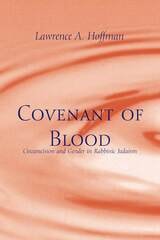
Covenant of Blood
Circumcision and Gender in Rabbinic JudaismLawrence A. Hoffman
University of Chicago Press, 1995
Central to both biblical narrative and rabbinic commentary, circumcision has remained a defining rite of Jewish identity, a symbol so powerful that challenges to it have always been considered taboo. Lawrence Hoffman seeks to find out why circumcision holds such an important place in the Jewish psyche. He traces the symbolism of circumcision through Jewish history, examining its evolution as a symbol of the covenant in the post-exilic period of the Bible and its subsequent meaning in the formative era of Mishnah and Talmud.
In the rabbinic system, Hoffman argues, circumcision was neither a birth ritual nor the beginning of the human life cycle, but a rite of covenantal initiation into a male "life line." Although the evolution of the rite was shaped by rabbinic debates with early Christianity, the Rabbis shared with the church a view of blood as providing salvation. Hoffman examines the particular significance of circumcision blood, which, in addition to its salvific role, contrasted with menstrual blood to symbolize the gender dichotomy within the rabbinic system. His analysis of the Rabbis' views of circumcision and menstrual blood sheds light on the marginalization of women in rabbinic law. Differentiating official mores about gender from actual practice, Hoffman surveys women's spirituality within rabbinic society and examines the roles mothers played in their sons' circumcisions until the medieval period, when they were finally excluded.
In the rabbinic system, Hoffman argues, circumcision was neither a birth ritual nor the beginning of the human life cycle, but a rite of covenantal initiation into a male "life line." Although the evolution of the rite was shaped by rabbinic debates with early Christianity, the Rabbis shared with the church a view of blood as providing salvation. Hoffman examines the particular significance of circumcision blood, which, in addition to its salvific role, contrasted with menstrual blood to symbolize the gender dichotomy within the rabbinic system. His analysis of the Rabbis' views of circumcision and menstrual blood sheds light on the marginalization of women in rabbinic law. Differentiating official mores about gender from actual practice, Hoffman surveys women's spirituality within rabbinic society and examines the roles mothers played in their sons' circumcisions until the medieval period, when they were finally excluded.
[more]