Results by title
140 books match the query 'Science Fiction & Fantasy' and 4 start with c
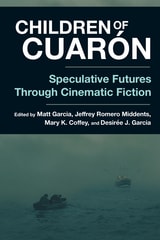
Children of Cuarón
Speculative Futures Through Cinematic FictionMatt Garcia
Rutgers University Press, 2027
Alfonso Cuarón’s Children of Men thrusts readers into a gripping near-future world where environmental collapse and global infertility have fortified borders and torn apart the fabric of society. Its stark depictions of mass deportation, lawless border zones, and the desperate fight for survival echo powerfully through Octavia Butler’s prophetic novels Parable of the Sower and Parable of the Talents, where environmental breakdown, migration, childbirth, and the resilience of women’s bodies form the core of her visionary storytelling. Remarkably, the futures imagined in these works are no longer distant—Butler’s 2024 has arrived, and Cuarón’s 2027 is nearly here. Children of Cuarón: Speculative Futures Through Cinematic Fiction ignites bold, necessary conversations about borders, immigration, and the urgent political, environmental, and social challenges facing our world today. By examining how speculative fiction dares to imagine what comes next, this book invites readers to confront the realities of our present—and the possibilities of our future—with fresh eyes and uncompromising clarity.

Close Encounters
Film, Feminism, and Science FicitonConstance Penley, Elisabeth Lyon, Lynn Spigel, and Janet Bergstrom, Editors
University of Minnesota Press, 1991
Close Encounters was first published in 1991. Minnesota Archive Editions uses digital technology to make long-unavailable books once again accessible, and are published unaltered from the original University of Minnesota Press editions.
Offers new critical approaches to science fiction as represented in film, television, fan culture, and other non-literary media. Addresses the way conventional notions of sexual difference are reworked by science fiction film. Includes the complete script of Peter Wollen's 1987 film Friendship's Death.
Contributors: Raymond Bellour, Janet Bergstrom, Roger Dadoun, Harvey R. Greenberg, M.D., Henry Jenkins III, Enno Patalas, Constance Penley, Vivian Sobchak, Lynn Spigel, and Peter Wollen.

Coordinates
Placing Science Fiction and FantasyGeorge E Slusser
Southern Illinois University Press, 1983
These thirteen original essays were written specifically for the Third J. Lloyd Eaton Conference on Science Fiction and Fantasy Literature, held February 21–22, 1981, at the University of California, Riverside.
Leslie Fiedler sets the tone of this volume by fixing a basic set of coordinates—that of “elitist” and “popular” standards.
Those replying to his charge are: Eric S. Rabkin, Professor of English at the University of Michigan and author of The Fantasticin Literature, “The Descent of Fantasy”; Gerald Prince, Professor of French at the University of Pennsylvania, “How New is New?”; Mark Rose, Professor of English at the University of California at Santa Barbara, author of Alien Encounters, “Jules Verne: Journey to the Center of Science Fiction”; Joseph Lenz, who teaches English Literature at the University of Michigan, “Manifest Destiny: Science Fiction Epic and Classical Forms”; Michelle Massé, of the English Department at the George Mason University, “‘All you have to do is know what you want’: Individual Expectations in Triton”;Gary K. Wolfe, who teaches English at Roosevelt University, author of The Known and the Unknown, “Autoplastic and Alloplastic Adaptations in Science Fiction: ‘Waldo’ and ‘Desertion’”; Robert Hunt, an editor with Glencoe Press, “Science Fiction for the Age of Inflation: Reading Atlas Shrugged in the 1980s”; George R. Guffey, Professor of English at UCLA, “Fahrenheit 451and the ‘Cubby-Hole Editors’ of Ballantine Books”; H. Bruce Franklin, Professor of English and American Literature at Rutgers University at Newark, “America as Science Fiction: 1939”; Sandra M. Gilbert, Professor of English at the University of California at Davis, and coauthor with Susan Gubar of Madwoman in the Attic, “Rider Haggard’s Heart of Darkness”; the aforementioned Susan Gubar, Professor of English at Indiana University, “She in Her/and: Feminism as Fantasy”; and George R. Slusser, Curator of the Eaton Collection, “Death and the Mirror: Existential Fantasy.”
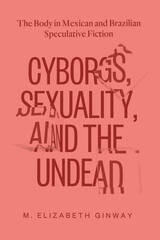
Cyborgs, Sexuality, and the Undead
The Body in Mexican and Brazilian Speculative FictionM. Elizabeth Ginway
Vanderbilt University Press, 2020
In Cyborgs, Sexuality, and the Undead, M. Elizabeth Ginway examines all these issues from a number of theoretical perspectives, most importantly through the lens of Bolívar Echeverría’s “baroque ethos,” which emphasizes the strategies that subaltern populations may adopt in order to survive and prosper in the face of massive historical and structural disadvantages. Foucault’s concept of biopolitics is developed in discussion with Roberto Esposito’s concept of immunity and Giorgio Agamben’s distinction between “political life” and “bare life.”
This book will be of interest to scholars of speculative fiction, as well as Mexicanists and Brazilianists in history, literary studies, and critical theory.