Results by title
67 books match the query 'Segregation' and 8 start with c
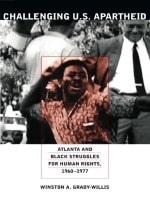
Challenging U.S. Apartheid
Atlanta and Black Struggles for Human Rights, 1960–1977Winston A. Grady-Willis
Duke University Press, 2006
Grady-Willis describes Black activism within a framework of human rights rather than in terms of civil rights. As he demonstrates, civil rights were only one part of a larger struggle for self-determination, a fight to dismantle a system of inequalities that he conceptualizes as “apartheid structures.” Drawing on archival research and interviews with activists of the 1960s and 1970s, he illuminates a wide range of activities, organizations, and achievements, including the neighborhood-based efforts of Atlanta’s Black working poor, clandestine associations such as the African American women’s group Sojourner South, and the establishment of autonomous Black intellectual institutions such as the Institute of the Black World. Grady-Willis’s chronicle of the politics within the Black freedom movement in Atlanta brings to light overlapping ideologies, gender and class tensions, and conflicts over divergent policies, strategies, and tactics. It also highlights the work of grassroots activists, who take center stage alongside well-known figures in Challenging U.S. Apartheid. Women, who played central roles in the human rights struggle in Atlanta, are at the foreground of this history.

Changing Perspectives
Black-Jewish Relations in Houston during the Civil Rights EraAllison E. Schottenstein
University of North Texas Press, 2021
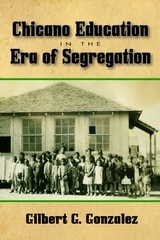
Chicano Education in the Era of Segregation
Gilbert G. Gonzalez
University of North Texas Press, 2013
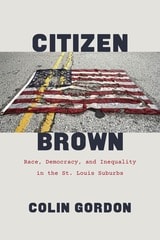
Citizen Brown
Race, Democracy, and Inequality in the St. Louis SuburbsColin Gordon
University of Chicago Press, 2019
Citizen Brown uncovers half a century of private practices and public policies that resulted in bitter inequality and sustained segregation in Ferguson and beyond. Gordon shows how municipal and school district boundaries were pointedly drawn to contain or exclude African Americans and how local policies and services—especially policing, education, and urban renewal—were weaponized to maintain civic separation. He also makes it clear that the outcry that arose in Ferguson was no impulsive outburst but rather an explosion of pent-up rage against long-standing systems of segregation and inequality—of which a police force that viewed citizens not as subjects to serve and protect but as sources of revenue was only the most immediate example. Worse, Citizen Brown illustrates the fact that though the greater St. Louis area provides some extraordinarily clear examples of fraught racial dynamics, in this it is hardly alone among American cities and regions.
Interactive maps and other companion resources to Citizen Brown are available at the book website.
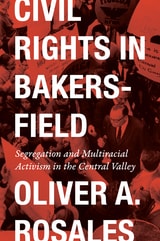
Civil Rights in Bakersfield
Segregation and Multiracial Activism in the Central ValleyOliver A. Rosales
University of Texas Press, 2024
2024 Outstanding Book Award, National Association for Ethnic Studies
2025 Honorable Mention, Norris & Carol Hundley Award, Pacific Coast Branch of the American Historical Association
2025 The Ambassador Julian Nava Best Ethnic Studies Book, International Latino Book Awards
A multiracial history of civil rights coalitions beyond the farm worker movement in twentieth-century Bakersfield, California.
In Civil Rights in Bakersfield, Oliver Rosales uncovers the role of the multiracial west in shaping the course of US civil rights history. Focusing on Bakersfield, one of the few sizable cities within California’s Central Valley for much of the twentieth century in a region most commonly known as a bastion of political conservatism, oil, and industrial agriculture, Rosales documents how multiracial coalitions emerged to challenge histories of racial segregation and discrimination. He recounts how the region was home to both the historic farm worker movement, led by César Chávez, Dolores Huerta, and Larry Itliong, and also a robust multiracial civil rights movement beyond the fields. This multiracial push for civil rights reform included struggles for fair housing, school integration, public health, media representation, and greater political representation for Black and Brown communities. In expanding on this history of multiracial activism, Rosales further explores the challenges activists faced in community organizing and how the legacies of coalition building contribute to ongoing activist efforts in the Central Valley of today.
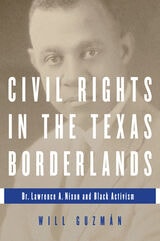
Civil Rights in the Texas Borderlands
Dr. Lawrence A. Nixon and Black ActivismWill Guzman
University of Illinois Press, 2016
Will Guzmán delves into Nixon's lifelong struggle against Jim Crow. Linking Nixon's activism to his independence from the white economy, support from the NAACP, and the man's own indefatigable courage, Guzmán also sheds light on Nixon's presence in symbolic and literal borderlands--as an educated professional in a time when few went to college, as an African American who made waves when most feared violent reprisal, and as someone living on the mythical American frontier as well as an international boundary.
A powerful addition to the literature on African Americans in the Southwest, Civil Rights in the Texas Borderlands explores seldom-studied corners of the Black past and the civil rights movement.
Crisis of Conscience
Arkansas Methodists and the Civil Rights StruggleJames T. Clemons
Butler Center for Arkansas Studies, 2007
Cycle of Segregation
Social Processes and Residential StratificationMaria Krysan
Russell Sage Foundation, 2017
Through original analyses of national-level surveys and in-depth interviews with residents of Chicago, Krysan and Crowder find that residential stratification is reinforced through the biases and blind spots that individuals exhibit in their searches for housing. People rely heavily on information from friends, family, and coworkers when choosing where to live. Because these social networks tend to be racially homogenous, people are likely to receive information primarily from members of their own racial group and move to neighborhoods that are also dominated by their group. Similarly, home-seekers who report wanting to stay close to family members can end up in segregated destinations because their relatives live in those neighborhoods. The authors suggest that even absent of family ties, people gravitate toward neighborhoods that are familiar to them through their past experiences, including where they have previously lived, and where they work, shop, and spend time. Because historical segregation has shaped so many of these experiences, even these seemingly race-neutral decisions help reinforce the cycle of residential stratification. As a result, segregation has declined much more slowly than many social scientists have expected.
To overcome this cycle, Krysan and Crowder advocate multi-level policy solutions that pair inclusionary zoning and affordable housing with education and public relations campaigns that emphasize neighborhood diversity and high-opportunity areas. They argue that together, such programs can expand the number of destinations available to low-income residents and help offset the negative images many people hold about certain neighborhoods or help introduce them to places they had never considered. Cycle of Segregation demonstrates why a nuanced understanding of everyday social processes is critical for interrupting entrenched patterns of residential segregation.