127 books match the query 'Sexual behavior' and 8 start with c
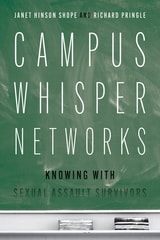
cover of Campus Whisper Networks: Knowing with Sexual Assault Survivors

Campus Whisper Networks

Knowing with Sexual Assault Survivors

Janet Hinson Shope

Rutgers University Press, 2026

Campus Whisper Networks examines how personal knowledge about student sexual assault circulates within college campus communities. Based upon both qualitative and quantitative survey data, Janet Hinson Shope and Richard Pringle's research demonstrates that students who have been sexually assaulted tell someone—almost always a friend. Most college students know someone who has been assaulted. Simply knowing, by means of relationships, that one or more peers have been assaulted affects the knowers, and the effects reverberate unevenly across campuses.  

Shope and Pringle highlight the structural properties that prohibit relational knowledge from becoming official institutional knowledge, confining it to whispers and secrecy within informal spheres of knowledge. The rules governing the circulation of such knowledge create an uneven epistemic field of sexual assault. This uneven field is consequential for the communities, affecting survivors and their confidants and shaping student views of the college community. Campus Whisper Networks demonstrates how personal and institutional avoidance, both the “need to not know” and “no need to know,” creates knowledge gaps that hide the community’s wounds and prevent personal knowledge from becoming social knowledge. 
[more]
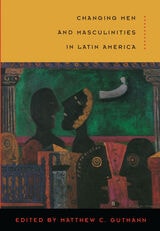
cover of Changing Men and Masculinities in Latin America

Changing Men and Masculinities in Latin America

Matthew C. Gutmann ed.

Duke University Press, 2003

Ranging from fatherhood to machismo and from public health to housework, Changing Men and Masculinities in Latin America is a collection of pioneering studies of what it means to be a man in Latin America. Matthew C. Gutmann brings together essays by well-known U.S. Latin Americanists and newly translated essays by noted Latin American scholars. Historically grounded and attuned to global political and economic changes, this collection investigates what, if anything, is distinctive about and common to masculinity across Latin America at the same time that it considers the relative benefits and drawbacks of studies focusing on men there. Demonstrating that attention to masculinities does not thwart feminism, the contributors illuminate the changing relationships between men and women and among men of different ethnic groups, sexual orientations, and classes.

The contributors look at Mexico, Argentina, Ecuador, Brazil, Colombia, Peru, Venezuela, Chile, and the United States. They bring to bear a number of disciplines—anthropology, history, literature, public health, and sociology—and a variety of methodologies including ethnography, literary criticism, and statistical analysis. Whether analyzing rape legislation in Argentina, the unique space for candid discussions of masculinity created in an Alcoholics Anonymous group in Mexico, the role of shame in shaping Chicana and Chicano identities and gender relations, or homosexuality in Brazil, Changing Men and Masculinities highlights the complex distinctions between normative conceptions of masculinity in Latin America and the actual experiences and thoughts of particular men and women.

Contributors.
Xavier Andrade, Daniel Balderston, Peter Beattie, Stanley Brandes, Héctor Carrillo, Miguel Díaz Barriga, Agustín Escobar, Francisco Ferrándiz, Claudia Fonseca, Norma Fuller, Matthew C. Gutmann, Donna Guy, Florencia Mallon, José Olavarría, Richard Parker, Mara Viveros
[more]
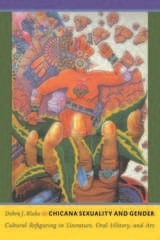
cover of Chicana Sexuality and Gender: Cultural Refiguring in Literature, Oral History, and Art

Chicana Sexuality and Gender

Cultural Refiguring in Literature, Oral History, and Art

Debra J. Blake

Duke University Press, 2008

Since the 1980s Chicana writers including Gloria Anzaldúa, Cherríe Moraga, Sandra Cisneros, Ana Castillo, and Alma Luz Villanueva have reworked iconic Mexican cultural symbols such as mother earth goddesses and La Llorona (the Wailing Woman of Mexican folklore), re-imagining them as powerful female figures. After reading the works of Chicana writers who created bold, powerful, and openly sexual female characters, Debra J. Blake wondered how everyday Mexican American women would characterize their own lives in relation to the writers’ radical reconfigurations of female sexuality and gender roles. To find out, Blake gathered oral histories from working-class and semiprofessional U.S. Mexicanas. In Chicana Sexuality and Gender, she compares the self-representations of these women with fictional and artistic representations by academic-affiliated, professional intellectual Chicana writers and visual artists, including Alma M. López and Yolanda López.

Blake looks at how the Chicana professional intellectuals and the U.S. Mexicana women refigure confining and demeaning constructions of female gender roles and racial, ethnic, and sexual identities. She organizes her analysis around re-imaginings of La Virgen de Guadalupe, La Llorona, indigenous Mexica goddesses, and La Malinche, the indigenous interpreter for Hernán Cortés during the Spanish conquest. In doing so, Blake reveals how the professional intellectuals and the working-class and semiprofessional women rework or invoke the female icons to confront the repression of female sexuality, limiting gender roles, inequality in male and female relationships, and violence against women. While the representational strategies of the two groups of women are significantly different and the U.S. Mexicanas would not necessarily call themselves feminists, Blake nonetheless illuminates a continuum of Chicana feminist thinking, showing how both groups of women expand lifestyle choices and promote the health and well-being of women of Mexican origin or descent.
[more]
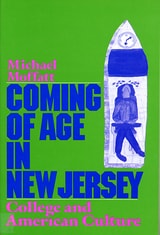
cover of Coming of Age in New Jersey: College and American Culture

Coming of Age in New Jersey

College and American Culture

Moffatt, Michael

Rutgers University Press, 1989
"With Kinseyesque diligence [Moffatt] catalogues the sexual habits and fantasies of his students. . . . His book vibrates with quirky authenticity." --New York Times Book Review "Useful for understanding the student experience . . . throughout the United States. . . . Beautifully written, carefully researched . . . a classic."--John Thelin, Educational Studies "Michael Moffatt is a multitalented, multidisciplinary scholar . . . who writes without a trace of gobbledygook. He deserves a wide following." --Rupert Wilkinson, Journal of American Studies "One of the most thoughtfully crafted case studies of undergraduate culture . . . ever written . . . a book every professor should read." --Paul J. Baker, Academe Coming of Age is about college as students really know it and--often--love it. To write this remarkable account, Michael Moffatt did what anthropologists usually do in more distant cultures: he lived among the natives. His findings are sometimes disturbing, potentially controversial, but somehow very believable. Coming of Age is a vivid slice of life of what Moffatt saw and heard in the dorms of a typical state university, Rutgers, in the 1980s. It is full of student voices: naive and worldy-wise, vulgar and polite, cynical, humorous, and sometimes even idealistic. But it is also about American culture more generally: individualism, friendship, community, bureaucracy, diversity, race, sex, gender, intellect, work, and play. As an example of an ethnography written about an anthropologist's own culture, this book is an uncommon one. As a new and revealing perspective on the much-studied American college student, it is unique.
[more]
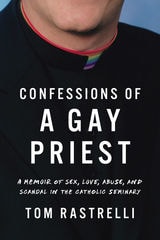
cover of Confessions of a Gay Priest: A Memoir of Sex, Love, Abuse, and Scandal in the Catholic Seminary

Confessions of a Gay Priest

A Memoir of Sex, Love, Abuse, and Scandal in the Catholic Seminary

Tom Rastrelli

University of Iowa Press, 2020

Tom Rastrelli is a survivor of clergy-perpetrated sexual abuse who then became a priest in the early days of the Catholic Church’s ongoing scandals. Confessions of a Gay Priest divulges the clandes­tine inner workings of the seminary, providing an intimate and unapologetic look into the psychosexual and spiritual dynamics of celibacy and lays bare the “formation” system that perpetuates the cycle of abuse and cover-up that continues today.

Under the guidance of a charismatic college campus minister, Rastrelli sought to reconcile his homosexuality and childhood sexual abuse. When he felt called to the priesthood, Rastrelli be­gan the process of “priestly discernment.” Priests welcomed him into a confusing clerical culture where public displays of piety, celibacy, and homophobia masked a closeted underworld in which elder priests preyed upon young recruits.

From there he ventured deeper into the seminary system seeking healing, hoping to help others, and striving not to live a double life. Trained to treat sexuality like an addiction, he and his brother seminarians lived in a world of cliques, competition, self-loathing, alcohol, hidden crushes, and closeted sex. Ultimately, the “for­mation” intended to make Rastrelli a compliant priest helped to liberate him.
[more]
cover of Criminal Intimacy: Prison and the Uneven History of Modern American Sexuality

Criminal Intimacy

Prison and the Uneven History of Modern American Sexuality

Regina Kunzel

University of Chicago Press, 2008

Sex is usually assumed to be a closely guarded secret of prison life. But it has long been the subject of intense scrutiny by both prison administrators and reformers—as well as a source of fascination and anxiety for the American public. Historically, sex behind bars has evoked radically different responses from professionals and the public alike. In Criminal Intimacy, Regina Kunzel tracks these varying interpretations and reveals their foundational influence on modern thinking about sexuality and identity.
 
Historians have held the fusion of sexual desire and identity to be the defining marker of sexual modernity, but sex behind bars, often involving otherwise heterosexual prisoners, calls those assumptions into question. By exploring the sexual lives of prisoners and the sexual culture of prisons over the past two centuries—along with the impact of a range of issues, including race, class, and gender; sexual violence; prisoners’ rights activism; and the HIV epidemic—Kunzel discovers a world whose surprising plurality and mutability reveals the fissures and fault lines beneath modern sexuality itself.
 
Drawing on a wide range of sources, including physicians, psychiatrists, sociologists, correctional administrators, journalists, and prisoners themselves—as well as depictions of prison life in popular culture—Kunzel argues for the importance of the prison to the history of sexuality and for the centrality of ideas about sex and sexuality to the modern prison. In the process, she deepens and complicates our understanding of sexuality in America.
[more]
cover of Crip Love Onscreen: Representations of Love, Sex, and Disability

Crip Love Onscreen

Representations of Love, Sex, and Disability

Sarah Rainey-Smithback

The Ohio State University Press, 2026

Crip Love Onscreen: Representations of Love, Sex, and Disability examines how disabled people’s sexual lives—including pleasure/sex, love, pregnancy, and sexual violence—are represented in popular film and television. Analyzing a variety of films and TV shows from the United States, Canada, and the United Kingdom, Sarah Rainey-Smithback traces patterns in disability representation that ignore or distort many of the realities of crip sexuality. These patterns of sexual representation tend to uphold compulsory able-bodiedness, heteronormativity, and privacy norms—what Rainey-Smithback terms “neoliberal love values,” or standards that celebrate normative forms of sexual desire, bodies, and intimacy practices.

As disability representation increases, though, new possibilities are emerging. Crip Love Onscreen also draws attention to the exceptional through a close reading of screen narratives (such as 50 First Dates,Love and Other Drugs,American Horror Story: Freak Show, and more) that push against neoliberal, heteronormative, and ableist values. Drawing on the work of queer/crip scholars and activists, Rainey-Smithback uncovers glimpses of what Tobin Siebers calls a “sexual culture for disabled people”—a space and way of being that expands sexual access and sexual experience.
[more]
cover of Crossings: Creative Ecologies of Cruising

Crossings

Creative Ecologies of Cruising

João Florêncio

Rutgers University Press, 2025

It’s difficult to pinpoint the origins of cruising. While the term was used by men seeking casual encounters with other men in the parks and streets of New York City as early as the 1920s, historical records show the practice is much older. Cruising has existed for as long as anyone outside the dominant sex and gender systems has sought sexual encounters outside of sanctioned norms. This book offers a serious exploration of queer sex and sex cultures, exploring cruising as a mode of thinking with the body and communicating through sexuality. 
 
A creative dialogue between a queer artist and a queer academic reminiscing about and thinking with their cruising experiences, Crossings takes queer sex practices and cultures seriously as ways of knowing and world-making. The result is an erotic hybrid form hovering between scholarship and avant-garde experimentation, between critical manifesto and sex memoir. Here, the voices of each author, merged together in one, invite the reader to inhabit the erotic spacetime between self and other, the familiar and the strange, desire and pleasure, climax and release. That is, the spaces and temporalities of cruising itself.
[more]