Results by title
95 books match the query 'Social media' and 6 start with c
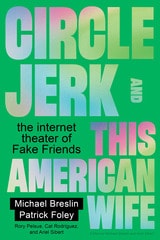
Circle Jerk and This American Wife
the internet theater of Fake FriendsMichael Breslin, Patrick Foley, Rory Pelsue, Cat Rodríguez, and Ariel Sibert, edited by Michael Breslin and Ariel Sibert
Northwestern University Press, 2026
Two plays along with process essays on the cacophonous world of pop culture, politics, and personal testimony that we call the internet
In March 2020, the New York theater company Fake Friends was pushed off the stage and into the land of the internet. This book marks the first publication of two of their deliciously absurd and toxically serious internet plays, Circle Jerk (the first-ever work in digital theater to be shortlisted for the Pulitzer Prize in Drama) and This American Wife. Circle Jerk tells the social media–infused tale of gay white supremacists creating an AI-influencer to dominate the global discourse, and This American Wife spins a surrealist web of queer devotion to the stars and performance strategies of reality television; both plays are unapologetically theatrical and digitally native, born out of the exigencies of the pandemic. This collection features an electrifying visual archive as well as individual essays from each company member reflecting on the practical and interpersonal processes of bringing these award-winning plays to life in our ever-more online, political, and personal world.
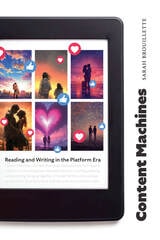
Content Machines
Reading and Writing in the Platform EraSarah Brouillette
Duke University Press, 2026
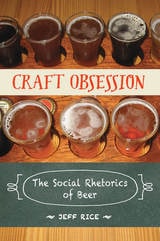
Craft Obsession
The Social Rhetorics of BeerJeff Rice
Southern Illinois University Press, 2016
Rice weaves together theories of writing, narrative, new media, and rhetoric with a personal story of his passion for craft beer. He identifies six key elements of social media rhetoric—anecdotes, repetition, aggregation, delivery, sharing, and imagery—and examines how each helps to transform small, personal experiences with craft into a more widespread movement. When shared via social media, craft anecdotes—such as the first time one had a beer—interrupt and repeat one another, building a sense of familiarity and identity among otherwise unconnected people. Aggregation, the practice of joining unlike items into one space, builds on this network identity, establishing a connection to particular brands or locations, both real and virtual. The public releases of craft beers are used to explore the concept of craft delivery, which involves multiple actors across multiple spaces and results in multiple meanings. Finally, Rice highlights how personal sharing operates within the community of craft beer enthusiasts, who share online images of acquiring, trading for, and consuming a wide variety of beers. These shared stories and images, while personal for each individual, reflect the dependence of craft on systems of involvement. Throughout, Rice relates and reflects on his own experience as a craft beer enthusiast and his participation via social media in these systems.
Both an objective scholarly study and an engaging personal narrative about craft beer, Craft Obsession provides valuable insights into digital writing, storytelling, and social media.
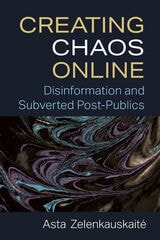
Creating Chaos Online
Disinformation and Subverted Post-PublicsAsta Zelenkauskaite
University of Michigan Press, 2022
With the prevalence of disinformation geared to instill doubt rather than clarity, Creating Chaos Online unmasks disinformation when it attempts to pass as deliberation in the public sphere and distorts the democratic processes. Asta Zelenkauskaitė finds that repeated tropes justifying Russian trolling were found to circulate across not only all analyzed media platforms’ comments but also across two analyzed sociopolitical contexts suggesting the orchestrated efforts behind messaging. Through a dystopian vision of publics that are expected to navigate in the sea of uncertain both authentic and orchestrated content, pushed by human and nonhuman actors, Creating Chaos Online offers a concept of post-publics. The idea of post-publics is reflected within the continuum of treatment of public, counter public, and anti-public. This book argues that affect-instilled arguments used in public deliberation in times of uncertainty, along with whataboutism constitute a playbook for chaos online.
Critiquing Communication Innovation
New Media in a Multipolar WorldRolien Hoyng
Michigan State University Press, 2022
Cyberlibertarianism
The Right-Wing Politics of Digital TechnologyDavid Golumbia
University of Minnesota Press, 2024
An urgent reckoning with digital technology’s fundamentally right-wing legal and economic underpinnings
In a timely challenge to the potent political role of digital technology, Cyberlibertarianism argues that right-wing ideology was built into both the technical and social construction of the digital world from the start. Leveraging more than a decade of research, David Golumbia traces how digital evangelism has driven the worldwide shift toward the political right, concealing inequality, xenophobia, dishonesty, and massive corporate concentrations of wealth and power beneath the utopian presumption of digital technology as an inherent social good.
Providing an incisive critique of the push for open access and open-source software and the legal battles over online censorship and net neutrality, Cyberlibertarianism details how the purportedly democratic internet has been employed as an organizing tool for terror and hate groups and political disinformation campaigns. As he unpacks our naively utopian conception of the digital world, Golumbia highlights technology’s role in the advancement of hyperindividualist and antigovernment agendas, demonstrating how Silicon Valley corporations and right-wing economists; antiestablishment figures such as Julian Assange, Elon Musk, Peter Thiel, Edward Snowden, and Mark Zuckerberg; and seemingly positive voices such as John Perry Barlow, Cory Doctorow, the Electronic Freedom Foundation, and Wikipedia all have worked to hamper regulation and weaken legal safeguards against exploitation.
Drawing from a wide range of thought in digital theory, economics, law, and political philosophy as well as detailed research and Golumbia’s own experience as a software developer, Cyberlibertarianism serves as a clarion call to reevaluate the fraught politics of the internet. In the hope of providing a way of working toward a more genuinely democratic and egalitarian future for digital technology, this magisterial work insists that we must first understand the veiled dogmas from which it has been constructed.
Retail e-book files for this title are screen-reader friendly.