165 books match the query 'Social sciences' and 9 start with c
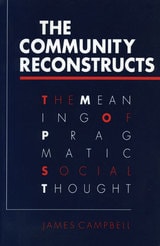
cover of COMMUNITY RECONSTRUCTS

COMMUNITY RECONSTRUCTS

James Campbell

University of Illinois Press, 1992

In The Community Reconstructs
  James Campbell explores the Pragmatists' contributions to American social
  thought, drawing upon the writings of William James, John Dewey, George Herbert
  Mead, James Hayden Tufts, and their various critics. He explores the Pragmatic
  analysis of society's potential for ongoing intelligent inquiry and cooperative
  evaluation to address social ills. Campbell also considers the nature of political
  language, the relative importance of the moral and political values of liberty
  and equality, and the vital role of commitment to the life of a democratic community.

 
[more]
cover of Chaos Theory in the Social Sciences: Foundations and Applications

Chaos Theory in the Social Sciences

Foundations and Applications

L. Douglas Kiel and Euel Elliott, Editors

University of Michigan Press, 1997

Chaos Theory in the Social Sciences: Foundations and Applications offers the most recent thinking in applying the chaos paradigm to the social sciences. The book explores the methodological techniques--and their difficulties--for determining whether chaotic processes may in fact exist in a particular instance and examines implications of chaos theory when applied specifically to political science, economics, and sociology. The contributors to the book show that no single technique can be used to diagnose and describe all chaotic processes and identify the strengths and limitations of a variety of approaches.
The essays in this volume consider the application of chaos theory to such diverse phenomena as public opinion, the behavior of states in the international arena, the development of rational economic expectations, and long waves.
Contributors include Brian J. L. Berry, Thad Brown, Kenyon B. DeGreene, Dimitrios Dendrinos, Euel Elliott, David Harvey, L. Ted Jaditz, Douglas Kiel, Heja Kim, Michael McBurnett, Michael Reed, Diana Richards, J. Barkley Rosser, Jr., and Alvin M. Saperstein.
L. Douglas Kiel and Euel W. Elliott are both Associate Professors of Government, Politics, and Political Economy, University of Texas at Dallas.
[more]
cover of Chaos of Disciplines

Chaos of Disciplines

Andrew Abbott

University of Chicago Press, 2000

In this vital new study, Andrew Abbott presents a fresh and daring analysis of the evolution and development of the social sciences. Chaos of Disciplines reconsiders how knowledge actually changes and advances. Challenging the accepted belief that social sciences are in a perpetual state of progress, Abbott contends that disciplines instead cycle around an inevitable pattern of core principles. New schools of thought, then, are less a reaction to an established order than they are a reinvention of fundamental concepts.
Chaos of Disciplines uses fractals to explain the patterns of disciplines, and then applies them to key debates that surround the social sciences. Abbott argues that knowledge in different disciplines is organized by common oppositions that function at any level of theoretical or methodological scale. Opposing perspectives of thought and method, then, in fields ranging from history, sociology, and literature, are to the contrary, radically similar; much like fractals, they are each mutual reflections of their own distinctions.
[more]
cover of Civics in a Digital Republic: A Transformative Curriculum

Civics in a Digital Republic

A Transformative Curriculum

Robert A. Waterson

West Virginia University Press, 2012

This innovative curriculum book provides key materials, resources, and tools to help secondary educators prepare their students to be engaged citizens of their community, state, nation and world. Five complete units of instruction, based on West Virginia Content Standards and Objectives, provide meaningful lessons while being mindful of the transition from tangible text to more digital curricula:

•Rights of the Individual 
•Freedoms of the Individual
•Responsibilities of the Individual
•Beliefs Concerning Societal Conditions 
•Financial Literacy
 Additional features of the curriculum include:
•24 lessons that provide specific teaching and learning strategies
•4 culminating activities for enrichment opportunities  
•A matrix illustrating the West Virginia Content Standards and Objectives covered
•A matrix illustrating compliance with the National Council for the Social Studies Standards  
•A curriculum toolbox that provides over 70 engaging web sites to visit and explore.

[more]
cover of Confronting Mass Democracy and Industrial Technology : Political and Social Theory from Nietzsche to Habermas

Confronting Mass Democracy and Industrial Technology

Political and Social Theory from Nietzsche to Habermas

John P. McCormick, ed.

Duke University Press, 2002

With a groundbreaking, interdisciplinary approach to German political and social theory, Confronting Mass Democracy and Industrial Technology provides fresh insight into the thought of many of the most influential intellectual figures of the twentieth century. Its essays detail the manner in which a wide range of German intellectuals grappled with the ramifications and implications of democracy, technology, knowledge, and control from the late Kaisserreich to the Weimar Republic, from the Third Reich and the Federal Republic through recently unified Germany.
Scholars representing the fields of political science, philosophy, history, law, literature, and cultural studies devote essays to the work of Nietzsche, Weber, Heidegger, Lukács, Schmitt, Marcuse, Adorno, and Habermas. They also discuss the writings of such figures as Brecht and Freud, who are not primarily thought of as political theorists, and explore the thought of Helmut Plessner and reformist theorists from East Germany who have been little studied in the English language. In the process of debating the nature and responsibilities of the modern state in an era of mass politics, unparalleled military technology, capacity for surveillance, and global media presence, the contributors question whether technology is best understood as an instrument of human design and collective control or as an autonomous entity that not only has a will and life of its own but one that forms the very fabric of modern humanity.

Contributors. Seyla Benhabib, Richard J. Bernstein, Peter C. Caldwell, Richard Dienst, David Dyzenhaus, Andrew Feenberg, Nancy S. Love, John P. McCormick, Jan-Werner Müller, Gia Pascarelli, William E. Scheuerman, Steven B. Smith, Tracy B. Strong, Richard Wolin

[more]
cover of Constructing the Pluriverse: The Geopolitics of Knowledge

Constructing the Pluriverse

The Geopolitics of Knowledge

Bernd Reiter, editor

Duke University Press, 2018

The contributors to Constructing the Pluriverse critique the hegemony of the postcolonial Western tradition and its claims to universality by offering a set of “pluriversal” approaches to understanding the coexisting epistemologies and practices of the different worlds and problems we inhabit and encounter. Moving beyond critiques of colonialism, the contributors rethink the relationship between knowledge and power, offering new perspectives on development, democracy, and ideology while providing diverse methodologies for non-Western thought and practice that range from feminist approaches to scientific research to ways of knowing expressed through West African oral traditions. In combination, these wide-ranging approaches and understandings form a new analytical toolbox for those seeking creative solutions for dismantling Westernization throughout the world.

Contributors. Zaid Ahmad, Manuela Boatcă, Hans-Jürgen Burchardt, Raewyn Connell, Arturo Escobar, Sandra Harding, Ehsan Kashfi, Venu Mehta, Walter D. Mignolo, Ulrich Oslender, Issiaka Ouattara, Bernd Reiter, Manu Samnotra, Catherine E. Walsh, Aram Ziai

 
[more]
cover of Controversies and Decisions: The Social Sciences and Public Policy

Controversies and Decisions

The Social Sciences and Public Policy

Charles Frankel

Russell Sage Foundation, 1976
Explores the various aspects of recent debates over the independence of the social sciences. The contributors are Kenneth E. Boulding, Harvey Brooks, Jonathan R. Cole, Stephen Cole, Lee J. Cronbach, Paul Doty, Yaron Ezrahi, Charles Frankel, H. Field Haviland, Hugh Hawkins, Harry G. Johnson, Robert Nisbet, Nicholas Rescher, Edward Shils, and Adam Yarmolinksy. The essays deal with such topics as the relation of "values" to "facts" in social science inquiry; the interplay of theoretical and practical considerations; the moral obligations of social science investigators in political contexts; and the ways and means of protecting and advancing the autonomy of the social sciences.
[more]
cover of Cultural Evolution: How Darwinian Theory Can Explain Human Culture and Synthesize the Social Sciences

Cultural Evolution

How Darwinian Theory Can Explain Human Culture and Synthesize the Social Sciences

Alex Mesoudi

University of Chicago Press, 2011

Charles Darwin changed the course of scientific thinking by showing how evolution accounts for the stunning diversity and biological complexity of life on earth. Recently, there has also been increased interest in the social sciences in how Darwinian theory can explain human culture.
 
Covering a wide range of topics, including fads, public policy, the spread of religion, and herd behavior in markets, Alex Mesoudi shows that human culture is itself an evolutionary process that exhibits the key Darwinian mechanisms of variation, competition, and inheritance. This cross-disciplinary volume focuses on the ways cultural phenomena can be studied scientifically—from theoretical modeling to lab experiments, archaeological fieldwork to ethnographic studies—and shows how apparently disparate methods can complement one another to the mutual benefit of the various social science disciplines. Along the way, the book reveals how new insights arise from looking at culture from an evolutionary angle. Cultural Evolution provides a thought-provoking argument that Darwinian evolutionary theory can both unify different branches of inquiry and enhance understanding of human behavior.
[more]
cover of Cultural Studies 1983: A Theoretical History

Cultural Studies 1983

A Theoretical History

Stuart Hall

Duke University Press, 2016

The publication of Cultural Studies 1983 is a touchstone event in the history of Cultural Studies and a testament to Stuart Hall's unparalleled contributions. The eight foundational lectures Hall delivered at the University of Illinois in 1983 introduced North American audiences to a thinker and discipline that would shift the course of critical scholarship. Unavailable until now, these lectures present Hall's original engagements with the theoretical positions that contributed to the formation of Cultural Studies. Throughout this personally guided tour of Cultural Studies' intellectual genealogy, Hall discusses the work of Richard Hoggart, Raymond Williams, and E. P. Thompson; the influence of structuralism; the limitations and possibilities of Marxist theory; and the importance of Althusser and Gramsci. Throughout these theoretical reflections, Hall insists that Cultural Studies aims to provide the means for political change.
[more]