Results by title
171 books match the query 'Soldiers' and 7 start with c

Chemical Heroes
Pharmacological Supersoldiers in the US MilitaryAndrew Bickford
Duke University Press, 2020
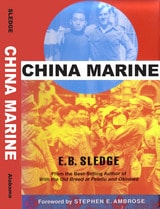
China Marine
E. B. Sledge
University of Alabama Press, 2002
From the respected author of one of the best books on World War II combat, comes an equally captivating saga of battle recovery, healing, and homecoming.
China Marine is the long-awaited sequel to E. B. Sledge’s critically acclaimed memoir, With the Old Breed at Peleliu and Okinawa. Picking up where his previous memoir leaves off, Sledge, a young marine in the First Division, traces his company’s movements and charts his own difficult passage to peace following his horrific experiences in the Pacific. He reflects on his duty in the ancient city of Peiping (now Beijing) and recounts the difficulty of returning to his hometown of Mobile, Alabama, and resuming civilian life haunted by the shadows of close combat.
Distinguished historians have praised Sledge’s first book as the definitive rifleman’s account of World War II, ranking it with the Civil War’s Red Badge of Courage and World War I’s All Quiet on the Western Front. Although With the Old Breed ends with the surrender of Japan, marines in the Pacific were still faced with the mission of disarming the immense Japanese forces on the Asian mainland and reestablishing order. For infantrymen so long engaged in the savage and surreal world of close combat, there remained the personal tasks of regaining normalcy and dealing with suppressed memories, fears, and guilt.
In China Marine, E. B. Sledge completes his story and provides emotional closure to the searing events detailed in his first memoir. He speaks frankly about the real costs of war, emotional and psychological as well as physical, and explains the lifetime loyalties that develop between men who face fear, loss, and horror together. That bond becomes one of the newfound treasures of life after battle.
With his hallmark style of simplicity, directness, and lack of sentimentality, "Sledgehammer" has given us yet another great document of war literature.

Co. Aytch, or a Side Show of the Big Show
A New Edition Introduced and Annotated by Philip LeighSam Watkins
Westholme Publishing, 2013
Co. Aytch, or a Side Show of the Big Show is perhaps the finest memoir of an ordinary Confederate soldier. According to Margaret Mitchell, “a better book there never was.” Sam Watkins served in Company H of the First Tennessee Infantry for the duration of the Civil War. Remarkably, he survived some of the most intense battles of the war, including Shiloh, Chickamauga, Kennesaw Mountain, Atlanta, and Franklin. He was one of only seven of the original members of Company H when it surrendered in April 1865. Watkins’s memoir was written in the winter of 1882–83. The humor and depth of writing at times rises to a level resembling Mark Twain; thus, twenty-first-century readers can still discover the everlasting treasures of Private Sam Watkins’s story just as it was. It is this reason that excerpts were featured frequently in Ken Burns’s documentary on the Civil War. However, since most of Sam’s original readers—or some of their family members—actually lived through the Civil War, much of the context for the narrative was common knowledge. But what was once received history has gradually disappeared, and presently only specialists can fully understand and appreciate Sam’s tale.
The chief aim for this new annotated edition of Co. Aytch—the first of its kind—is to amplify the experience for today’s readers by providing the missing context. Over 240 annotations clarify the situational backgrounds, personalities, and terminology that might not be familiar to most readers. The annotations also identify and explain errors mostly resulting from Sam’s occasionally faulty memory or limited perspective. Similarly, twentyfour battlefield and war theater maps enable readers to track Sam’s combat participation as well as his journeys while marching with the army. Finally fifteen photographs and prints illustrate some of the battles, people, towns, buildings, tools of war, and ruins that Sam witnessed. As someone once cleverly observed, “It’s not an adventure until something goes wrong.” If nothing else, Sam’s memoir is a foot soldier’s view of the resulting horrors, heroics, and healing humor when war planning routinely goes awry.
Confederate Bushwhacker
Mark Twain in the Shadow of the Civil WarJerome Loving
University Press of New England, 2013
Confederate Colonels
A Biographical RegisterBruce S. Allardice
University of Missouri Press, 2008
Confederate Guerrilla
The Civil War Memoir of Joseph M. BaileyT. Lindsay Baker
University of Arkansas Press, 2007
Joseph M. Bailey’s memoir, Confederate Guerrilla, provides a unique perspective on the fighting that took place behind Union lines in Federal-occupied northwest Arkansas during and after the Civil War. This story—now published for the first time—will appeal to modern readers interested in the grassroots history of the Trans-Mississippi war. Bailey participated in the Battle of Pea Ridge and the siege of Port Hudson, eventually escaping to northwest Arkansas where he fought as a guerrilla against Federal troops and civilian unionists. After Federal forces gained control of the area, Bailey rejoined the Confederate army and continued in regular service in northeast Texas until the end of the war.
Historians will find the descriptions of military campaigns and the observations on guerrilla war especially valuable. According to Bailey, Southern guerrillas were motivated less by a sense of loyalty to either the Confederate or Union side than by a determination to protect their families and neighbors from the “Mountain Federals.” This partisan war waged between the rebel guerrillas and Southern Unionists was essentially a “struggle for supremacy and revenge.”
Comprehensive annotations are provided by editor T. Lindsay Baker to illuminate the clarity and reliability of Bailey’s late-life memoir.

Cordelia Harvey
Civil War AngelBob Kann
Wisconsin Historical Society Press, 2011
Cordelia Harvey: Civil War Angel includes sidebars on medical care, early nursing, and military prisons. A timeline, glossary of terms, and suggestions for activities and discussion round out this spirited narrative.