Results by title
87 books match the query 'Sound' and 3 start with c
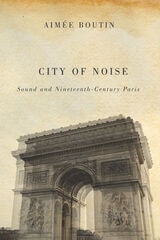
City of Noise
Sound and Nineteenth-Century ParisAimee Boutin
University of Illinois Press, 2015
Beloved as the city of light, Paris in the nineteenth century sparked the acclaim of poets and the odium of the bourgeois with its distinctive sounds. Street vendors bellowed songs known as the Cris de Paris that had been associated with their trades since the Middle Ages; musicians itinerant and otherwise played for change; and flâneurs-writers, fascinated with the city's underside, listened and recorded much about what they heard.
Aimée Boutin tours the sonic space that orchestrated the different, often conflicting sound cultures that defined the street ambience of Paris. Mining accounts that range from guidebooks to verse, Boutin braids literary, cultural, and social history to reconstruct a lost auditory environment. Throughout, impressions of street noise shape writers' sense of place and perception of modern social relations. As Boutin shows, the din of the Cris contrasted economic abundance with the disparities of the capital, old and new traditions, and the vibrancy of street commerce with an increasing bourgeois demand for quiet. In time, peddlers who provided the soundtrack for Paris's narrow streets yielded to modernity, with its taciturn shopkeepers and wide-open boulevards, and the fading songs of the Cris became a dirge for the passing of old ways.
Aimée Boutin tours the sonic space that orchestrated the different, often conflicting sound cultures that defined the street ambience of Paris. Mining accounts that range from guidebooks to verse, Boutin braids literary, cultural, and social history to reconstruct a lost auditory environment. Throughout, impressions of street noise shape writers' sense of place and perception of modern social relations. As Boutin shows, the din of the Cris contrasted economic abundance with the disparities of the capital, old and new traditions, and the vibrancy of street commerce with an increasing bourgeois demand for quiet. In time, peddlers who provided the soundtrack for Paris's narrow streets yielded to modernity, with its taciturn shopkeepers and wide-open boulevards, and the fading songs of the Cris became a dirge for the passing of old ways.
[more]
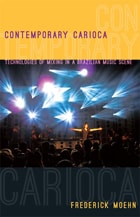
Contemporary Carioca
Technologies of Mixing in a Brazilian Music SceneFrederick Moehn
Duke University Press, 2012
Brazilian popular music is widely celebrated for its inventive amalgams of styles and sounds. Cariocas, native residents of Rio de Janeiro, think of their city as particularly conducive to musical mixture, given its history as a hub of Brazilian media and culture. In Contemporary Carioca, the ethnomusicologist Frederick Moehn introduces a generation of Rio-based musicians who collaboratively have reinvigorated Brazilian genres, such as samba and maracatu, through juxtaposition with international influences, including rock, techno, and funk. Moehn highlights the creativity of individual artists, including Marcos Suzano, Lenine, Pedro Luís, Fernanda Abreu, and Paulinho Moska. He describes how these artists manage their careers, having reclaimed some control from record labels. Examining the specific meanings that their fusions have in the Carioca scene, he explains that musical mixture is not only intertwined with nationalist discourses of miscegenation, but also with the experience of being middle-class in a country confronting neoliberal models of globalization. At the same time, he illuminates the inseparability of race, gender, class, place, national identity, technology, and expressive practice in Carioca music and its making. Moehn offers vivid depictions of Rio musicians as they creatively combine and reconcile local realities with global trends and exigencies.
[more]
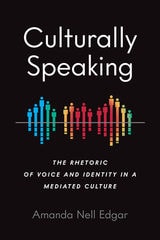
Culturally Speaking
The Rhetoric of Voice and Identity in a Mediated CultureAmanda Nell Edgar
The Ohio State University Press, 2019
Winner, 2020 Outstanding Book Award, Critical/Cultural Studies Division of the National Communication Association
Recent pieces by NPR, the BBC, and Forbes have called attention to the power of voice—positing that “your voice is the secret to getting hired” and that “voice can accelerate or hold back a career.” While it has become clearer that such things as pitch and intonation can be tied to assumptions about one’s gender, race/ethnicity, and class, studying voice as a socially constructed artifact carries with it unique challenges. In response, Culturally Speaking: The Rhetoric of Voice and Identity in a Mediated Culture presents an innovative approach to studying the spoken voice in media, showing how racial and gendered oppression bubble beneath the surface of American culture’s most recognized speaking voices, spreading invisible messages about which kinds of vocal identities are privileged and which kinds should be silenced.
Through her analysis of prominent voices in American culture—including Morgan Freeman, Tina Fey, Barack Obama, Adele, Dave Chappelle, Richard Pryor, and George Lopez—Amanda Nell Edgar argues that voices carry a residue of the particular cultural environments in which they are formed, and that these environments can be traced and analyzed to add a sonic dimension to our understanding of race and gender as rhetorically situated identities—pushing back against the often-unnoticed systems of sound-based discrimination.
[more]