Results by title
112 books match the query 'Spirituality' and 6 start with c
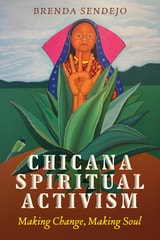
Chicana Spiritual Activism
Making Change, Making SoulBrenda Sendejo
University of Arizona Press, 2026
This book explores the profound impact of spiritual activism within the Chicana feminist movement in Texas. It illuminates how a cohort of Texas Chicanas embraced spiritual activism in pursuit of social change during the movement and into the present day.
The book draws on an array of qualitative methodologies—including interviews, autoethnography, testimonio, pláticas, and archival analysis—to develop what the author formulates as “methodologies of the spirit.” Focusing on the lived experiences, histories, and spiritual activism of sixteen Chicanas/Tejanas, Sendejo shows how these trailblazing women confronted the enduring impacts and repercussions of colonial legacies in Texas through their involvement in movement initiatives such as electoral politics through Mujeres Por La Raza, the cultural arts movement, developing Chicana feminist thought, and the establishment of bilingual education and Chicana/o studies programs.
The activists highlighted in the book include well-known figures such as Santa Barraza, Norma E. Cantú, Rosie Castro, Martha P. Cotera, Inés Hernández-Ávila, and others. Through their work, these activists emerged as architects of their own healing and transformation. Simultaneously, they opened avenues for others to embark on similar journeys reshaping religious practices and unearthing and disseminating spiritual, feminist, and ancestral knowledges.

Christ and Spirituality in St. Thomas Aquinas
Jean-Pierre Torrell
Catholic University of America Press, 2011
Christianity and Process Thought
Spirituality for a Changing WorldJoseph A. Bracken
Templeton Press, 2006
“If someone were to ask,‘Where is God?’ how would you respond?”
Joseph A. Bracken, SJ, uses this question as a springboard to introduce the process-relational metaphysics of Alfred North Whitehead and other process theologians as he tries to reconcile the sometimes-conflicting views of traditional Christian doctrines and the modern scientific world. To present this material in an accessible manner to a wider audience, Bracken reworks Whitehead’s “model” of the God-world relationship, showing that God is involved in an ongoing, ever-changing relationship with humans and other . He also discusses the work of other contemporary theologians to help Christians come to terms with their role in our multi-dimensional pluralistic society.
Bracken examines divine and human creativity, the collective power of good and evil, divine providence and human freedom, prayer, altruism, and the basic question, “What is truth?” He shows how Whitehead&rsqio;s process thought approach to these issues can in fact "harmonize" traditional Christian beliefs and contemporary culture, benefiting both faith and reason.
Understanding the God-world relationship subtly influences our attitude toward ourselves, toward other human beings, and indeed toward all of God’s creatures, says Bracken. His revision of Whitehead's metaphysical vision in terms of a cosmic community shows how modern views of the world and God can be accepted and kept in balance with the traditional biblical views found in the Christian faith and how this balance can help Christians make better choices in a world shaped both by contemporary natural science and by traditional Christian spirituality.
“If we truly believe that in God we live and move and have our being and that as a result we share with the divine persons in a deeply communitarian way of life together with all of God’s creatures, we may be more readily inclined to make the periodic sacrifice of personal self-interest so as to pursue the higher good of sustained life in community. In the end, it is simply a matter of seeing the ‘bigger picture,’ realizing what life is ultimately all about.”

Christianity, Wilderness, and Wildlife
Susan Bratton
University of Scranton Press, 2009
Circling Faith
Southern Women on SpiritualityWendy Reed
University of Alabama Press, 2012
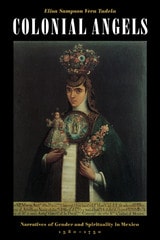
Colonial Angels
Narratives of Gender and Spirituality in Mexico, 1580-1750By Elisa Sampson Vera Tudela
University of Texas Press, 2000
Spain's attempt to establish a "New Spain" in Mexico never fully succeeded, for Spanish institutions and cultural practices inevitably mutated as they came in contact with indigenous American outlooks and ways of life. This original, interdisciplinary book explores how writing by and about colonial religious women participated in this transformation, as it illuminates the role that gender played in imposing the Spanish empire in Mexico.
The author argues that the New World context necessitated the creation of a new kind of writing. Drawing on previously unpublished writings by and about nuns in the convents of Mexico City, she investigates such topics as the relationship between hagiography and travel narratives, male visions of the feminine that emerge from the reworking of a nun's letters to her confessor into a hagiography, the discourse surrounding a convent's trial for heresy by the Inquisition, and the reports of Spanish priests who ministered to noble Indian women. This research rounds out colonial Mexican history by revealing how tensions between Spain and its colonies played out in the local, daily lives of women.