Results by title
254 books match the query 'Sports' and 12 start with c
Cheating the Spread
Gamblers, Point Shavers, and Game Fixers in College Football and BasketballAlbert J. Figone
University of Illinois Press, 2012
Circling the Bases
Essays on the Challenges and Prospects of the Sports IndustryAuthored by Andrew Zimbalist
Temple University Press, 2010
In Circling the Bases, leading sports economist Andrew Zimbalist continues his discussion and analysis of the major issues and challenges confronting the sports industry in the second decade of the 21st century. Presenting a general overview of the sports business at both the college and professional levels, this volume places concerns such as the antitrust status of sports leagues, the stalled progress of gender equity in college sports, and the control of Performance Enhancing Drugs in historical context.
Zimbalist also provides a deeper understanding of how sports have fared and changed with the sharpening financial crisis and 2009 economic downturn—from the morphing role of salary caps and revenue distribution and the rapid escalation of college coaches' compensation to the financing of sports facilities and the economic impact of hosting the Olympic Games.
In Circling the Bases, Zimbalist continues to show how the business of sports is evolving and how the sports industry is becoming more closely linked with the corporate sector and thus more vulnerable to the vicissitudes of the U.S. and world economies. Zimbalist deftly shows how sports are facing the uncertainties of the future and what the implications are for sports fans, players, owners, and leagues.

City Games
The Evolution of American Urban Society and the Rise of SportsSteven A. Riess
University of Illinois Press, 1989
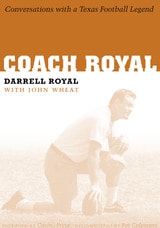
Coach Royal
Conversations with a Texas Football LegendBy Darrell Royal, with John Wheat
University of Texas Press, 2005
Many legendary men have been associated with University of Texas football, but for most fans one man will always be "Coach"—Darrell K Royal. One of the most successful coaches in college football, Royal led the Longhorns to three national championships and eleven Southwest Conference titles during his twenty years (1956-1976) as UT's head coach. He coached some of the Horns' best players, including future Heisman Trophy winner Earl Campbell, and was named NCAA Coach of the Year three times. In 1969, an ABC-TV poll of sportswriters called Royal the Coach of the Decade. In 1996 UT recognized his unrivalled contribution to Longhorn football when it designated Memorial Stadium the Darrell K Royal-Texas Memorial Stadium in his honor.
Now, for the first time, Darrell Royal tells his life story in his own words. He remembers growing up poor in Hollis, Oklahoma, during the Great Depression, and describes playing college football for the University of Oklahoma and then coaching a succession of college teams and one pro team before settling in at UT for the rest of his career. He gives a fascinating, behind-the-scenes look at Longhorn football during his time-recruiting strategies, coaching techniques, the famous wishbone offense, unforgettable wins and losses, and his impressions of rival teams and coaches, including Bear Bryant of Texas A&M and Alabama and Frank Broyles of Arkansas.
Proving that he's still the same straight shooter as always, Darrell Royal even discusses some of the controversies he's dealt with, including early charges of racism in the UT football program, the impact of Title IX on college athletics, his association with Jim Bob Moffett and the Freeport-MacMoRan Corporation, his longtime friendship with Willie Nelson, and his decision to retire from coaching. But whether he's describing the tough times he's faced professionally and personally or the rewards of being UT's most beloved coach and goodwill ambassador, Royal maintains the same plainspoken honesty and sense of honor that—as much as the winning seasons—have made him a legend to so many people.
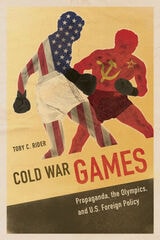
Cold War Games
Propaganda, the Olympics, and U.S. Foreign PolicyToby C Rider
University of Illinois Press, 2016
Drawing on newly declassified materials and archives, Toby C. Rider chronicles how the U.S. government used the Olympics to promote democracy and its own policy aims during the tense early phase of the Cold War. Rider shows how the government, though constrained by traditions against interference in the Games, eluded detection by cooperating with private groups, including secretly funded émigré organizations bent on liberating their home countries from Soviet control. At the same time, the United States utilized Olympic host cities as launching pads for hyping the American economic and political system. Behind the scenes, meanwhile, the government attempted clandestine manipulation of the International Olympic Committee. Rider also details the campaigns that sent propaganda materials around the globe as the United States mobilized culture in general, and sports in particular, to fight the communist threat.
Deeply researched and boldly argued, Cold War Games recovers an essential chapter in Olympic and postwar history.
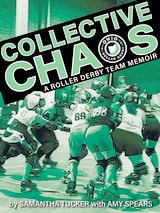
Collective Chaos
A Roller Derby Team MemoirSamantha Tucker
Ohio University Press, 2023
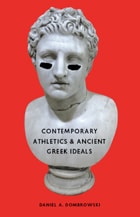
Contemporary Athletics and Ancient Greek Ideals
Daniel A. Dombrowski
University of Chicago Press, 2009
Despite their influence in our culture, sports inspire dramatically less philosophical consideration than such ostensibly weightier topics as religion, politics, or science. Arguing that athletic playfulness coexists with serious underpinnings, and that both demand more substantive attention, Daniel Dombrowski harnesses the insights of ancient Greek thinkers to illuminate contemporary athletics.
Dombrowski contends that the ideas of Plato, Aristotle, and Plotinus shed important light on issues—such as the pursuit of excellence, the concept of play, and the power of accepting physical limitations while also improving one’s body—that remain just as relevant in our sports-obsessed age as they were in ancient Greece. Bringing these concepts to bear on contemporary concerns, Dombrowski considers such questions as whether athletic competition can be a moral substitute for war, whether it necessarily constitutes war by other means, and whether it encourages fascist tendencies or ethical virtue. The first volume to philosophically explore twenty-first-century sport in the context of its ancient predecessor, Contemporary Athletics and Ancient Greek Ideals reveals that their relationship has great and previously untapped potential to inform our understanding of human nature.
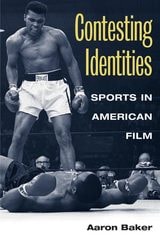
Contesting Identities
Sports in American FilmAaron Baker
University of Illinois Press, 2003
Analysis of race, class and gender in American sports films
Since the earliest days of the silent era, American filmmakers have been drawn to the visual spectacle of sports and their compelling narratives of conflict, triumph, and individual achievement. In Contesting Identities Aaron Baker examines how these cinematic representations of sports and athletes have evolved over time--from The Pinch Hitter and Buster Keaton's College to White Men Can't Jump, Jerry Maguire, and Girlfight. He focuses on how identities have been constructed and transcended in American society since the early twentieth century.Whether depicting team or individual sports, these films return to that most American of themes, the master narrative of self-reliance. Baker shows that even as sports films tackle socially constructed identities like class, race, ethnicity, sexuality, and gender, they ultimately underscore transcendence of these identities through self-reliance.
Looking at films from almost every sporting genre--with a particular focus on movies about boxing, baseball, basketball, and football--Contesting Identities maps the complex cultural landscape depicted in American sports films and the ways in which stories about "subaltern" groups winning acceptance by the mainstream majority can serve to reinforce the values of that majority.
In addition to discussing the genre's recurring dramatic tropes, from the populist prizefighter to the hot-headed rebel to the "manly" female athlete, Baker also looks at the social and cinematic impacts of real-life sports figures from Jackie Robinson and Babe Didrikson Zaharias to Muhammad Ali and Michael Jordan.
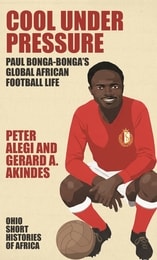
Cool Under Pressure
Paul Bonga-Bonga’s Global African Football LifePeter Alegi and Gerard A. Akindes
Ohio University Press, 2027
This concise scholarly biography is the first English-language book to tell the story of Paul Bonga-Bonga’s extraordinary sporting life in Congo and Belgium. The book is divided into three parts: Childhood and Youth, Adulthood, and Maturity. Part 1 focuses on Bonga-Bonga’s early years under Belgian colonial rule, his formative experiences in mission schools, and his emergence as a precocious soccer talent. Part 2 focuses on a booming Kinshasa in the 1950s, when he started first for Union and then for the popular Daring Club as a left-footed midfielder who mesmerized crowds in Africa’s largest stadium. After being scouted as a member of a Congolese all-star team that toured Belgium in 1957, he signed with Standard Liège in the Belgian first division. Part 3 analyzes Bonga-Bonga’s six seasons at Standard, where he contributed to the club’s first three league championships and played in the European Cup semifinals against Real Madrid. The last chapter chronicles his coaching accomplishments, notably his work as the first Black African licensed head coach in Belgium and as technical director of Zaire’s national team.
Against a backdrop of colonialism, independence, and globalization, this biography demonstrates how Bonga-Bonga’s achievements and struggles helped pave the way for today’s Afro-Belgian footballers. It does so by drawing on a rich set of written and oral evidence in multiple languages—including interviews with Bonga-Bonga himself—as well as photographs and vintage video footage. His lifelong movement between Congo and Belgium highlights the nonlinear nature of African migration and further deepens understanding of Congo’s underappreciated role in the cultural and economic globalization of soccer. Well suited for teachers, students, and general readers interested in sports, culture, and identity, this book deepens knowledge of African social change in a global context and connects to key themes in African studies and sports history, such as individual agency, migration, race and racism, masculinity, citizenship, and belonging. Bonga-Bonga’s sporting life is proof, if proof were still needed, that histories of modern Africa are incomplete without football.
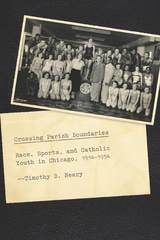
Crossing Parish Boundaries
Race, Sports, and Catholic Youth in Chicago, 1914-1954Timothy B. Neary
University of Chicago Press, 2016
In this book, Timothy B. Neary reveals the history of Bishop Bernard Sheil’s Catholic Youth Organization (CYO), which brought together thousands of young people of all races and religions from Chicago’s racially segregated neighborhoods to take part in sports and educational programming. Tens of thousands of boys and girls participated in basketball, track and field, and the most popular sport of all, boxing, which regularly filled Chicago Stadium with roaring crowds. The history of Bishop Sheil and the CYO shows a cosmopolitan version of American Catholicism, one that is usually overshadowed by accounts of white ethnic Catholics aggressively resisting the racial integration of their working-class neighborhoods. By telling the story of Catholic-sponsored interracial cooperation within Chicago, Crossing Parish Boundaries complicates our understanding of northern urban race relations in the mid-twentieth century.
Cut Time
An Education at the FightsCarlo Rotella
University of Chicago Press, 2005
Tracing the consequences of hurt and craft, the two central facts of boxing, Rotella reveals moving resonances between the worlds inside and outside the ropes. The brief, disastrous fistic career of one of his students pinpoints the moment when adulthood arrives; the hard-won insight of a fellow fan shows Rotella how to reckon with a car crash. Mismatches, resilience, pride, pain, and aging—Rotella's lessons from the ring extend far beyond the sport. In Cut Time, Rotella achieves the near-impossible: he makes the fight world relevant to us, whether we're fans or not.
"Cut Time should be read not just by fight aficionados but also by fans of intelligent nonfiction writing. . . . An absorbing read."—Sports Illustrated
"Just when you think it's all been written, a good writer takes a shining new look at an old subject and breathes life into it. . . . Rotella has preserved the blow-by-blow and the grandeur of another age but has somehow expanded the ring to include his own generation's proclivities and sensibility."—Los Angeles Times
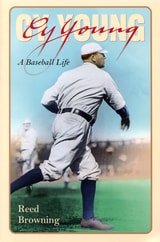
Cy Young
A Baseball LifeReed Browning
University of Massachusetts Press, 2000
He was the winner of 511 major league baseball games, nearly a hundred more than any other pitcher. He threw three no-hitters, including the first perfect game in the new American League. He was among the original twelve players inducted into baseball's Hall of Fame, and his name is now attached to the game's most prestigious pitching award. Yet for all his accomplishments, Cy Young remains to most baseball fans a legendary but little known figure.
In this book, Reed Browning re-creates the life of Denton True “Cyclone” Young and places his story in the context of a rapidly changing turn-of-the-century America. Born in rural Ohio, the son of a Civil War veteran, Young learned his trade at a time when only underhand pitching was permitted. When he began his professional career in 1890, pitchers wore no gloves and stood five feet closer to the batter than they do today. By the time he retired in 1911, the game of baseball had evolved into its modern form and claimed unquestioned status as America's “national pastime.”
As Browning shows, Young's extraordinary mastery of his craft owed much to his ability to adapt to the changing nature of the game. Endowed with an exceptional fastball, he gradually developed a wide array of deliveries and pitches—all of which he could throw with astonishing control. Yet his success can also be attributed, at least in part, to the rustic values of loyalty, hard work, and fair play that he embraced and embodied, and for which he became renowned among baseball fans of his day.