Results by title
63 books match the query 'Statistics' and 4 start with c

Canada Votes, 1935-1989
Frank Feigert
Duke University Press, 1989
The result is a compendium of data and analysis that can be found nowhere else and which will be an invaluable sourcebook for students of Canadian political behavior.
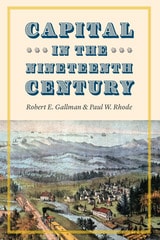
Capital in the Nineteenth Century
Robert E. Gallman and Paul W. Rhode
University of Chicago Press, 2020
When we think about history, we often think about people, events, ideas, and revolutions, but what about the numbers? What do the data tell us about what was, what is, and how things changed over time? Economist Robert E. Gallman (1926–98) gathered extensive data on US capital stock and created a legacy that has, until now, been difficult for researchers to access and appraise in its entirety.
Gallman measured American capital stock from a range of perspectives, viewing it as the accumulation of income saved and invested, and as an input into the production process. He used the level and change in the capital stock as proxy measures for long-run economic performance. Analyzing data in this way from the end of the US colonial period to the turn of the twentieth century, Gallman placed our knowledge of the long nineteenth century—the period during which the United States began to experience per capita income growth and became a global economic leader—on a strong empirical foundation. Gallman’s research was painstaking and his analysis meticulous, but he did not publish the material backing to his findings in his lifetime. Here Paul W. Rhode completes this project, giving permanence to a great economist’s insights and craftsmanship. Gallman’s data speak to the role of capital in the economy, which lies at the heart of many of the most pressing issues today.
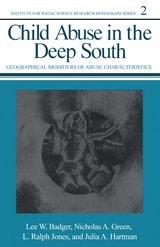
Child Abuse in the Deep South
Geographical Modifiers of Abuse CharacteristicsLee W. Badger
University of Alabama Press, 1988
A powerful, data-driven investigation into how race, geography, and community shape the reporting and response to child abuse in Alabama.
Child Abuse in the Deep South is a groundbreaking examination of how child maltreatment is reported, confirmed, and understood in Alabama—a state shaped by deep historical, racial, and geographic divides. Drawing on over 7,000 case reports, this study reveals how factors such as race, community size, and regional culture influence the identification and handling of abuse cases. With a focus on both rural and urban settings, the book uncovers patterns of systemic bias, underreporting, and institutional response that have long gone unaddressed.
Through rigorous data analysis and a compassionate lens, this work challenges assumptions about child welfare in the American South and offers critical insights for policymakers, social workers, legal professionals, and scholars. Child Abuse in the Deep South is both a call to action and a vital resource for understanding the intersection of social justice, public policy, and child protection in one of the nation’s most complex regions.
Child Abuse in the Deep South provides a quantitative benchmark that investigators and policy-makers will find invaluable on the path to defining at-risk populations, effective interventions, and treatments.
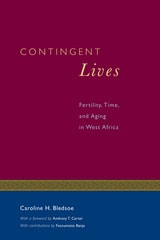
Contingent Lives
Fertility, Time, and Aging in West AfricaCaroline H. Bledsoe
University of Chicago Press, 2002
Using ethnographic and demographic data from a three-year study in rural Gambia, Contingent Lives explains this seemingly counterintuitive fact by juxtaposing two very different understandings of the life course: one is a linear, Western model that equates aging and the ability to reproduce with the passage of time, the other a Gambian model that views aging as contingent on the cumulative physical, social, and spiritual hardships of personal history, especially obstetric trauma. Viewing each of these two models from the perspective of the other, Caroline Bledsoe produces fresh understandings of the classical anthropological subjects of reproduction, time, and aging as culturally shaped within women's conjugal lives. Her insights will be welcomed by scholars of anthropology and demography as well as by those working in public health, development studies, gerontology, and the history of medicine.