Results by title
117 books match the query 'Storytelling' and 8 start with c
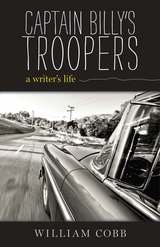
Captain Billy's Troopers
A Writer's LifeWilliam Cobb
University of Alabama Press, 2015
Captain Billy’s Troopers is a frank, literary memoir about William Cobb’s life as a southern writer—his struggles with addiction and illness, his career as a teacher and novelist, and his hard‑won return to creative life.
In this audacious memoir, William Cobb reveals the tumultuous creative life of a distinguished practitioner of southern and Alabama storytelling. As poignant and inspiring as his own fiction, Captain Billy’s Troopers traces Cobb’s early life, education, and struggles with alcohol and the debilitating condition normal pressure hydrocephalus (NPH).
Like a curving river, the broad sweep of Cobb’s turbulent life includes both startling cataracts and desultory eddies, leading sometimes into shadows or opening into unexpected sunlight. With unsentimental clarity, Cobb recounts coming of age in his native Demopolis in the churning middle years of the twentieth century. It’s there he has his first tantalizing tastes of alcohol and begins to drink habitually. Readers then travel with Cobb to Livingston University (now the University of West Alabama) and then on to Vanderbilt University. Along the way, readers relish his first experiences of love and success as a writer, leading to a career as a professor of writing at Alabama College (now the University of Montevallo) in 1963.
From there Cobb’s struggles with alcohol and depression lead to elongated years of tumbling creative output and the collapse of his marriage. The summer of 1984 found Cobb in rehab, the first step in his path to recovery. His unflinching memoir narrates both the milestones and telling details of his intense therapy and years in Alcoholics Anonymous (AA). In the sober thirty years since, Cobb has published a string of critically praised novels and a prize-winning collection of short stories. The capstone of his comeback was winning the Harper Lee Award in 2007 for distinguished fiction writing.
In 2000, shortly after retiring, Cobb developed NPH, which upset his sense of balance and triggered dementia symptoms and other maladies. Nine years later in 2009, brain surgery brought Cobb a dramatic recovery, which began the third act in his writing career. Vital, honest, and entertaining, Captain Billy’s Troopers captures the life of an Alabama original.
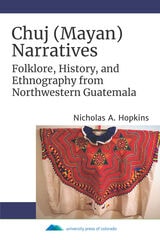
Chuj (Mayan) Narratives
Folklore, History, and Ethnography from Northwestern GuatemalaNicholas A. Hopkins
University Press of Colorado, 2020
The book illustrates the broad range of stories people tell each other, from mythological and legendary topics to procedural discussions and stories borrowed from European and African societies. Hopkins provides context for the narratives by introducing the reader to Chuj culture and history, conveying important events as described by indigenous participants. These events include customs and practices related to salt production as well as the beginnings of the disastrous civil war of the last century, which resulted in the destruction of several villages from which the narratives in this study originated. Hopkins also provides an analytical framework for the strategies of the storytellers and presents the narratives with Chuj text and English translation side-by-side.
Chuj (Mayan) Narratives analyzes the strategies of storytelling in an innovative framework applicable to other corpora and includes sufficient grammatical information to function as an introduction to the Chuj language. The stories illustrate the persistence of Classic Maya themes in contemporary folk literature, making the book significant to Mesoamericanists and Mayanists and an essential resource for students and scholars of Maya linguistics and literary traditions, storytelling, and folklore.
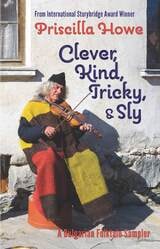
Clever, Kind, Tricky, and Sly
A Bulgarian Folktale SamplerPriscilla Howe
Parkhurst Brothers, Inc., 2020
Each folktale expresses an aspect of Bulgarian folk culture, presents characters who are clever enough to avoid ill-conceived courtship, kind enough to esteem even the poorest of neighbors, tricky enough to evade shysters, or sly enough to remain independent in the face of great power. Each of these traits has helped the Bulgarian people survive and thrive in a relatively poor, mountainous environment for more than fourteen centuries. In celebrating these traits and others, the folktales collected here honor the character of a people.
Community Listening
Stories, Hauntings, PossibilitiesJenn Fishman
University Press of Colorado, 2025
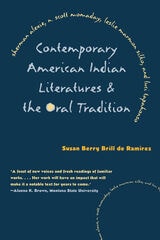
Contemporary American Indian Literatures and the Oral Tradition
Susan Berry Brill de Ramírez
University of Arizona Press, 1999
. To demonstrate this point, she explores literary works both by established Native writers such as Sherman Alexie, N. Scott Momaday, Leslie Marmon Silko, and Luci Tapahonso and by less-well-known writers such as Anna Lee Walters, Della Frank, Lee Maracle, and Louis Owens. Through her literary engagements with many poems, novels, and short stories, she demonstrates a new way to read and understand the diverse body of American Indian literatures. Brill de Ramírez's conversive approach interweaves two interconnected processes: co-creating the stories by participating in them as listener-readers and recognizing orally informed elements in the stories such as verbal minimalism and episodic narrative structures.
Because this methodology is rooted in American Indian oral storytelling traditions, Native voices from these literary works are able to more directly inform the scholarly process than is the case in more textually based critical strategies. Through this innovative approach, Brill de Ramírez shows that literature is not a static text but an interactive and potentially transforming conversation between listener-readers, storyteller-writers, and the story characters as well. Her book furthers the discussion of how to read American Indian and other orally informed literatures with greater sensitivity to their respective cultural traditions and shows that the immediacy of the relationship between teller, story, and listener can also be experienced in the relationships between writers, literary works, and their listener-readers.

Cooking Up a Storytime
Mix-and-Match Menus for Easy ProgrammingSusan Anderson-Newham
American Library Association, 2014
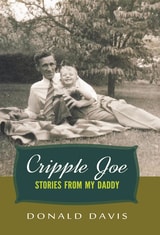
Cripple Joe
Stories from my DaddyDonald Davis
Parkhurst Brothers, Inc., 2016
"A million questions about him began to line themselves up in my mind." Davis writes. "Where did he go to high school? I did not know." Did he get any education behind that? What were his early jobs, and where did he live then? I was now only twenty-eight, my father was dead, and I had been to young and immature to know to ask t=for the stories that would have filled out his life for me."
The surprise of a lifetime came when he called home and his recently departed father picked up the phone: "Hello! This is Joe Davis. What can I do for you today?"
That case of mistaken identity changed Donald Davis's outlook on the value of family and the need for story gathering. In the twenty-two years until his father's second death, he rarely let an opportunity pass to collect and cherish the stories of his life.
Cripple Joe is the happy result.
Davis tells how his father and an African-American hospital orderly quietly broke down racial barriers in their small mountain town.
He tells how his father employed his humane brand of justice on an eager young chemist whose experiments veered into manufacturing gunpowder, on sons who nearly burned a barn, and on teenagers who organized a disastrous coed camping trip.
And best of all, he tells how Joe Davis--a man known as "Banker Joe" for his work in the loan department but to a select few as "Cripple Joe"--turned a gruesome accident into an opportunity that broadened his world and that of his son.
Critical Data Storytelling for Libraries
Crafting Ethical Narratives for Advocacy and ImpactKate McDowell
American Library Association, 2025
- the dynamic interrelationships between storyteller, audience, and story which lie at the heart of storytelling;
- ways to mesh library data collection processes with long-term storytelling potential, prioritizing interaction over transaction;
- three time-honored and effective narrative strategies for organizing the informational and emotional content of library data stories, easily adaptable for any situation;
- approaches for emphasizing inclusivity and justice to ensure that library advocates can tell stories that challenge stereotypes, promote equity, and align their efforts with broader ethical and social goals;
- audience attitudes as challenges and opportunities for library data communication; and
- strategies for maintaining open and transparent public communication in the face of rampant misinformation and active disinformation campaigns.