Results by title
105 books match the query 'Sustainable development' and 10 start with c
Casa Pueblo
A Puerto Rican Model of Self-GovernanceAlexis Massol González, Translated by Ashwin Ravikumar and Paul Schroeder Rodríguez
Lever Press, 2022

Challenging Nature
Local Knowledge, Agroscience, and Food Security in Tanga Region, TanzaniaPhilip W. Porter
University of Chicago Press, 2005
Porter first began work on this project in 1972, asking 250 farmers in the region about life history, environmental and agricultural changes, types of crops grown and methods of planting, environmental assessments, agricultural practices, food and water supplies, training and education, and attitudes toward nature. Twenty years later, he returned and reinterviewed as many farmers as could be found from the first survey. The result contextualizes the environmental history of the region while informing current and future agricultural development.
Chefs, Restaurants, and Culinary Sustainability
Carole Counihan
University of Arkansas Press, 2025
Chefs, Restaurants, and Culinary Sustainability explores how chefs around the world approach culinary sustainability in highly unstable times while working in myriad professional domains. Building on empirical data collected from a wide range of cultural, historical, political, and economic settings, the contributors to this collection provide a sophisticated and engaging examination of how chefs in diverse culinary contexts tackle the increasingly urgent societal and environmental need for a more secure food future.
Cities in the Anthropocene
New Ecology and Urban PoliticsIhnji Jon
Pluto Press, 2021
Climate change is real, and extreme weather events are its physical manifestations. These extreme events affect how we live and work in cities, and subsequently the way we design, plan, and govern them. Taking action ‘for the environment’ is not only a moral imperative; instead, it is activated by our everyday experience in the city.
Based on the author’s site visits and interviews in Darwin (Australia), Tulsa (Oklahoma), Cleveland (Ohio), and Cape Town (South Africa), this book tells the story of how cities can lead a transformative pro-environment politics.
National governments often fail to make binding agreements that bring about radical actions for the environment. This book shows how cities, as local sites of mobilizing a collective, political agenda, can be frontiers for activating the kind of environmental politics that appreciates the role of ‘nature’ in the everyday functioning of our urban life.
Conservation Is Our Government Now
The Politics of Ecology in Papua New GuineaPaige West
Duke University Press, 2006
West reveals how every aspect of the Crater Mountain Wildlife Management Area—including ideas of space, place, environment, and society—was socially produced, created by changing configurations of ideas, actions, and material relations not only in Papua New Guinea but also in other locations around the world. Complicating many of the assumptions about nature, culture, and development underlying contemporary conservation efforts, Conservation Is Our Government Now demonstrates the unique capacity of ethnography to illuminate the relationship between the global and the local, between transnational processes and individual lives.
Contours of the Illiberal State
Governing Circulation in the Smart EconomyEdited by Boris Vormann and Christian Lammert
Campus Verlag, 2019
Costing the Earth?
Perspectives on Sustainable DevelopmentBernd Meyer
Haus Publishing, 2009
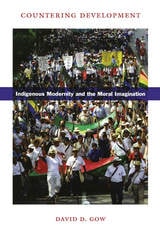
Countering Development
Indigenous Modernity and the Moral ImaginationDavid D. Gow
Duke University Press, 2008
Through ethnographic fieldwork conducted annually in Cauca from 1995 through 2002, Gow compares the development plans of the three communities, looking at both the planning processes and the plans themselves. In so doing, he demonstrates that there is no single indigenous approach to development and modernity. He describes differences in how each community defined and employed the concept of culture, how they connected a concern with culture to economic and political reconstruction, and how they sought to assert their own priorities while engaging with the existing development resources at their disposal. Ultimately, Gow argues that the moral vision advanced by the indigenous movement, combined with the growing importance attached to human rights, offers a fruitful way to think about development: less as a process of integration into a rigidly defined modernity than as a critical modernity based on a radical politics of inclusive citizenship.
Culture and the Question of Rights
Forests, Coasts, and Seas in Southeast AsiaCharles Zerner, ed.
Duke University Press, 2003
Calling for radical redefinitions of development and ownership and for new understandings of the translation of culture and rights in politically dangerous contexts—natural resource frontiers—this volume links social injustice and the degradation of Southeast Asian environments. Charles Zerner and his colleagues show how geographical areas once viewed as wild and undeveloped are actually cultural artifacts shaped by complex interactions with human societies. Drawing on richly varied sources of evidence and interpretation—from trance dances, court proceedings, tree planting patterns, marine and forest rituals, erotic poems, and codifications of customary law, Culture and the Question of Rights reveals the ironies, complexities, and histories of contemporary communities’ struggles to retain their gardens, forests, fishing territories, and graveyards. The contributors examine how these cultural activities work to both construct and to lay claim to nature. These essays open up new avenues for negotiating indigenous rights against a background of violence, proliferating markets, and global ideas of biodiversity and threatened habitat.
Contributors. Jane Atkinson, Don Brenneis, Stephanie Fried, Nancy Peluso, Marina Roseman, Anna Tsing, Charles Zerner