Results by title
129 books match the query 'Technique' and 4 start with c
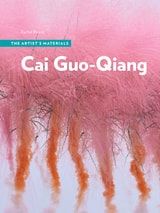
Cai Guo-Qiang
The Artist's MaterialsRachel Rivenc
J. Paul Getty Trust, The, 2025
This groundbreaking book provides the first material study of the celebrated contemporary artist Cai Guo-Qiang, known worldwide for his use of subversive materials, particularly gunpowder.
Cai Guo-Qiang (China, b. 1957) is among the most prominent contemporary artists active today. His prolific, diverse creative practice—which includes gunpowder drawings and paintings, explosion events, videos, multimedia installations, and site-specific works—draws on a personal belief system that freely blends symbols and tenets from Eastern and Western traditions. Cai’s output seeks to establish dialogues among different cultures, different periods of time, and even different species—always while probing our shared humanity and the connections that can be divined across space and time, out of chaos and disorder. Based on in-depth interviews between the author and artist and with studio assistants, as well as extensive examination, sampling, and scientific analysis of a wide range of artworks, this publication addresses the implications of Cai’s distinctive materials and processes and their associated conservation issues.
Written for conservation scientists, conservators, specialists in contemporary art history, museum curators, collections managers, practicing artists, collectors, and art enthusiasts, this book offers insights into the life, methods, and materials of a leading figure in the art world. The technical discussions provide essential findings that will inform strategies for the future care of his works.
[more]
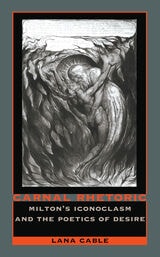
Carnal Rhetoric
Milton’s Iconoclasm and the Poetics of DesireLana Cable
Duke University Press, 1995
In recent years, New Historicists have situated the iconoclasm of Milton’s poetry and prose within the context of political, cultural, and philosophical discourses that foreshadow early modernism. In Carnal Rhetoric, Lana Cable carries these investigations further by exploring the iconoclastic impulse in Milton’s works through detailed analyses of his use of metaphor. Building on a provocative iconoclastic theory of metaphor, she breaks new ground in the area of affective stylistics, not only as it pertains to the writings of Milton but also to all expressive language.
Cable traces the development of Milton’s iconoclastic poetics from its roots in the antiprelatical tracts, through the divorce tracts and Areopagitica, to its fullest dramatic representation in Eikonoklastes and Samson Agonistes. Arguing that, like every creative act, metaphor is by nature a radical and self-transgressing agent of change, she explores the site where metaphoric language and imaginative desire merge. Examining the demands Milton places on metaphor, particularly his emphasis on language as a vehicle for mortal redemption, Cable demonstrates the ways in which metaphor acts for him as that creative and radical agent of change. In the process, she reveals Milton’s engagement, at the deepest levels of linguistic creativity, with the early modern commitment to an imaginative and historic remaking of the world.
An insightful and synthetic book, Carnal Rhetoric will appeal to scholars of English literature, Milton, and the Renaissance, as well as to those with an interest in the theory of affective stylistics as it pertains to reader-response criticism, semantics, epistemology, and the philosophy and psychology of language.
[more]
Character, Scene, and Story
New Tools from the Dramatic Writer's CompanionWill Dunne
University of Chicago Press, 2017
Will Dunne first brought the workshop experience down to the desk level with The Dramatic Writer’s Companion, offering practical exercises to help playwrights and screenwriters work through the problems that arise in developing their scripts. Now writers looking to further enhance their storytelling process can turn to Character, Scene, and Story.
Featuring forty-two new workshop-tested exercises, this sequel to The Dramatic Writer’s Companion allows writers to dig deeper into their scripts by fleshing out images, exploring characters from an emotional perspective, tapping the power of color and sense memory to trigger ideas, and trying other visceral techniques. The guide also includes a troubleshooting section to help tackle problem scenes. Writers with scripts already in progress will find they can think deeper about their characters and stories. And those who are just beginning to write will find the guidance they need to discover their best starting point. The guide is filled with hundreds of examples, many of which have been developed as both plays and films.
Character, Scene, and Story is fully aligned with the new edition of The Dramatic Writer’s Companion, with cross-references between related exercises so that writers have the option to explore a given topic in more depth. While both guides can stand alone, together they give writers more than one hundred tools to develop more vivid characters and craft stronger scripts.
[more]
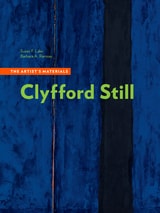
Clyfford Still
The Artist’s MaterialsSusan F. Lake
J. Paul Getty Trust, The, 2022
This groundbreaking book provides the first detailed account of the materials and techniques of perhaps the most radical—and until now, least studied—major American Abstract Expressionist.
Among the most radical of the great American Abstract Expressionist painters, Clyfford Still has also long been among the least studied. Still severed ties with the commercial art world in the early 1950s, and his estate at the time of his death in 1980 comprised some 3,125 artworks—including more than 800 paintings—that were all but unknown to the art world. Susan F. Lake and Barbara A. Ramsay were granted access to this collection by the estate and by the Clyfford Still Museum in Denver, which houses this immense corpus today.
This volume, based on the authors’ materials research and enriched by their unprecedented access to Still’s artworks, paints, correspondence, studio records, and personal library, provides the first detailed account of his materials, working methods, and techniques. Initial chapters provide an engaging and erudite overview of the artist's life. Subsequent chapters trace the development of his visionary style, offer in-depth materials analysis of selected works from each decade of his career, and suggest new approaches to the care and conservation of his paintings. There is also a series of technical appendices as well as a full bibliography.
[more]