Results by title
234 books match the query 'Technological innovations' and 17 start with c
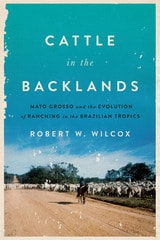
Cattle in the Backlands
Mato Grosso and the Evolution of Ranching in the Brazilian TropicsBy Robert W. Wilcox
University of Texas Press, 2017
Henry A. Wallace Award, The Agricultural History Society, 2018
Brazil has the second-largest cattle herd in the world and is a major exporter of beef. While ranching in the Amazon—and its destructive environmental consequences—receives attention from both the media and scholars, the states of Mato Grosso and Mato Grosso do Sul actually host the most cattle. A significant beef producer in Brazil beginning in the late nineteenth century, the region served as a laboratory for raising cattle in the tropics, where temperate zone ranching practices do not work. Mato Grosso ranchers and cowboys transformed ranching’s relationship with the environment, including the introduction of an exotic cattle breed—the Zebu—that now dominates Latin American tropical ranching.
Cattle in the Backlands presents a comprehensive history of ranching in Mato Grosso. Using extensive primary sources, Robert W. Wilcox explores three key aspects: the economic transformation of a remote frontier region through modern technical inputs; the resulting social changes, especially in labor structures and land tenure; and environmental factors, including the long-term impact of ranching on ecosystems, which, he contends, was not as detrimental as might be assumed. Wilcox demonstrates that ranching practices in Mato Grosso set the parameters for tropical beef production in Brazil and throughout Latin America. As the region was incorporated into national and international economic structures, its ranching industry experienced the entry of foreign investment, the introduction of capitalized processing facilities, and nascent discussions of ecological impacts—developments that later affected many sectors of the Brazilian economy.

Chemical Heroes
Pharmacological Supersoldiers in the US MilitaryAndrew Bickford
Duke University Press, 2020
Cineaste on Film Criticism, Programming, and Preservation in the New Millennium
Edited by Cynthia Lucia and Rahul Hamid
University of Texas Press, 2017
Digital technology and the Internet have revolutionized film criticism, programming, and preservation in deeply paradoxical ways. The Internet allows almost everyone to participate in critical discourse, but many print publications and salaried positions for professional film critics have been eliminated. Digital technologies have broadened access to filmmaking capabilities, as well as making thousands of older films available on DVD and electronically. At the same time, however, fewer older films can be viewed in their original celluloid format, and newer, digitally produced films that have no “material” prototype are threatened by ever-changing servers that render them obsolete and inaccessible.
Cineaste, one of the oldest and most influential publications focusing on film, has investigated these trends through a series of symposia with the top film critics, programmers, and preservationists in the United States and beyond. This volume compiles several of these symposia: “Film Criticism in America Today” (2000), “International Film Criticism Today” (2005), “Film Criticism in the Age of the Internet” (2008), “Film Criticism: The Next Generation” (2013), “The Art of Repertory Film Exhibition and Digital Age Challenges” (2010), and “Film Preservation in the Digital Age” (2011). It also includes interviews with the late, celebrated New Yorker film critic Pauline Kael and the critic John Bloom (“Joe Bob Briggs”), as well as interviews with the programmers/curators Peter von Bagh and Mark Cousins and with the film preservationist George Feltenstein. This authoritative collection of primary-source documents will be essential reading for scholars, students, and film enthusiasts.
Classics from Papyrus to the Internet
An Introduction to Transmission and ReceptionBy Jeffrey M. Hunt, R. Alden Smith, and Fabio Stok
University of Texas Press, 2017
Winner, PROSE Award, Classics, Association of American Publishers (AAP), 2018
Writing down the epic tales of the Trojan War and the wanderings of Odysseus in texts that became the Iliad and the Odyssey was a defining moment in the intellectual history of the West, a moment from which many current conventions and attitudes toward books can be traced. But how did texts originally written on papyrus in perhaps the eighth century BC survive across nearly three millennia, so that today people can read them electronically on a smartphone?
Classics from Papyrus to the Internet provides a fresh, authoritative overview of the transmission and reception of classical texts from antiquity to the present. The authors begin with a discussion of ancient literacy, book production, papyrology, epigraphy, and scholarship, and then examine how classical texts were transmitted from the medieval period through the Renaissance and the Enlightenment to the modern era. They also address the question of reception, looking at how succeeding generations responded to classical texts, preserving some but not others. This sheds light on the origins of numerous scholarly disciplines that continue to shape our understanding of the past, as well as the determined effort required to keep the literary tradition alive. As a resource for students and scholars in fields such as classics, medieval studies, comparative literature, paleography, papyrology, and Egyptology, Classics from Papyrus to the Internet presents and discusses the major reference works and online professional tools for studying literary transmission.
Climatic Media
Transpacific Experiments in Atmospheric ControlYuriko Furuhata
Duke University Press, 2022

Clinical Labor
Tissue Donors and Research Subjects in the Global BioeconomyMelinda Cooper and Catherine Waldby
Duke University Press, 2014
Cooper and Waldby examine the rapidly expanding transnational labor markets surrounding assisted reproduction and experimental drug trials. As they discuss, the pharmaceutical industry demands ever greater numbers of trial subjects to meet its innovation imperatives. The assisted reproductive market grows as more and more households look to third-party providers for fertility services and sectors of the biomedical industry seek reproductive tissues rich in stem cells. Cooper and Waldby trace the historical conditions, political economy, and contemporary trajectory of clinical labor. Ultimately, they reveal clinical labor to be emblematic of labor in twenty-first-century neoliberal economies.
Collecting Experiments
Making Big Data BiologyBruno J. Strasser
University of Chicago Press, 2019
Every scientist working today draws on databases to produce scientific knowledge. Databases have become more common than microscopes, voltmeters, and test tubes, and the increasing amount of data has led to major changes in research practices and profound reflections on the proper professional roles of data producers, collectors, curators, and analysts.
Collecting Experiments traces the development and use of data collections, especially in the experimental life sciences, from the early twentieth century to the present. It shows that the current revolution is best understood as the coming together of two older ways of knowing—collecting and experimenting, the museum and the laboratory. Ultimately, Bruno J. Strasser argues that by serving as knowledge repositories, as well as indispensable tools for producing new knowledge, these databases function as digital museums for the twenty-first century.
Communication Convergence in Contemporary China
International Perspectives on Politics, Platforms, and ParticipationPatrick Shaou-Whea Dodge
Michigan State University Press, 2020
Communication and Empire
Media, Markets, and Globalization, 1860-1930Dwayne R. Winseck and Robert M. Pike
Duke University Press, 2007
Drawing on extensive research in corporate and government archives, Winseck and Pike illuminate the actions of companies and cartels during the late nineteenth century and early twentieth, in many different parts of the globe, including Africa, Asia, and Central and South America as well as Europe and North America. The complex history they relate shows how cable companies exploited or transcended national policies in the creation of the global cable network, how private corporations and government agencies interacted, and how individual reformers fought to eliminate cartels and harmonize the regulation of world communications. In Communication and Empire, the multinational conglomerates, regulations, and the politics of imperialism and anti-imperialism as well as the cries for reform of the late nineteenth century and early twentieth emerge as the obvious forerunners of today’s global media.
Competitiveness Matters
Industry and Economic Performance in the U.S.Candace Howes and Ajit Singh, Editors
University of Michigan Press, 2000

Composing Place
Digital Rhetorics for a Mobile WorldJacob Greene
Utah State University Press, 2022
Greene identifies three emerging “modalities” through which mobile technologies are being used by digital writers. First, to counter dominant discourses in contested spaces; second, to historicize entrenched narratives in iconic spaces; and third, to amplify marginalized voices in mundane spaces. Through these modalities, Greene employs Indigenous philosophies and theories that upend the ways that the discipline has centered placed-based rhetorics, offering digital writers better strategies for using mobile media as a platform for civic deliberation, social advocacy, and political action.
Composing Place offers close analyses of mobile media experiences created by various artists and digital media practitioners, as well as detailed overviews of Greene’s own projects (also accessible through the companion website: www.composingplace.com). These projects include a digital “countertour” of SeaWorld that demonstrates the ways in which the attraction is driven by capitalism; an augmented reality tour of Detroit’s Woodward Avenue; and a mobile advocacy project in Jacksonville, Florida, that demonstrates the inequitable effects of car-centric public infrastructure. Ultimately, by engaging with these theoretical frameworks, rhetorical design principles, and pedagogical practices of mobile writing, readers can utilize the unique affordances of mobile media in various teaching and research contexts.

Content Machines
Reading and Writing in the Platform EraSarah Brouillette
Duke University Press, 2026
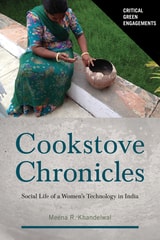
Cookstove Chronicles
Social Life of a Women’s Technology in IndiaMeena R. Khandelwal
University of Arizona Press, 2024
Based on anthropological research in Rajasthan, Cookstove Chronicles argues that the supposedly obsolete chulha persists because it offers women control over the tools needed to feed their families. Their continued use of old stoves alongside the new is not a failure to embrace new technologies but instead a strategy to maximize flexibility and autonomy. The chulha is neither the villain nor hero of this story. It produces particulate matter that harms people’s bodies, leaves soot on utensils and walls, and accelerates glacial melting and atmospheric warming. Yet it also depends on renewable biomass fuel and supports women’s autonomy as a local, do-it-yourself technology.
Meena Khandelwal, a feminist anthropologist, describes her collaboration with engineers, archaeologists, and others. She employs critical social theory and reflections from fieldwork to bring together research from a range of fields, including history, geography, anthropology, energy and environmental studies, public health, and science and technology studies (STS). In so doing she not only demystifies multidisciplinary research but also highlights the messy reality of actual behavior.
Cookstove Chronicles critically examines why, despite extensive development efforts, use of the chulha persists. It offers an important new framework for looking at development, technology, environmental change, and human behavior.

Crip Screens
Countering Psychiatric Media TechnologiesOlivia Banner
Duke University Press, 2025
Critical Study Of Work
edited by Rick Baldoz, Charles Koeber and Philip Kraft
Temple University Press, 2001
The editors have assembled a collection of provocative, original essays on work and workplaces throughout the world that challenge the current celebration of globalization and new technologies. Building on labor process analysis, individual case studies venture beyond factory and office to examine "virtual" workplaces, computer-era cottage work, and emotional and household labor. The settings range from Indian and Irish software factories to Brazilian supermarkets, Los Angeles sweatshops, and Taiwanese department stores.
Other essays seek to make theoretical sense of increasingly de-centered production chains, fluid work relations, and uncertain employment. Individually and collectively the authors construct a new critical study of work, highlighting the connections between geography, technology, gender, race, and class. They offer an accessible and flexible approach to the study of workplace relations and production organization -- and even the notion of work itself.
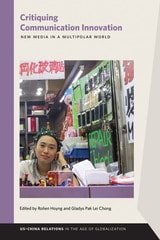
Critiquing Communication Innovation
New Media in a Multipolar WorldRolien Hoyng
Michigan State University Press, 2022

Cyber-Marx
Cycles and Circuits of Struggle in High Technology CapitalismNick Dyer-Witheford
University of Illinois Press, 1999
Dyer-Witheford maps the dynamics of modern capitalism, showing how capital depends for its operations not just on exploitation in the immediate workplace, but on the continuous integration of a whole series of social sites and activities, from public health and maternity to natural resource allocation and the geographical reorganization of labor power. He also shows how these sites and activities may become focal points of subversion and insurgency, as new means of communication vital for the smooth flow of capital also permit otherwise isolated and dispersed points of resistance to connect and combine with one another.
Cutting through the smokescreen of high-tech propaganda, Dyer-Witheford predicts the advent of a reinvented, "autonomist" Marxism that will rediscover the possibility of a collective, communist transformation of society. Refuting the utopian promises of the information revolution, he discloses the real potentialities for a new social order in the form of a twenty-first-century communism based on the common sharing of wealth.