Results by title
80 books match the query 'Tennessee' and 6 start with c

Co. Aytch, or a Side Show of the Big Show
A New Edition Introduced and Annotated by Philip LeighSam Watkins
Westholme Publishing, 2013
Co. Aytch, or a Side Show of the Big Show is perhaps the finest memoir of an ordinary Confederate soldier. According to Margaret Mitchell, “a better book there never was.” Sam Watkins served in Company H of the First Tennessee Infantry for the duration of the Civil War. Remarkably, he survived some of the most intense battles of the war, including Shiloh, Chickamauga, Kennesaw Mountain, Atlanta, and Franklin. He was one of only seven of the original members of Company H when it surrendered in April 1865. Watkins’s memoir was written in the winter of 1882–83. The humor and depth of writing at times rises to a level resembling Mark Twain; thus, twenty-first-century readers can still discover the everlasting treasures of Private Sam Watkins’s story just as it was. It is this reason that excerpts were featured frequently in Ken Burns’s documentary on the Civil War. However, since most of Sam’s original readers—or some of their family members—actually lived through the Civil War, much of the context for the narrative was common knowledge. But what was once received history has gradually disappeared, and presently only specialists can fully understand and appreciate Sam’s tale.
The chief aim for this new annotated edition of Co. Aytch—the first of its kind—is to amplify the experience for today’s readers by providing the missing context. Over 240 annotations clarify the situational backgrounds, personalities, and terminology that might not be familiar to most readers. The annotations also identify and explain errors mostly resulting from Sam’s occasionally faulty memory or limited perspective. Similarly, twentyfour battlefield and war theater maps enable readers to track Sam’s combat participation as well as his journeys while marching with the army. Finally fifteen photographs and prints illustrate some of the battles, people, towns, buildings, tools of war, and ruins that Sam witnessed. As someone once cleverly observed, “It’s not an adventure until something goes wrong.” If nothing else, Sam’s memoir is a foot soldier’s view of the resulting horrors, heroics, and healing humor when war planning routinely goes awry.

Country Comes to Town
The Music Industry and the Transformation of NashvilleHill Jeremy
University of Massachusetts Press, 0

Country Comes to Town
The Music Industry and the Transformation of NashvilleJeremy Hill
University of Massachusetts Press, 2016
Country music evokes a simple, agrarian past, with images of open land and pickup trucks. While some might think of the genre as a repository of nostalgia, popular because it preserves and reveres traditional values, Jeremy Hill argues that country music has found such expansive success because its songs and its people have forcefully addressed social and cultural issues as well as geographic change. Hill demonstrates how the genre and its fans developed a flexible idea of “country,” beyond their rural roots, and how this flexibility allowed fans and music to “come to town,” to move into and within urban spaces, while retaining a country “character.”
To understand how the genre has become the far-reaching commercial phenomenon that it is today, Hill explores how various players within the country music fold have grappled with the notion of place. He shows both how the industry has transformed the city of Nashville and how country music—through song lyrics, imagery associated with the music, and branding—has reshaped ideas about the American landscape and character. As the genre underwent significant change in the last decades of the twentieth century, those who sought to explain its new styles and new locations relied on a traditional theme: “You can take the boy out of the country, but you can't take the country out of the boy.” Hill demonstrates how this idea—that you can still be “country” while no longer living in a rural place—has been used to expand country's commercial appeal and establish a permanent home in the urban space of Nashville.
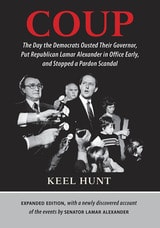
Coup
The Day the Democrats Ousted Their Governor, Put Republican Lamar Alexander in Office Early, and Stopped a Pardon ScandalKeel Hunt
Vanderbilt University Press, 2017
On January 17, 1979, driven by new information that some of the worst criminals in the state's penitentiaries were about to be released (and fears that James Earl Ray might be one of them), a small bipartisan group chose to take charge. Senior Democratic leaders, friends of the sitting governor, together with the Republican governor-elect Lamar Alexander (now US Senator from Tennessee), agreed to oust Blanton from office before another night fell. It was a maneuver unique in American political history.
Expanded edition, with a newly discovered account of the events by Senator Lamar Alexander:
"In December 2015 something unexpected happened. Keel [Hunt] delivered to my Nashville office a brown three-ring binder. He had only recently discovered it in a box that had been in storage for thirty years." —Senator Lamar Alexander
This binder contained the forgotten typescript, written in 1985, of Alexander's recollections of the events leading up to his early inauguration on January 17, 1979. In this expanded edition of Coup, the Senator's 22,000-word text has been added as a lost footnote to Hunt's definitive account.
From the foreword by John L. Seigenthaler:
"The individual stories of those government officials involved in the coup—each account unique, but all of them intersecting—were scattered like disconnected pieces of a jigsaw puzzle on the table of history until the author conceived this book. Perhaps because it happened so quickly, and without major disagreement, protest, or dissent, this truly historic moment has been buried in the public mind. In unearthing the drama in gripping detail, Keel Hunt assures that the 'dark day' will be remembered as a bright one in which conflicted politicians came together in the public interest."
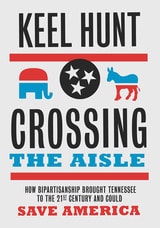
Crossing the Aisle
How Bipartisanship Brought Tennessee to the Twenty-First Century and Could Save AmericaKeel Hunt
Vanderbilt University Press, 2018
The Tennessee story, as the Pulitzer Prize–winning author Jon Meacham observes in his foreword to this book, offers striking examples of bipartisan cooperation on many policy fronts—and a mode of governing that provides lessons for America in this frustrating era of partisan stalemate.
For more on Crossing the Aisle and author Keel Hunt, visit KeelHunt.com.
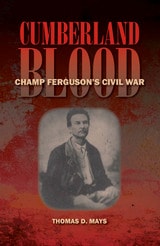
Cumberland Blood
Champ Ferguson's Civil WarThomas D. Mays
Southern Illinois University Press, 2008
By the end of the Civil War, Champ Ferguson had become a notorious criminal whose likeness covered the front pages of Harper’s Weekly, Leslie’s Illustrated, and other newspapers across the country. His crime? Using the war as an excuse to steal, plunder, and murder Union civilians and soldiers.
Cumberland Blood: Champ Ferguson’s Civil War offers insights into Ferguson's lawless brutality and a lesser-known aspect of the Civil War, the bitter guerrilla conflict in the Appalachian highlands, extending from the Carolinas through Tennessee, Kentucky, Virginia, and West Virginia. This compelling volume delves into the violent story of Champ Ferguson, who acted independently of the Confederate army in a personal war that eventually garnered the censure of Confederate officials.
Author Thomas D. Mays traces Ferguson's life in the Cumberland highlands of southern Kentucky, where—even before the Civil War began—he had a reputation as a vicious killer.
Ferguson, a rising slave owner, sided with the Confederacy while many of his neighbors and family members took up arms for the Union. For Ferguson and others in the highlands, the war would not be decided on the distant fields of Shiloh or Gettysburg: it would be local—and personal.
Cumberland Blood describes how Unionists drove Ferguson from his home in Kentucky into Tennessee, where he banded together with other like-minded Southerners to drive the Unionists from the region. Northern sympathizers responded, and a full-scale guerrilla war erupted along the border in 1862. Mays notes that Ferguson's status in the army was never clear, and he skillfully details how raiders picked up Ferguson's gang to work as guides and scouts. In 1864, Ferguson and his gang were incorporated into the Confederate army, but the rogue soldier continued operating as an outlaw, murdering captured Union prisoners after the Battle of Saltville, Virginia.
Cumberland Blood, enhanced by twenty-one illustrations, is an illuminating assessment of one of the Civil War's most ruthless men.
Ferguson's arrest, trial, and execution after the war captured the attention of the nation in
1865, but his story has been largely forgotten. Cumberland Blood: Champ Ferguson's Civil War returns the story of Ferguson's private civil war to its place in history.