Results by title
967 books match the query 'Theater' and 50 start with c
Caffe Cino
The Birthplace of Off-Off-BroadwayWendell C. Stone
Southern Illinois University Press, 2005
“It’s Magic Time!” That colorful promise began each performance at the Caffe Cino, the storied Greenwich Village coffeehouse that fostered the gay and alternative theatre movements of the 1960s and launched the careers of such stage mainstays as Sam Shepard, Lanford Wilson, Robert Heide, Harry Koutoukas, Robert Patrick, Robert Dahdah, Helen Hanft, Al Pacino, and Bernadette Peters. As Off-Off-Broadway productions enjoy a deserved resurgence, theatre historian and actor Wendell C. Stone reopens the Cino’s doors in this vibrant look at the earliest days of OOB.
Rife with insider interviews and rich with evocative photographs, Caffe Cino: The Birthplace of Off-Off-Broadway provides the first detailed account of Joe Cino’s iconic café theatre and its influence on American theatre. A hub of artistic innovation and haven for bohemians, beats, hippies, and gays, the café gave a much-sought outlet to voices otherwise shunned by mainstream entertainment. The Cino’s square stage measured only eight feet, but the dynamic ideas that emerged there spawned the numerous alternative theatre spaces that owe their origins to the risky enterprise on Cornelia Street.
Californios, Anglos, and the Performance of Oligarchy in the U.S. West
Andrew Gibb
Southern Illinois University Press, 2018
This interdisciplinary study draws on performance studies, theatre historiography, and New Western History to identify how the unique power relations of historical California were constituted and perpetuated through public performances—not only traditional theatrical productions but also social events such as elite weddings and community dances—and historical events like the U.S. seizure of the city of Monterey, the feting of Commodore Stockton in San Francisco, and the Bear Flag Revolt.

Carnival Texts
Three Plays for Ensemble PerformanceJames MacDonald
Intellect Books, 2011
Designed for undergraduate performance, Carnival Texts comprises three related dramatic works, all of which have as their point of departure Russian theorist Mikhail Bakhtin’s concept of carnival, a literary style designed to subvert dominant assumptions through chaos and humor. Making creative use of post-Brechtian performance theory, these texts blur the distinction between spectator and performer in a fascinating exploration of physical, moral, and cultural upheaval in a postmodern age. Performance theory is crucial to understanding how performance affects collective understanding, and this book will be of interest to a broad range of students of drama and theater.
Carnival Theater
Uruguay’s Popular Performers and National CultureGustavo Remedi
University of Minnesota Press, 2004
Offers a new model for interpreting popular national culture through Uruguay’s carnival theater troupes
The murgas are troupes of performers, musicians, writers, and creators who, during Montevideo’s Carnival, perform on the tablados, temporary stages built in the neighborhoods of Uruguay’s capital city each year. Throughout the period of Uruguay’s subjection to a brutal dictatorship and in the following era of “democratization,” the murgas, envisioned originally as popular theater, were transformed into a symbol of social resistance, celebrated by many and perceived by others as menacing and subversive.
Focusing on the cultural practices of the lower classes and more specifically on the processes and productions of the murgas, Gustavo Remedi’s Carnival Theater is a deeply thoughtful consideration of Uruguayan society’s identity crisis and subsequent redefinition in the wake of the authoritarian-bureaucratic-technocratic regimes of the 1970s. A revealing work of cultural criticism, the book proposes a new set of criteria for the interpretation and critique of national culture.
Carrying All before Her
Celebrity Pregnancy and the London Stage, 1689-1800Chelsea Phillips
University of Delaware Press, 2022
The rise of celebrity stage actresses in the long eighteenth century created a class of women who worked in the public sphere while facing considerable scrutiny about their offstage lives. Such powerful celebrity women used the cultural and affective significance of their reproductive bodies to leverage audience support and interest to advance their careers, and eighteenth-century London patent theatres even capitalized on their pregnancies. Carrying All Before Her uses the reproductive histories of six celebrity women (Susanna Mountfort Verbruggen, Anne Oldfield, Susannah Cibber, George Anne Bellamy, Sarah Siddons, and Dorothy Jordan) to demonstrate that pregnancy affected celebrity identity, impacted audience reception and interpretation of performance, changed company repertory and altered company hierarchy, influenced the development and performance of new plays, and had substantial economic consequences for both women and the companies for which they worked. Deepening the fields of celebrity, theatre, and women's studies, as well as social and medical histories, Phillips reveals an untapped history whose relevance and impact persists today.
Celebrity Across the Channel, 1750–1850
Anaïs Pédron
University of Delaware Press, 2021
Champagne Charlie and Pretty Jemima
Variety Theater in the Nineteenth CenturyGillian Rodger
University of Illinois Press, 2010
In this rich, imaginative survey of variety musical theater, Gillian M. Rodger masterfully chronicles the social history and class dynamics of the robust, nineteenth-century American theatrical phenomenon that gave way to twentieth-century entertainment forms such as vaudeville and comedy on radio and television. Fresh, bawdy, and unabashedly aimed at the working class, variety honed in on its audience's fascinations, emerging in the 1840s as a vehicle to accentuate class divisions and stoke curiosity about gender and sexuality. Cross-dressing acts were a regular feature of these entertainments, and Rodger profiles key male impersonators Annie Hindle and Ella Wesner while examining how both gender and sexuality gave shape to variety. By the last two decades of the nineteenth century, variety theater developed into a platform for ideas about race and whiteness.
As some in the working class moved up into the middling classes, they took their affinity for variety with them, transforming and broadening middle-class values. Champagne Charlie and Pretty Jemima places the saloon keepers, managers, male impersonators, minstrels, acrobats, singers, and dancers of the variety era within economic and social contexts by examining the business models of variety shows and their primarily white, working-class urban audiences. Rodger traces the transformation of variety from sexualized entertainment to more family-friendly fare, a domestication that mirrored efforts to regulate the industry, as well as the adoption of aspects of middle-class culture and values by the shows' performers, managers, and consumers.
Changing the Subject
Marvin Carlson and Theatre Studies 1959-2009Edited and with an Introduction by Joseph Roach
University of Michigan Press, 2009
Chapal Rani, the Last Queen of Bengal
The Life and Times of a Female ImpersonatorSandip Roy
Seagull Books, 2025
As the last great female impersonator of Bengali theater, Chapal Bhaduri—known as Chapal Rani—once held audiences spellbound in the jatra tradition, where men became goddesses and heroines. But when women finally took their place on stage, Chapal found himself exiled from the world he had ruled. In this groundbreaking biography, Sandip Roy captures the rise and fall of a performer whose art was inseparable from his identity.
Told in Chapal’s own voice and interwoven with evocative fictional vignettes, Chapal Rani, the Last Queen of Bengal brings to life Kolkata’s golden age of theater and the resilience of a man who refused to disappear. Through decades of research and deeply personal interviews, Roy crafts a moving portrait of gender and belonging.
Character and the Individual Personality in English Renaissance Drama
Tragedy, History, TragicomedyJohn E. Curran
University of Delaware Press, 2014
Published by University of Delaware Press. Distributed worldwide by Rutgers University Press.
Character, Scene, and Story
New Tools from the Dramatic Writer's CompanionWill Dunne
University of Chicago Press, 2017
Featuring forty-two new workshop-tested exercises, this sequel to The Dramatic Writer’s Companion allows writers to dig deeper into their scripts by fleshing out images, exploring characters from an emotional perspective, tapping the power of color and sense memory to trigger ideas, and trying other visceral techniques. The guide also includes a troubleshooting section to help tackle problem scenes. Writers with scripts already in progress will find they can think deeper about their characters and stories. And those who are just beginning to write will find the guidance they need to discover their best starting point. The guide is filled with hundreds of examples, many of which have been developed as both plays and films.
Character, Scene, and Story is fully aligned with the new edition of The Dramatic Writer’s Companion, with cross-references between related exercises so that writers have the option to explore a given topic in more depth. While both guides can stand alone, together they give writers more than one hundred tools to develop more vivid characters and craft stronger scripts.
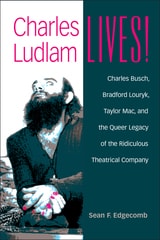
Charles Ludlam Lives!
Charles Busch, Bradford Louryk, Taylor Mac, and the Queer Legacy of the Ridiculous Theatrical CompanySean F. Edgecomb
University of Michigan Press, 2017
Author Sean F. Edgecomb focuses on the neo-Ridiculous artists Charles Busch, Bradford Louryk, and Taylor Mac to trace the connections between Ludlam’s legacy and their performances, using alternative queer models such as kinetic kinship, lateral historiography, and a new approach to camp. Charles Ludlam Lives! demonstrates that the queer legacy of Ludlam is one of distinct transformation—one where artists can reject faithful interpretations in order to move in new interpretive directions.

Charles Ludlam Lives!
Charles Busch, Bradford Louryk, Taylor Mac, and the Queer Legacy of the Ridiculous Theatrical CompanySean F. Edgecomb
University of Michigan Press, 2017
Author Sean F. Edgecomb focuses on the neo-Ridiculous artists Charles Busch, Bradford Louryk, and Taylor Mac to trace the connections between Ludlam’s legacy and their performances, using alternative queer models such as kinetic kinship, lateral historiography, and a new approach to camp. Charles Ludlam Lives! demonstrates that the queer legacy of Ludlam is one of distinct transformation—one where artists can reject faithful interpretations in order to move in new interpretive directions.
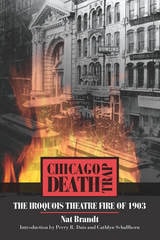
Chicago Death Trap
The Iroquois Theatre Fire of 1903Nat Brandt. Introduction by Perry R. Duis and Cathlyn Schallhorn
Southern Illinois University Press, 2006
On the afternoon of December 30, 1903, during a sold-out matinee performance, a fire broke out in Chicago’s Iroquois Theatre. In the short span of twenty minutes, more than six hundred people were asphyxiated, burned, or trampled to death in a panicked mob’s failed attempt to escape. In Chicago Death Trap: The Iroquois Theatre Fire of 1903, Nat Brandt provides a detailed chronicle of this horrific event to assess not only the titanic tragedy of the fire itself but also the municipal corruption and greed that kindled the flames beforehand and the political cover-ups hidden in the smoke and ash afterwards.
Advertised as “absolutely fireproof,” the Iroquois was Chicago’s most modern playhouse when it opened in the fall of 1903. With the approval of the city’s building department, theater developers Harry J. Powers and William J. Davis opened the theater prematurely to take full advantage of the holiday crowds, ignoring flagrant safety violations in the process.
The aftermath of the fire proved to be a study in the miscarriage of justice. Despite overwhelming evidence that the building had not been completed, that fire safety laws were ignored, and that management had deliberately sealed off exits during the performance, no one was ever convicted or otherwise held accountable for the enormous loss of life.
Lavishly illustrated and featuring an introduction by Chicago historians Perry R. Duis and Cathlyn Schallhorn, Chicago Death Trap: The Iroquois Theatre Fire of 1903 is rich with vivid details about this horrific disaster, captivatingly presented in human terms without losing sight of the broader historical context.
Chicago
With the Chicago Tribune Articles That Inspired ItMaurine Watkins, Edited by Thomas H. Pauly, Foreword by Charles H. Cosgrove
Southern Illinois University Press, 2025
In 1924, the murder trials of Beulah Annan and Belva Gaertner shocked the world, providing the real-life inspiration for Maurine Watkins’s unforgettable characters, Roxie Hart and Velma Kelly. Now, a century later, this reissue of Watkins’s play offers a fresh look at the origins of the story that has since become a household name.
From the silent film Chicago produced by Cecil B. DeMille in 1927 to the 1942 film Roxie Hart starring Ginger Rogers and the Broadway sensation created by Bob Fosse, Fred Ebb, and John Kander, this play has continuously evolved. It even inspired the 2002 Oscar-winning film Chicago starring Renée Zellweger, Catherine Zeta-Jones, and Richard Gere. But until recently, as editor Thomas H. Pauly writes in the book’s introduction, the real-life roots of the story were obscured.
While researching for a book on crime-as-entertainment during the 1920s, Pauly came across Maurine Watkins’s play, which was then out of print. After noticing similarities between the play and a series of articles Watkins penned for the Chicago Tribune prior to the creation of her play, Pauly knew he had stumbled upon a revelation: Watkins’s play was based on real people. His republication of the play, alongside substantial background material and a reprinting of Watkins’s news articles, has become an indispensable starting point for all subsequent interest in Watkins and Chicago, whose subject remains as topical as ever.
This special edition includes a new foreword by Charles H. Cosgrove, author of They Both Reached for the Gun: Beulah Annan, Maurine Watkins, and the Trial That Became Chicago. Cosgrove’s extensive research into the real-life cases provides deeper insight into the world that Watkins portrayed with such satirical brilliance. Additionally, the original editor, Thomas H. Pauly, has contributed a new preface, further enhancing understanding of the play and its inspiration, the thrilling true-crime story that captivated a nation and birthed a cultural phenomenon.
Childhood and Nineteenth-Century American Theatre
The Work of the Marsh Troupe of Juvenile ActorsShauna Vey
Southern Illinois University Press, 2015
Looking at the daily work lives of five members of the Marsh Troupe—the father and manager, Robert Marsh, and four child performers, Mary Marsh, Alfred Stewart, Louise Arnot, and Georgie Marsh—Vey reveals the realities of the antebellum theatre and American society: the rise of the nineteenth-century impresario; the emerging societal constructions of girlhood and goodness; the realities of child labor; the decline of the apprenticeship model of actor training; shifts in gender roles and the status of working women; and changes in the economic models of theatre production, including the development of the stock company system.
Both a microhistory of a professional theatre company and its juvenile players in the decade before the Civil War and a larger narrative of cultural change in the United States, Childhood and Nineteenth-Century American Theatre sheds light on how childhood was idealized both on and off the stage, how the role of the child in society shifted in the nineteenth century, and the ways economic value and sentiment contributed to how children were viewed.
Chinatown Opera Theater in North America
Nancy Yunhwa Rao
University of Illinois Press, 2017
Irving Lowens Award, Society for American Music (SAM), 2019
Music in American Culture Award, American Musicological Society (AMS), 2018
Certificate of Merit for Best Historical Research in Recorded Country, Folk, Roots, or World Music, Association for Recorded Sound Collections (ARSC), 2018
Outstanding Achievement in Humanities and Cultural Studies: Media, Visual, and Performance Studies, Association for Asian American Studies (AAAS), 2019
The Chinatown opera house provided Chinese immigrants with an essential source of entertainment during the pre–World War II era. But its stories of loyalty, obligation, passion, and duty also attracted diverse patrons into Chinese American communities
Drawing on a wealth of new Chinese- and English-language research, Nancy Yunhwa Rao tells the story of iconic theater companies and the networks and migrations that made Chinese opera a part of North American cultures. Rao unmasks a backstage world of performers, performance, and repertoire and sets readers in the spellbound audiences beyond the footlights. But she also braids a captivating and complex history from elements outside the opera house walls: the impact of government immigration policy; how a theater influenced a Chinatown's sense of cultural self; the dissemination of Chinese opera music via recording and print materials; and the role of Chinese American business in sustaining theatrical institutions. The result is a work that strips the veneer of exoticism from Chinese opera, placing it firmly within the bounds of American music and a profoundly American experience.
Chinese Dreams
Pound, Brecht, Tel QuelEric Hayot
University of Michigan Press, 2011
China’s profound influence on the avant-garde in the 20th century was nowhere more apparent than in the work of Ezra Pound, Bertolt Brecht, and the writers associated with the Parisian literary journal Tel quel. Chinese Dreams explores the complex, intricate relationship between various “Chinas”—as texts—and the nation/culture known simply as “China”—their context—within the work of these writers. Eric Hayot calls into question the very means of representing otherness in the history of the West and ultimately asks if it might be possible to attend to the political meaning of imagining the other, while still enjoying the pleasures and possibilities of such dreaming. The latest edition of this critically acclaimed book includes a new preface by the author.
“Lucid and accessible . . . an important contribution to the field of East-West comparative studies, Asian studies, and modernism.”
—Comparative Literature Studies
“Instead of trying to decipher the indecipherable ‘China’ in Western literary texts and critical discourses, Hayot chose to show us why and how ‘China’ has remained, and will probably always be, an enchanting, ever-elusive dream. His approach is nuanced and refreshing, his analysis rigorous and illuminating.”
—Michelle Yeh, University of California, Davis
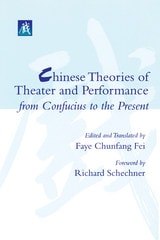
Chinese Theories of Theater and Performance from Confucius to the Present
Edited and Translated by Faye Chunfang Fei
University of Michigan Press, 2002
The writings collected here treat the origins, aesthetic principles, and functions of theater. Some are virtual manuals on playwriting and performance techniques; some describe the practices, conditions, and government policies concerning theatrical performance. Many of the selections forcefully dispute the myth that Chinese theater is valuable in performance but lacking in literature--the fact is that there is an equal, if not more prominent, emphasis on theme and content. What emerges from the writings in Chinese Theories of Theater and Performance from Confucius to the Present is a highly evolved and sophisticated aesthetic.
The texts are enhanced by Faye C. Fei's extensive introductions and annotative notes that provide essential background and contextual information. She has provided accurate and engagingly written translations of the texts, making the majority of them available in English for the first time. The anthology will appeal to teachers and students of theater and performance, artists interested in Chinese theater and arts, and scholars and historians of Asia. Literary critics, aestheticians, philosophers, and social scientists will also find the volume of interest, since Chinese conceptions of the theater and performance are closely connected to China's general outlook on the humanities.
Faye C. Fei is Assistant Professor of Dramatic Arts, Macalester College.
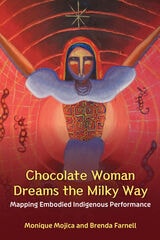
Chocolate Woman Dreams the Milky Way
Mapping Embodied Indigenous PerformanceMonique Mojica and Brenda Farnell
University of Michigan Press, 2023
Co-authored with anthropologist Brenda Farnell, the book challenges the divide between artist and scholar, and addresses the many levels of cultural, disciplinary, and linguistic translations required to achieve this. Placing the complex intellect inherent to Indigenous Knowledges at its center, the book engages Indigenous performance theory, and concepts that link body, land, and story, such as terra nullius/corpus nullius, mapping, pattern literacy, land literacy, and movement literacy. Enhanced by contributions from other artists and scholars, the book challenges Eurocentric ideologies about what counts as “performance” and what is required from an “audience,” as well as long-standing body-mind dualisms.
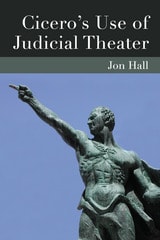
Cicero's Use of Judicial Theater
Jon Hall
University of Michigan Press, 2014
While Cicero’s Use of Judicial Theater will be of interest primarily to professional scholars and students studying the speeches of Cicero, its wider analyses, both of Roman cultural customs and the idiosyncratic practices of the courts, will prove relevant also to social historians, as well as historians of legal procedure.
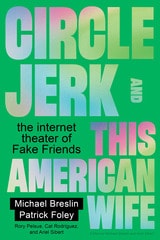
Circle Jerk and This American Wife
the internet theater of Fake FriendsMichael Breslin, Patrick Foley, Rory Pelsue, Cat Rodríguez, and Ariel Sibert, edited by Michael Breslin and Ariel Sibert
Northwestern University Press, 2026
Two plays along with process essays on the cacophonous world of pop culture, politics, and personal testimony that we call the internet
In March 2020, the New York theater company Fake Friends was pushed off the stage and into the land of the internet. This book marks the first publication of two of their deliciously absurd and toxically serious internet plays, Circle Jerk (the first-ever work in digital theater to be shortlisted for the Pulitzer Prize in Drama) and This American Wife. Circle Jerk tells the social media–infused tale of gay white supremacists creating an AI-influencer to dominate the global discourse, and This American Wife spins a surrealist web of queer devotion to the stars and performance strategies of reality television; both plays are unapologetically theatrical and digitally native, born out of the exigencies of the pandemic. This collection features an electrifying visual archive as well as individual essays from each company member reflecting on the practical and interpersonal processes of bringing these award-winning plays to life in our ever-more online, political, and personal world.
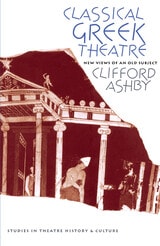
Classical Greek Theatre
New Views of an Old SubjectClifford Ashby
University of Iowa Press, 1998
Many dogmas regarding Greek theatre were established by researchers who lacked experience in the mounting of theatrical productions. In his wide-ranging and provocative study, Clifford Ashby, a theatre historian trained in the practical processes of play production as well as the methods of historical research, takes advantage of his understanding of technical elements to approach his ancient subject from a new perspective. In doing so he challenges many long-held views.
Archaeological and written sources relating to Greek classical theatre are diverse, scattered, and disconnected. Ashby's own (and memorable) fieldwork led him to more than one hundred theatre sites in Greece, southern Italy, Sicily, and Albania and as far into modern Turkey as Hellenic civilization had penetrated. From this extensive research, he draws a number of novel revisionist conclusions on the nature of classical theatre architecture and production.
The original orchestra shape, for example, was a rectangle or trapezoid rather than a circle. The altar sat along the edge of the orchestra, not at its middle. The scene house was originally designed for a performance event that did not use an up center door. The crane and ekkyklema were simple devices, while the periaktoi probably did not exist before the Renaissance. Greek theatres were not built with attention to Vitruvius' injunction against a southern orientation and were probably sun-sited on the basis of seasonal touring. The Greeks arrived at the theatre around mid-morning, not in the cold light of dawn. Only the three-actor rule emerges from this eclectic examination somewhat intact, but with the division of roles reconsidered upon the basis of the actors' performance needs. Ashby also proposes methods that can be employed in future studies of Greek theatre. Final chapters examine the three-actor production of Ion, how one should not approach theatre history, and a shining example of how one should.
Ashby's lengthy hands-on training and his knowledge of theatre history provide a broad understanding of the ways that theatre has operated through the ages as well as an ability to extrapolate from production techniques of other times and places.
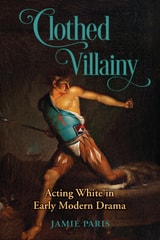
Clothed Villainy
Acting White in Early Modern DramaJamie Paris
University of Alabama Press, 2026
Examines how centuries-old stagecraft shaped modern racial politics—and why the performance of whiteness still commands the spotlight.
From Shakespearean blackface to the alt-right’s khaki-clad protests, Clothed Villainy: Acting White in in Early Modern Drama by Jamie Paris confronts the uncomfortable truths of racial performance across centuries. Paris argues that whiteness is not a fixed identity but a precarious and performative construct—shaped and sustained through actions, appearances, and cultural scripts.
Drawing on critical race theory, performance studies, and Indigenous scholarship, Clothed Villainy traces how racial scripts—whether “playing Black,” “playing Indian,” or especially “playing white”—have been used to uphold white supremacy and erase marginalized identities. By examining the costuming and characterization of white actors portraying Black villains on the early modern stage, Paris reveals how these theatrical traditions continue to echo in contemporary racial politics.
Written with bold clarity and personal insight, this book opens space for reimagining race, history, and identity through a more critical and inclusive lens. Clothed Villainy is essential reading for scholars, students, and anyone seeking to understand the deep-rooted performance of race in society and how we might reimagine it for a more equitable future.
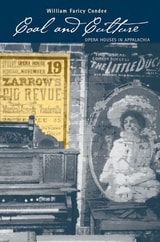
Coal and Culture
Opera Houses in AppalachiaWilliam Faricy Condee
Ohio University Press, 2005
Opera houses were fixtures of Appalachian life from the end of the Civil War through the 1920s. Most towns and cities had at least one opera house during this golden age. Coal mining and railroads brought travelers, money, and change to the region. Many aspects of American life converged in the opera house.
Coal and Culture: Opera Houses in Appalachia is a critical appreciation of the opera house in the coal-mining region of Appalachia from the mid-1860s to the early 1930s. Author William Faricy Condee demonstrates that these were multipurpose facilities that were central to the life of their communities. In the era before radio, movies, television, and malls, these buildings were essential. They housed little, if any, opera, but were used for almost everything else, including traveling theater, concerts, religious events, lectures, commencements, boxing matches, benefits, union meetings, and—if the auditorium had a flat floor—skating and basketball.
The only book on opera houses that stresses their cultural context, Condee’s unique study will interest cultural geographers, scholars of Appalachian studies, and all those who appreciate the gaudy diversity of the American scene.
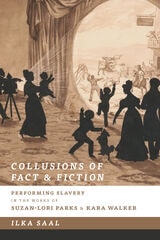
Collusions of Fact and Fiction
Performing Slavery in the Works of Suzan-Lori Parks and Kara WalkerSaal, Ilka
University of Iowa Press, 2021
Saal argues that the attempt to reconstruct or recuperate the experience of African Americans under slavery is no longer at stake in the works of artists growing up in the post–Civil Rights era. Instead, they lay bare the discursive dimension of our contemporary understanding of the past and address the continued impact of its various verbal and visual signs upon contemporary identities. In this manner, Parks and Walker stake out new possibilities for engaging the past and inhabiting the present and future.
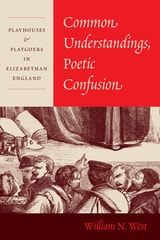
Common Understandings, Poetic Confusion
Playhouses and Playgoers in Elizabethan EnglandWilliam N. West
University of Chicago Press, 2021
What if going to a play in Elizabethan England was more like attending a football match than a Broadway show—or playing in one? In Common Understandings, Poetic Confusion, William N. West proposes a new account of the kind of participatory entertainment expected by the actors and the audience during the careers of Shakespeare and his contemporaries. West finds surprising descriptions of these theatrical experiences in the figurative language of early modern players and playgoers—including understanding, confusion, occupation, eating, and fighting. Such words and ways of speaking are still in use today, but their earlier meanings, like that of theater itself, are subtly, importantly different from our own. Playing was not confined to the actors on the stage but filled the playhouse, embracing audiences and performers in collaborative experiences that did not belong to any one alone but to the assembled, various crowd. What emerged in playing was a kind of thinking and feeling distributed across persons and times that were otherwise distinct. Thrown apples, smashed bottles of beer, and lumbering bears—these and more gave verbal shape to the physical interactions between players and playgoers, creating circuits of exchange, production, and consumption.
Composed Theatre
Aesthetics, Practices, ProcessesEdited by Matthias Rebstock and David Roesner
Intellect Books, 2012
A unique contribution to an emerging field, Composed Theatre explores musical strategies of organization as viable alternative means of organizing theatrical work. In addition to insightful essays by a stellar group of international contributors, this volume also includes interviews with important practitioners, shedding light on historical and theoretical aspects of composed theatre.
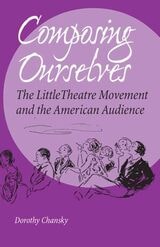
Composing Ourselves
The Little Theatre Movement and the American AudienceDorothy Chansky
Southern Illinois University Press, 2005
When movies replaced theatre as popular entertainment in the years 1910–20, the world of live drama was wide open for reform. American advocates and practitioners founded theatres in a spirit of anticommercialism, seeking to develop an American audience for serious theatre, mounting plays in what would today be called “alternative spaces,” and uniting for the cause an eclectic group of professors, social workers, members of women’s clubs, bohemians, artists, students, and immigrants. This rebellion, called the Little Theatre Movement, also prompted and promoted the college theatre major, the inclusion of theatre pedagogy in K–12 education, prototypes for the nonprofit model, and the notion that theatre is a valuable form of self-expression.
Composing Ourselves: The Little Theatre Movement and the American Audience argues that the movement was a national phenomenon, not just the result of aspirants copying the efforts of the much-storied Provincetown Players, Washington Square Players, Neighborhood Playhouse, and Chicago Little Theatre. Going beyond the familiar histories of the best-known groups, Dorothy Chansky traces the origins of both the ideas and the infrastructures for serious theatre that are ordinary parts of the American cultural landscape today; she also investigates the gender discrimination, racism, and class insensitivity that were embedded in reformers’ ideas of the “universal” and that still trouble the rhetoric of regional, educational, and community theatre.
An important piece of revisionist history, Composing Ourselves shows how theatre reform, in keeping with other Progressive Era activism, took on corporate, conservative society, but did so in ways that were sometimes contradictory. For example, women constituted the majority of ticket buyers and the bulk of unsung labor, yet plays by women were considered inferior. Most reformers were comfortably middle class and sought change that would eliminate the anomie of modernity but not challenge their privileged positions.
Chansky deliberates on antifeminist images of women theatergoers in literature and cartoons and considers the achievements and failures of the Drama League of America, a network of women’s clubs, following up with a case study of the playwright Alice Gerstenberg to point out that theatre history has not fully realized the role of women in the Little Theatre Movement. Even as women were earning the majority of degrees in newly minted theatre programs, their paths were barred to most professional work except teaching. Chansky also considers a blackface production of a play about rural African Americans, which was a step towards sympathetic portrayals of minority characters yet still a reinforcement of white upper- and middle-class perspectives.

Computer Scenographics
Darwin Reid Payne
Southern Illinois University Press, 1994
Darwin Reid Payne’s approach to theatrical design is that of a computer advocate and pioneer. With Computer Scenographics, he ushers in a new generation of scenery design by applying state-of-the-art technology to the traditional methods of scenography. Though not a how-to book, Computer Scenographics is a general introduction to, and an affirmation of, the value of computer graphics for both student and working scenographers.
Payne acknowledges that many scenographers would not want to use computers exclusively in the preparation of their designs. Today’s scenographers continue to value the manual skills of drawing and painting, learned and perfected over time, and would not consider abandoning these skills entirely. And it is unlikely that the most powerful computer or most sophisticated software could ever supplant that intimate interaction of hand and mind provided by traditional tools and materials. Nevertheless, Payne’s utilization of the Virtus Walk-Through computer program to facilitate set design expands the tools of the artist to new dimensions.
Aided by 129 illustrations, Payne addresses four major topics: (1) how computer studios are set up; (2) how computers serve as storage for visual ideas and as conceptual tools; (3) how technical information needed for producing a scenographer’s ideas onstage is created with computers; (4) and how modelmaking has been changed by computer-generated three-dimensional possibilities, especially by the introduction of "virtual reality" onto the computer platform.
Consent Practices in Performing Arts Education
Edited by Elaine DiFalco Daugherty and Heather Trommer-Beardslee
Intellect Books, 2024
This book explores consent as a foundational principle to guide practices and policies in university-level performing arts education. It includes descriptions of the structural power dynamics present in educational spaces and provides tools for mitigating them. It adapts the consent protocols that are foundational to theatrical intimacy direction and applies them to classroom and rehearsal spaces across performing arts disciplines.
The book discusses consent, opening lines of communication, personal boundaries, and modeling behaviors that respect those boundaries. Additionally, contributors use experiential reflections to address the real-world challenges that teachers face as they work to reshape their teaching habits and processes to include consent practices.
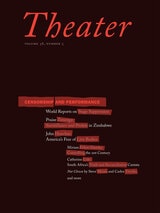
Contemporary Censorship and Performance, Volume 38
Miriam Felton-Dansky and Tom Sellar, eds.
Duke University Press, 0
The collection includes an essay that explores the function of live performance in recent freedom-of-expression debates, such as those featuring Janet Jackson and Don Imus, and persistent national anxieties about performers’ bodies. The issue also features an international censorship forum that brings together reports of incidents from Burma, Singapore, Germany, Italy, and the United States. A special report from Zimbabwe provides an in-depth look at the repression of oppositional theater by one of Africa’s most dictatorial regimes while another article looks at REwind: A Cantata for Voice, Tape and Testimony, a new musical composition that takes once-silenced voices recorded for South Africa’s Truth and Reconciliation Commission and transforms them into a hymn for a postapartheid nation. The issue also includes the first publication of an inventive new play that is a satirical as well as chilling look at suppression and dissent in post-9/11 America.
Contributors: Howard Barker, Reverend Billy, Catherine Cole, Mike Daisey, Dean Damjanovski, Miriam Felton-Dansky, Jacob Gallagher-Ross, John Houchin, Rabih Mroué, Freddie Rokem, Tom Sellar, Fadi Toufiq, Praise Zenenga
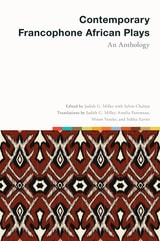
Contemporary Francophone African Plays
An AnthologyJudith G. Miller
Bucknell University Press, 2024
Contemporary Latina/o Theater
Wrighting EthnicityJon D. Rossini
Southern Illinois University Press, 2008
In Contemporary Latina/o Theater, Jon D. Rossini explores the complex relationship between theater and the creation of ethnicity in an unprecedented examination of six Latina/o playwrights and their works: Miguel Piñero, Luis Valdez, Guillermo Reyes, Octavio Solis, José Rivera, and Cherríe Moraga. Rossini exposes how these writers use the genre as a tool to reveal and transform existing preconceptions about their culture. Through “wrighting”—the triplicate process of writing plays, righting misconceptions about ethnic identity, and creating an entirely new way of understanding Latina/o culture—these playwrights directly intervene in current conversations regarding ethnic identity, providing the tools for audiences to reexplore their previously held perspectives outside the theater.
Examining these writers and their works in both cultural and historical contexts, Rossini reveals how playwrights use the liminal space of the stage—an area on the thresholds of both theory and reality—to “wright” new insights into Latina/o identity. They use the limits of the theater itself to offer practical explorations of issues that could otherwise be discussed only in highly theoretical terms.
Rossini traces playwrights’ methods as they address some of the most challenging issues facing contemporary Latinas/os in America: from the struggles for ethnic solidarity and the dangers of a community based in fear, to stereotypes of Latino masculinity and the problematic fusion of ethnicity and politics. Rossini discusses the looming specter of the border in theater, both as a conceptual device and as a literal reality—a crucial subject for modern Latinas/os, given recent legislation and other actions. Throughout, the author draws intriguing comparisons to the cultural limbo in which many Latinas/os find themselves today.
An indispensable volume for anyone interested in drama and ethnic studies, Contemporary Latina/o Theater underscores the power of theatricality in exploring and rethinking ethnicity. Rossini provides the most in-depth analysis of these plays to date, offering a groundbreaking look at the ability of playwrights to correct misconceptions and create fresh perspectives on diversity, culture, and identity in Latina/o America.
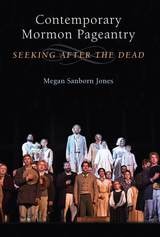
Contemporary Mormon Pageantry
Seeking After the DeadMegan Sanborn Jones
University of Michigan Press, 2018
Contemporary Opera in Flux
Edited by Yayoi U. Everett
University of Michigan Press, 2024
Contemporary Opera in Flux bridges the gaps between expanding literature on opera, theater, new music, postmodern dramaturgy, and posthuman aesthetics, while also confronting larger questions of identity, representation, and narrative agency that are at the forefront of contemporary music scholarship. This collection of essays engages critically with the past out of a conviction that, amid general public perceptions of opera as anachronistic or elitist, contemporary opera has emerged as an artistic incubator for experimentation.
Contemporary Plays by African American Women
Ten Complete WorksEdited by Sandra Adell
University of Illinois Press, 2015
Selections: Blue Door, by Tanya Barfield; Levee James, by S. M. Shephard-Massat; Hoodoo Love, by Katori Hall; Carnaval, by Nikkole Salter; Single Black Female, by Lisa B. Thompson; Fabulation, or The Re-Education of Undine, by Lynn Nottage; BlackTop Sky, by Christina Anderson; Voyeurs de Venus, by Lydia Diamond; Fedra, by J. Nicole Brooks; and Uppa Creek: A Modern Anachronistic Parody in the Minstrel Tradition, by Keli Garrett.
Contemporary Theatre in Mayan Mexico
Death-Defying ActsBy Tamara L. Underiner
University of Texas Press, 2004
From the dramatization of local legends to the staging of plays by Shakespeare and other canonical playwrights to the exploration of contemporary sociopolitical problems and their effects on women and children, Mayan theatre is a flourishing cultural institution in southern Mexico. Part of a larger movement to define Mayan self-identity and reclaim a Mayan cultural heritage, theatre in Mayan languages has both reflected on and contributed to a growing awareness of Mayans as contemporary cultural and political players in Mexico and on the world's stage.
In this book, Tamara Underiner draws on fieldwork with theatre groups in Chiapas, Tabasco, and Yucatán to observe the Maya peoples in the process of defining themselves through theatrical performance. She looks at the activities of four theatre groups or networks, focusing on their operating strategies and on close analyses of selected dramatic texts. She shows that while each group works under the rubric of Mayan or indigenous theatre, their works are also in constant dialogue, confrontation, and collaboration with the wider, non-Mayan world. Her observations thus reveal not only how theatre is an agent of cultural self-definition and community-building but also how theatre negotiates complex relations among indigenous communities in Mayan Mexico, state governments, and non-Mayan artists and researchers.
Creating Historical Drama
A Guide for Communities, Theatre Groups, and PlaywrightsChristian H. Moe, Scott J. Parker, and George McCalmon. Foreword by Romulus Linney
Southern Illinois University Press, 2005
This guidebook for transforming actual American figures and events into dramatic form has aided many communities and groups in writing, planning, and producing first-rate historical dramas. The new edition of Creating Historical Drama: A Guide for Communities, Theatre Groups, and Playwrights features updated examples of drama and dramatic activities from short indoor productions to large-scale, outdoor historical dramas; new material about funding, economic impact on communities, budgeting, and marketing; and current information on physical theatre development.
Responding to a national interest in dramatizing historical material in a variety of community settings, the volume begins with a discussion on the scope and sources of historical drama, as well as the reasons for historicizing drama. From there, it details the features of biography, pageant, and epic dramas, and takes on important issues such as historical accuracy and dealing with expository material. The handbook then provides assistance in composing drama, leading and organizing the theatre group, organizing the community’s resources, and evaluating the audience and the production site. Twenty-nine illustrations, with sketches by Darwin Payne and Ronald Naverson, augment the discussion.
Written for the nonspecialist and particularly useful to novice playwrights and directors, the volume is equally important for professional historians, educators, and theatre artists. More than a guidebook, Creating Historical Drama convincingly demonstrates that the genre is a beneficial and significant cultural phenomenon that not only educates and entertains, but also has the power to revitalize civic economy and morale.
Creating the Self in the Contemporary American Theatre
Robert J. Andreach
Southern Illinois University Press, 1998
Combining his skills as both a professional reviewer of theatre and a literary critic, Robert J. Andreach finds himself in a unique position to provide coherence to what most observers perceive as an unrelated welter of contemporary theatrical experiences. Exploring the theatre from the 1960s to the present, he shows the various ways in which the contemporary American theatre creates a personal, theatrical, and national self.
Andreach argues that the contemporary American theatre creates multiple selves that reflect and give voice to the many communities within our multicultural society. These selves are fragmented and enclaved, however, which makes necessary a counter movement that seeks, through interaction among the various parts, to heal the divisions within, between, and among them.
In his examination of the contemporary theatre, Andreach demonstrates that the plays and the performance art of the feminist, African-American, Hispanic-American, Asian-American, and Native American theatres are equal to the works created within the dominant Eurocentric culture.
He then turns to comparable works created within the culture of what performance artist Karen Finley calls the "one male god," works that reflect the breakup of an old order. He discusses the experimental theatre, which turns to the imagination to reveal the nature of the self, and concludes with an examination of recent American works, pointing out in each either the presence or absence of resolution within the divisions of self.
Critical Perspectives on Contemporary Plays by Women
The Early Twenty-First CenturyPenny Farfan and Lesley Ferris, Editors
University of Michigan Press, 2021
This book foregrounds some of the ways in which women playwrights from across a range of contexts and working in a variety of forms and styles are illuminating the contemporary world while also contributing to its reshaping as they reflect, rethink, and reimagine it through their work for the stage. The book is framed by a substantial introduction that sets forth the critical vision and structure of the book as a whole, and an afterword that points toward emerging currents in and expansions of the contemporary field of playwriting by women on the cusp of the third decade of the twenty-first century. Within this frame, the twenty-eight chapters that form the main body of the book, each focusing on a single play of critical significance, together constitute a multi-faceted, inevitably partial, yet nonetheless integral picture of the work of women playwrights since 2000 as they engage with some of the most pressing issues of our time. Some of these issues include the continuing oppression of and violence against women, people of color, LGBTQ+ people, and ethnic minorities; the ongoing processes of decolonization; the consequences of neoliberal capitalism; the devastation and enduring trauma of war; global migration and the refugee crisis; the turn to right-wing populism; and the impact of climate change, including environmental disaster and species extinction.
The book is structured into seven sections: Replaying the Canon; Representing Histories; Staging Lives; Re-imagining Family; Navigating Communities; Articulating Intersections; and New World Order(s). These sections group clusters of plays according to the broad critical actions they perform or, in the case of the final section, the new world orders that they capture through their stagings of the seeming impasse of the politically and environmentally catastrophic global present moment. There are many other points of resonance among and across the plays, but this seven-part structure foregrounds the broader actions that drive the plays, both in the Aristotelian dramaturgical sense and in the larger sense of the critical interventions that the plays creatively enact. In this way, the seven-part structure establishes correspondences across the great diversity of dramatic material represented in the book while at the same time identifying key methods of critical approach and areas of focus that align the book’s contributors across this diversity. The structure of the book thus parallels what the playwrights themselves are doing, but also how the contributors are approaching their work. Plays featured in the book are from Canada, Australia, South Africa, the US, the UK, France, Argentina, New Zealand, Syria, Brazil, Italy, and Austria; the playwrights include Margaret Atwood, Leah Purcell, Yaël Farber, Paula Vogel, Adrienne Kennedy, Suzan-Lori Parks, debbie tucker green, Lisa Loomer, Hélène Cixous. Anna Deavere Smith, Lola Arias, Lisa Kron and Jeanine Tesori, Marie Clements, Quiara Alegría Hudes, Alia Bano, Holly Hughes, Whiti Hereaka, Julia Cho, Liwaa Yazji, Grace Passô, Dominique Morisseau, Emma Dante, Frances Ya-Chu Cowhig, Lynn Nottage, Elfriede Jelinek, Caryl Churchill, Colleen Murphy, and Lucy Kirkwood.
Encompassing several generations of playwrights and scholars, ranging from the most senior to mid-career to emerging voices, the book will be essential reading for established researchers, a valuable learning resource for students at all levels, and a useful and accessible guide for theatre practitioners and interested theatre-goers.
Critical Theory and Performance
Revised and Enlarged EditionJanelle G. Reinelt and Joseph R. Roach, Editors
University of Michigan Press, 2007
Critical Theory and Performance presents a broad range of critical and theoretical methods and applies them to contemporary and historical performance genres—from stage plays, dance-dramas, performance art, cabaret, stand-up comedy, and jazz to circus, street theater, and shamanistic ritual. As the first comprehensive introduction to critical theory’s rich and diverse contributions to the study of drama, theater, and performance, the book has been highly influential for more than a decade in providing fertile ground for academic investigations in the lively field of performance studies.
This updated and expanded edition presents nineteen new essays by the field’s leading scholars and practitioners as well as new critical introductions by editors Janelle G. Reinelt and Joseph R. Roach. Reflecting recent trends in performance studies, this revised edition now includes discussions of critical race theory, postcolonial studies, gender and sexualities, and mediatized cultures. The resulting volume is a unique and indispensable tool for critics, teachers, and students that paves the way for future scholarship.
Janelle G. Reinelt is Professor of Theatre and Performance at the University of Warwick. Reinelt and Roach
Joseph R. Roach is Charles C. and Dorathea S. Dilley Professor of Theater and English at Yale University.
Critical University Studies and Performance
Edited by Noe Montez and Ariel Nereson
Vanderbilt University Press, 2026
Critical University Studies and Performance explores how we contend with issues of power, race, class, and gender in higher education, specifically as they relate to the complexities of theater and performance studies programs. In what ways might the fields of theater, performance, and dance studies, as they operate in institutions of higher education, support hegemonic logics as well as model reparative practices, given their perhaps unique disciplinary relationships to staging representation and their shared emphasis on embodiment as a practical and theoretical area of engagement?
Montez and Nereson bring together scholars with a diverse range of career experiences and embodied positions inside of higher learning in order to deepen the field’s theoretical inquiry using an ethnic studies framework. By participating in the interdisciplinary discourse of critical university studies, the volume aims to explore how to conduct ethical research that critiques the university while remaining mindful of our always contingent place within it. The contributors examine the ways the university commodifies minoritarian knowledge, tokenizes the arts, and reproduces inequality. This book offers strategic ways to build liberatory communities and revolutionary networks among students and faculty alike in order to envision futures within and beyond the academy.
Cross and Dragon – Matteo Ricci and China
A Screenplay by Edwin KongEdwin Kong
Hong Kong University Press, 2025
Edwin Kong brings to life the extraordinary journey of Matteo Ricci, the Italian Jesuit whose daring mission to China reshaped the course of East-West relations. Sent by the Pope in the late sixteenth century to convert the Chinese Emperor, Ricci faced an impenetrable barrier—Ming Dynasty China was closed to foreigners. But armed with knowledge and an unmatched mastery of memory techniques, he found another way in.
Disguised as a Buddhist monk, Ricci captivated scholars, officials, and eventually the imperial court, introducing Western science while immersing himself in Chinese culture. His thirty-year odyssey from rural villages to the heart of the Forbidden City proved that engagement, rather than conquest, could bridge civilizations.
Told in the form of a screenplay, Cross and Dragon is a gripping historical drama with urgent contemporary resonance, exploring the power of faith and cultural exchange in the face of division.
Cuba Inside Out
Revolution and Contemporary TheatreYael Prizant
Southern Illinois University Press, 2014
The collapse of the Soviet Union in 1989 drastically altered life in Cuba. Theatre artists were faced with new economic and social realities that changed their day-to-day experiences and ways of looking at the world beyond the island. The Cuban Revolution’s resistance to and intersections with globalization, modernity, emigration and privilege are central to the performances examined in this study. The first book-length study in English of Cuban and Cuban American plays, Cuba Inside Out provides a framework for understanding texts and performances that support, challenge, and transgress boundaries of exile and nationalism. Prizant reveals the intricacies of how revolution is staged theatrically, socially, and politically on the island and in the Cuban diaspora. This close examination of seven plays written since 1985 seeks to alter how U.S. audiences perceive Cuba, its circumstances, and its theatre.
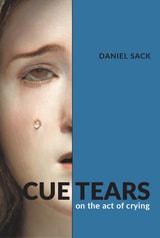
Cue Tears
On the Act of CryingDaniel Sack
University of Michigan Press, 2024
Across seven semi-autonomous essays, Cue Tears looks at the mechanisms of tear production, internal and external techniques that actors use to weep, and the effects of tears in performance situations on the stage, in the gallery, and in the classroom. The writing moves with a light touch between theory and criticism of a broad range of instances from literature, theater, performance art, visual art, and cinema, while also embracing a strong autobiographical and personal slant. Author Daniel Sack’s father was a biochemist who studied tears and collected his son’s tears for research during his childhood. These “reflex tears” were produced as a physical response to irritation—an eye stretched past the point of blinking, a cotton swab up the nose. This childhood occupation coincided with his first years taking acting classes, trying to learn how to cry “emotional tears” onstage through psychological stimulation and the recollection of memory. Cue Tears investigates these memories and methods, finding that tears both shore up and dissolve distinctions between truth and artifice, emotional and physical, private and public, sad and humorous.
Cultural Struggles
Performance, Ethnography, PraxisDwight Conquergood
University of Michigan Press, 2013
The late Dwight Conquergood’s research has inspired an entire generation of scholars invested in performance as a meaningful paradigm to understand human interaction, especially between structures of power and the disenfranchised. Conquergood’s research laid the groundwork for others to engage issues of ethics in ethnographic research, performance as a meaningful paradigm for ethnography, and case studies that demonstrated the dissolution of theory/practice binaries.Cultural Struggles is the first gathering of Conquergood’s work in a single volume, tracing the evolution of one scholar’s thinking across a career of scholarship, teaching, and activism, and also the first collection of its kind to bring together theory, method, and complete case studies.
The collection begins with an illuminating introduction by E. Patrick Johnson and ends with commentary by other scholars (Micaela di Leonardo, Judith Hamera, Shannon Jackson, D. Soyini Madison, Lisa Merrill, Della Pollock, and Joseph Roach), engaging aspects of Conquergood’s work and providing insight into how that work has withstood the test of time, as scholars still draw on his research to inform their current interests and methods.

Curating Crisis
Tom Sellar, special issue editor
Duke University Press, 2017
Contributors. Tilmann Broszat, Boris Charmatz, Kenneth Collins, Thomas F. DeFrantz, Sigrid Gareis, André Lepecki, Sodja Lotker, Florian Malzacher, Jay Pather, Suely Rolnik, Tom Sellar, Miranda Wright
Curtain Calls
British and American Women and the Theater, 1660–1820Mary A. Schofield
Ohio University Press, 1991
“I here and there o’heard a Coxcomb cry,
Ah, rot—’tis a Woman’s Comedy.”
Thus Aphra Behn ushers in a new era for women in the British Theatre (Sir Patient Fancy, 1678). In the hundred years that were to follow—and exactly those years that Curtain Calls examines—women truly took the theater world by storm.
For each woman who chose a career in the theater world of the eighteenth century, there is a unique tale of struggle, insult, success, good or bad fortune, disaster, seduction, or fame. Whether acting, writing, reviewing, or stage managing, women played a major, if frequently unacknowledged, role in the history of the theater from the late seventeenth through the early nineteenth centuries. From Alpha Behn’s earliest plays through the glorious celebrity of Sara Siddons, women molded the taste of the age and carved out in the theater one of the few available opportunities for independence and renown.
Not all the women who tried succeeded, of course, and even the best faced opposition as they challenged the male stronghold of playwriting and theater managing. Curtain Calls maps the new territory as these pioneering women staked it for their own; it chronicles their lives, their triumphs, and their losses.
We begin with Aphra Behn, whose first play was staged in 1670, and conclude in the early decades of the nineteenth century with Inchbald and Siddons. The one hundred and fifty years encompassed by their lives contain the careers of dozens of lesser–known women, a network, as Dr. Johnson would have it, encompassing both talent and tribulation.
Contributors include: Edward Langhans, Linda R. Payne, Pat Rogers, Maureen e. Mulvihill, Deborah Payne, Betty Rizzo, Ellen Donkin, Frances M. Kavenik, Jessica Munns, nancy Cotton, Edna L. Steevs, Doreen Saar, Jean B. Kern, Katherine M. Rogers, Constance Clark, William J. Burling, Judith Phillips Stanton, Douglas Butler, Rose Zimbardo, and the editors.
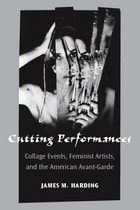
Cutting Performances
Collage Events, Feminist Artists, and the American Avant-GardeJames M. Harding
University of Michigan Press, 2012
"A thoughtful and engaging contribution to the field that will have a sustained and lasting impact on the way feminist performance is defined and understood, as well as on how feminist histories and historiographies continue to challenge and transform the larger field of performance."
---Charlotte Canning, The University of Texas at Austin
"Harding forcefully challenges and destabilizes the male-centered Eurocentric genealogy of the avant-garde, which he claims is an uncontested, linear, positivistic history, unproblematized by theory. Then he argues that this gendered biased version of the European avant-garde is carried over into American historiography . . . A forceful case for a revisionist history."
---Daniel Gerould, The City University of New York Graduate Center
Cutting Performances challenges four decades' worth of scholarship on the American avant-garde by offering a provocative reconceptualization of the history of avant-garde performance along feminist lines. Focusing on five women artists (Elsa von Freytag-Loringhoven, Gertrude Stein, Yoko Ono, Carolee Schneemann, and Valerie Solanas) whose performance aesthetics made prominent use of collage techniques, James M. Harding sheds light on the cultural history of the avant-garde and the role that experimental women artists played in that history. He investigates the prominent position that collage technique occupied within the artists' performance aesthetic, and the decisively feminist inflection that their work gives to collage as a mode of avant-garde expression. The radical juxtapositions in their works produce the powerful effects of making the familiar strange and establishing contexts from which new understandings may emerge.
Harding examines the performative dimensions of collage in experimental, feminist redefinitions of the literary, graphic, and theatrical arts, filling a void in a scholarly discourse that, while ostensibly about the vanguard, has lagged well behind other significant theoretical and historiographical currents. Cutting Performances not only challenges assumptions that have governed scholarship on the American avant-garde but also establishes a context to rethink the history of American avant-garde performance along feminist lines. It will appeal to audiences interested in theater history and performance studies as well as those interested in the cultural history of the avant-garde and the role that feminist experimental artists have played in it.
James M. Harding is Professor of English at the University of Mary Washington. His other books include Not the Other Avant-Garde: Transnational Foundations of Avant-Garde Performance (with John Rouse); Restaging the Sixties: Radical Theaters and Their Legacies (with Cindy Rosenthal); and Contours of the Theatrical Avant-Garde: Performance and Textuality.
Illustration: Carolee Schneemann in Eye Body-36 Transformative Actions (1963) Action for camera (Photograph by Erró). Reproduced by permission of Carolee Schneemann.