Results by title
132 books match the query 'Thomas, Aquinas, Saint' and 4 start with c
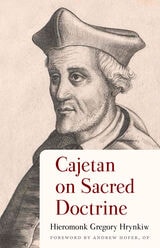
Cajetan on Sacred Doctrine
Hieromonk Gregory Hrynkiw
Catholic University of America Press, 2020
Cardinal Tommaso de Vio (1469-1534), commonly known as Cajetan, remains a misunderstood figure. Cajetan on Sacred Doctrine is the first ever monograph on Cajetan as a theologian in his own right, and it fills an immense lacuna in the debate on the nature of sacred doctrine from the Thomism of the Renaissance. Confirming Cajetan as a key protagonist within the emergent Reformation, this work delivers an indispensable immersion into his theological method in relation to his closest predecessors and contemporaries: Hervaeus Natalis, Blessed Duns Scotus, Gregory of Rimini, Johannes Capreolus, Silvestro Mazzolini da Prierio, Martin Luther, and others.
The first ever commentary on St. Thomas Aquinas’s entire Summa Theologiae was published by Cajetan. This monograph focuses primarily on the Summa Theologiae Ia pars, question 1, concerning sacred doctrine, and how Cajetan unpacks the potency of Aquinas’s opening syllogism, setting forth a coherent division of the question, and ultimately touching the mind of Aquinas when revealing the articles of the Apostles’ Creed as the Summa Theologiae’s macrostructure. Finally, we are shown how Cajetan emphasizes the essential link between ecclesiology and the communication of sacred doctrine, especially the papacy’s role in guaranteeing the proposal and explication of the faith.
Cajetan’s accomplishments as a biblical exegete established him as a renowned Renaissance scholar and a forerunner of future ecumenical dialogue. Furthermore, his grasp of theology’s perennial properties continue to make him an important interlocutor in the renewed quest for a unity in theology in an ever more fragmented aggregation of theologies.
Cajetan’s theological labor is a perpetuation of the via antiqua, a biblical-theological worldview handed down through Tradition. St. Gregory the Theologian (329-390), the via antiqua’s preeminent Eastern representative and chief theological constructor of Christendom, offers the monograph’s author--himself a Byzantine Hieromonk--a prime opportunity for a few closing insights on the innate symphony between two very distant periods and distinct theological traditions within the one ecumenical Church.
[more]
Christ and Spirituality in St. Thomas Aquinas
Jean-Pierre Torrell
Catholic University of America Press, 2011
The studies in this volume investigate themes of particular spiritual relevance in Aquinas's theology: friendship, charity, prayer, configuration to Christ, priesthood, preaching.
[more]
Contemplation and Kingdom
Kevin Hart
St. Augustine's Press, 2020
This book rises out of Dr. Kevin Hart’s 2020 Aquinas Lecture at the University of Dallas. Contemplation and Kingdom seeks to retrieve aspects of Richard of St. Victor's treatment of contemplation, principally in De arca mystica, and does so by weighing Thomas Aquinas's reservations about this treatment in the Summa theologiæ. Is Aquinas right to object, as Augustine does in De Doctrina Christiana, that our contemplation should go directly to God and not be stalled in the consideration of the natural world? What relation is there between Jesus's preaching of the Kingdom and the contemplation of God? Is the contemplative life consistent with Jesus's injunction to love both God and neighbor? These are the principal questions considered in the book.
This book is vintage Hart, erudite, well written, a treat for a wide readership. It is an example of how theology ought to be done, with a clarity and depth unsurpassed in today’s scholarly world. Its blend of anglo-saxon elegance and continental insights will be praised in the Academy and outside. – Jean-Yves Lacoste, Clare Hall, Cambridge
In the light of great contemporary interest in contemplation, this brilliant and erudite work is a stunning example. The focus on Richard of St. Victor and Thomas Aquinas is especially appropriate. Theologians and philosophers will be especially thankful for Kevin Hart’s work on the actuality of contemplation. – David Tracy, University of Chicago
Kevin Hart holds the Edwin B. Kyle Chair of Christian Theology at the University of Virginia where he is also Courtesy Professor of English and Courtesy Professor of French. In 2020 he was awarded the Aquinas Medal by the Department of Philosophy at the University of Dallas. His 2020 Étienne Gilson Lectures, given at L'Institut Catholique de Paris, offer a fresh approach to the theology of the imago dei in Augustine. His 2020 Gifford Lectures, given at Glasgow University, examine various questions to do with the theology of contemplation and propose a new "hermeneutics of contemplation." His most recent scholarly publications include Kingdoms of God and Poetry and Revelation, and his most recent collections of poetry are Wild Track: New and Selected Poems and Barefoot.
[more]
Cooperation with Evil
Thomistic Tools of AnalysisKevin L. Flannery, SJ
Catholic University of America Press, 2019
Contemporary society very often asks of individuals and/or corporate entities that they perform actions connected in some way with the immoral actions of other individuals or entities. Typically, in the attempt to determine what would be unacceptable cooperation with such immoral actions, Christian scholars and authorities refer to the distinction, which appears in the writings of Alphonsus Liguori, between material and formal cooperation, the latter being connected in some way with the cooperator's intention in so acting. While expressing agreement with most of Alphonsus's determinations in these regards, Cooperation with Evil also argues that the philosophical background to these determinations often lacks coherence, especially when compared to related passages in the writings of Thomas Aquinas.
Having compared the philosophical approaches of these two great moralists, Cooperation with Evil then describes a number of ideas in Thomas's writings that might serve as more effective tools for the analysis of cases of possible immoral cooperation. The book also includes, as appendixes, translations of relevant passages in both Alphonsus and Thomas.
[more]