Results by title
71 books match the query 'Training of' and 6 start with c
Changing the Way We Teach
Writing and Resistance in the Training of Teaching AssistantsSally Barr Ebest
Southern Illinois University Press, 2005
Changing the Way We Teach: Writing and Resistance in the Training of Teaching Assistants draws on eighteen case studies to illustrate the critical role writing plays in overcoming graduate student resistance to instruction, facilitating change, and developing professional identity. Sally Barr Ebest argues that teaching assistants in English must be actively engaged in the theory and practice underlying composition pedagogy in order to better understand how to alter the way they teach and why such change is necessary.
In illustrating the potential for change when the paradigm shift in composition is applied to graduate education, Ebest considers recent discussions of composition pedagogy; post-secondary teaching theories; cognitive, social cognitive, and educational psychology; and issues of gender, voice, and writing.
Stemming from research conducted over a five-year period, this volume explores how a cross-section of teaching assistants responded to pedagogy as students and how their acceptance of pedagogy affected their performance as instructors. Investigating reasons behind manifestations of resistance and necessary elements for overcoming it, Ebest finds that engagement in composition strategies—reflective writing, journaling, drafting, and active learning—and restoration of feelings of self-efficacy are the primary factors that facilitate change.
Concerned with gender as it relates to personal construct, Changing the Way We Teach traces the influence of familial expectations and the effects of literacy experiences on students and draws correlations between feminist and composition pedagogy. Ebest asserts that the phenomena contributing to the development of a strong, unified voice in women—self-knowledge, empathy, positive role models, and mentors—should be essential elements of a constructivist graduate curriculum.
To understand composition pedagogy and to convince students of its values, Ebest holds that educators must embrace it themselves and trace the effects through active research. By providing graduate students with pedagogical sites for research and reflection, faculty enable them to express their anger or fear, study its sources, and quite often write their way to a new understanding.

College Writing and Beyond
A New Framework for University Writing InstructionAnne Beaufort
Utah State University Press, 2007
Composition research consistently demonstrates that the social context of writing determines the majority of conventions any writer must observe. Still, most universities organize the required first-year composition course as if there were an intuitive set of general writing "skills" usable across academic and work-world settings.
In College Writing and Beyond: A New Framework for University Writing Instruction, Anne Beaufort reports on a longitudinal study comparing one student’s experience in FYC, in history, in engineering, and in his post-college writing. Her data illuminate the struggle of college students to transfer what they learn about "general writing" from one context to another. Her findings suggest ultimately not that we must abolish FYC, but that we must go beyond even genre theory in reconceiving it.
Accordingly, Beaufort would argue that the FYC course should abandon its hope to teach a sort of general academic discourse, and instead should systematically teach strategies of responding to contextual elements that impinge on the writing situation. Her data urge attention to issues of learning transfer, and to developmentally sound linkages in writing instruction within and across disciplines. Beaufort advocates special attention to discourse community theory, for its power to help students perceive and understand the context of writing.
Command Culture
Officer Education in the U.S. Army and the German Armed Forces, 1901-1940, and the Consequences for World War IIJörg Muth
University of North Texas Press, 2011
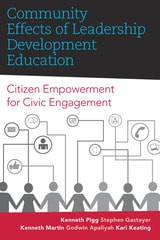
Community Effects of Leadership Development Education
Citizen Empowerment for Civic EngagementKenneth Pigg
West Virginia University Press, 2015
Community leadership development programs are designed to increase the capacity of citizens for civic engagement. These programs fill gaps in what people know about governance and the processes of governance, especially at the local level. The work of many in this field is a response to the recognition that in smaller, rural communities, disadvantaged neighborhoods, or disaster areas, the skills and aptitudes needed for citizens to be successful leaders are often missing or underdeveloped.
Community Effects of Leadership Development Education presents the results of a five-year study tracking community-level effects of community leadership development programs drawn from research conducted in Illinois, Minnesota, Missouri, South Carolina, Ohio, and West Virginia.
As the first book of its kind to seek answers to the question of whether or not the millions of dollars invested each year in community leadership development programs are valuable in the real world, this book challenges researchers, community organizers, and citizens to identify improved ways of demonstrating the link from program to implementation, as well as the way in which programs are conceived and designed.
This text also explores how leadership development programs relate to civic engagement, power and empowerment, and community change, and it demonstrates that community leadership development programs really do produce community change. At the same time, the findings of this study strongly support a relational view of community leadership, as opposed to other traditional leadership models used for program design.
To complement their findings, the authors have developed CENCE, a new model for community leadership development programs, which links leadership development efforts to community development by understanding how Civic Engagement, Networks, Commitment, and Empowerment work together to produce community viability.
CounterStories from the Writing Center
Frankie Condon
Utah State University Press, 2021
Practicing what Derrick Bell has termed “creative truth telling,” these writers are not concerned with individual white women in writing centres but with the social, political, and cultural capital that is the historical birthright of white, straight, cis-gendered women, particularly in writing centre studies. The essays collected in this volume test, defy, and overflow the bounds of traditional academic discourse in the service of powerful testimony, witness, and counterstory.
CounterStories from the Writing Center is a must-read for writing centre directors, scholars, and tutors who are committed to antiracist pedagogy and offers a robust intersectional analysis to those who seek to understand the relationship between the work of writing centres and the problem of racism. Accessible and usable for both graduate and undergraduate students of writing centre theory and practice, this work troubles the field’s commonplaces and offers a rich envisioning of what writing centres materially committed to inclusion and equity might be and do.
Contributors: Dianna Baldwin, Nicole Caswell, Mitzi Ceballos, Romeo Garcia, Neisha-Anne Green, Doug Kern, T. Haltiwanger Morrison, Bernice Olivas, Moira Ozias, Trixie Smith, Willow Trevino

Curriculum Materials Collections and Centers
Legacies from the Past, Visions of the FutureRita Kohrman
Assoc of College & Research Libraries, 2012